Live data from Hacker News

Spaced repetition

gwern.net

51–60 of 118 posts

Re: Spaced repetition

#51
post #4

Spaced repetition is a wonderful tool. I came across it when I started learning languages and have over 5000 cards in my largest Anki deck for words and phrases. A lot of thought is put into how to use a learners time most effectively. The algorithm designers seem to want to optimize their software so that a student only sees a card they are likely to be on the verge of forgetting. Because of this, uses often fail wh…

My main problem with spaced repetition programs like Anki is getting the motivation to stick with them long-term. This also dovetails in with my problems with procrastination. I've never seen a good solution. Most of the proposed solutions boil down to "just do it". It doesn't work for me.

> My main problem with spaced repetition programs like Anki is getting the motivation to stick with them long-term. This also dovetails in with my problems with procrastination. I've never seen a good solution. Most of the proposed solutions boil down to "just do it". It doesn't work for me.

If it's just one or at most three such'daily'things you want to do i had great success with simple "don't break the chain" kind of apps - every day you succeed in doing your task you check the box and it's marked on a calendar. There really is a drive not to ruin this beautiful chain, and I've found myself following through for months at a time - but then when you do fail once and the chain is broken the motivation really takes a slump as well.

Checking in with a friend or your partner can also help. Get some mild social accountability going and you might find yourself quite driven to follow through.
Re: Spaced repetition

#52
post #46

Earlier quoted context omitted.

Can you expand a bit on the coordinate terms issue? My impression would be that comes rather from the encoding rather than recall?

Sure, I'll try to elaborate. Suppose you're reading a biography of Huygens. You may find yourself inspired to memorize a few of the basic facts therein. Dutifully, you feed his life's dates, his major acquaintances and maybe a few places of importance into the SR system of your choice. You are committed and keep repeating those facts in ever-increasing intervals. After a few years a random conversation touches upon t…

Fascinating thanks, this is a new term for me but strikes a chord.

It also fits nicely with the limited understanding we have of the recall of information in our brains - it all comes down to context and activating the right network (or paths) which can only be reached by activating related/overlapping networks. So once you activate memory on a specific issue you can more easily activate related information (or even do so without intention as you describe). Having more easily reachable 'access points' (strongly encoded and thus well connected information) makes it then easier to access related information.

A corollary is that in order to remember information it's important to connect it to previous well established memories (eg "how does this new concept fit my own experience").

Thanks for this.

Re: Spaced repetition

#53

I am a big believer in the effectiveness of SRS for getting a basic foothold in a new language or subject, but I stopped adding cards to my Anki decks after awhile because the effort needed to create high quality cards is too high. Studying is a breeze with SRS, but inputting and formatting study material into a computer takes too much time, especially if you want to include images or other context. SRS works best wi…

"I know of no better way of bootstrapping those first 2000 words of vocabulary in a language"

For me, a much, much better way has been something called Total Physical Reponse (TPR)[1]

It basically involves a speaker of the target giving the learner a verbal command to perform an action, demonstrating the commanded action, and then prompting the learner once again with the same command.

For example, if a teacher was teaching English, he/she could say:

"sit down"

then demonstrate what they mean by sitting down themselves, then say "sit down" to the student. The student would then mimick the action of the teacher, by sitting down.

Then the teacher could say, "pick up the fork", pick up a fork themselves, and then say to the student, "pick up the fork", and the student would pick the fork up, etc.

This is super effective for learning vocabulary and grammar at the same time, in context. For me, that's a much easier, faster, and more natural way to learn than using any flashcards or spaced-repetition program.

The downside, of course, is that this is just for listening and understanding. It eventually will have to be augmented with other techniques for speaking and learning to read and write. But for just learning to hear and understand the basics of a language quickly, that is the most effective technique I know.

[1] - https://en.wikipedia.org/wiki/Total_physical_response

Re: Spaced repetition

#54

Med student + developer here. As one that has to memorize insane quantities of information in a limited amount of time, I'll offer some thoughts on my experiences with various memorization strategies mentioned (or not mentioned) in the article. 1. Understanding the "big picture." The idea is, if you understand the mechanism underlying X, you can reason out Y. This works great for physiology-type where things work in…

Very interesting thoughts and my experience is very much the same!

One question: do you still remember the chemical path today (vs other similar items)? My experience with loci is very positive but i agree it's time intensive. From what I've read practice makes it quicker, but it is actually this time spent and the deeper processing and linking with other information that occurs when you use loci or most other mnemonic methods that has the memory-strengthening effect.

Re: Spaced repetition

#55

Earlier quoted context omitted.

My main problem with spaced repetition programs like Anki is getting the motivation to stick with them long-term. This also dovetails in with my problems with procrastination. I've never seen a good solution. Most of the proposed solutions boil down to "just do it". It doesn't work for me.

> My main problem with spaced repetition programs like Anki is getting the motivation to stick with them long-term. This also dovetails in with my problems with procrastination. I've never seen a good solution. Most of the proposed solutions boil down to "just do it". It doesn't work for me. If it's just one or at most three such'daily'things you want to do i had great success with simple "don't break the chain" kind…

"If it's just one or at most three such'daily'things you want to do i had great success with simple "don't break the chain" kind of apps - every day you succeed in doing your task you check the box and it's marked on a calendar. There really is a drive not to ruin this beautiful chain, and I've found myself following through for months at a time - but then when you do fail once and the chain is broken the motivation really takes a slump as well."

This reminds me of the big physical yearly calendar I put on my apartment's door. It's right there in front of my face every time I go out the door. When I first got it, I crossed out all of the days that had passed for the year, and wrote in what was to come on important days of the year. Each day I would look to see what was on the calendar, and cross out yesterday's day. I had this nice long chain of crossed out boxes and written in appointments.

That worked for a while, but eventually, I stopped. Now it's been months and the calendar hangs there, and I don't touch it. I can't fail to see it all the time, every day I leave home, but I've just phased it out, I ignore it, and don't even notice it 99% of the time. Sometimes I do notice it or remember that it's there, and that I should really be crossing out those days, but I don't actually do anything.

That's the thing about procrastination. It's one thing to know what you should be doing, and quite another thing to do it. Tricks like "don't break the chain" can only get you so far.

Re: Spaced repetition

#56
post #13
post #2

I find it very frustrating that spaced repetition is the best recourse we (humans) have to remember information. I am regularly concerned with the number of thoughts and interesting ideas I have each day, and don't manage to write down or otherwise preserve. I have begun recording some minor annotations and idle thoughts on paper a month ago and after reviewing them today, I am shocked at how many I simply do not rec…

There are techniques with better payoff and retention. Check the memory systems advocated by David Roth or Harry Lorayne, or the locus method ( https://en.m.wikipedia.org/wiki/Method_of_loci )

How do you know they have better payoff and retention?

Re: Spaced repetition

#57
post #2

I find it very frustrating that spaced repetition is the best recourse we (humans) have to remember information. I am regularly concerned with the number of thoughts and interesting ideas I have each day, and don't manage to write down or otherwise preserve. I have begun recording some minor annotations and idle thoughts on paper a month ago and after reviewing them today, I am shocked at how many I simply do not rec…

I find it very frustrating that spaced repetition is the best recourse we (humans) have to remember information. I've worked on this for a while. I've written several different memory programs, for helping to review and memorize things. I have some thoughts that may help you feel better: In the end, spaced repetition is not what causes people to memorize things. You can review an object over and over and over......50…

Having a Memory is only half the equation recall is the other. Take a movie you have not watched in a decade and write down what you recall about it and how it ends. Then watch the first half and write down what you remember about the second half. Chances are good you will be able to add a lot more details the second time.

Spaced repition aids both parts of this so not only is the information stored it's also easy to retrieve.

Re: Spaced repetition

#58
post #2

I find it very frustrating that spaced repetition is the best recourse we (humans) have to remember information. I am regularly concerned with the number of thoughts and interesting ideas I have each day, and don't manage to write down or otherwise preserve. I have begun recording some minor annotations and idle thoughts on paper a month ago and after reviewing them today, I am shocked at how many I simply do not rec…

I find it very frustrating that spaced repetition is the best recourse we (humans) have to remember information. I've worked on this for a while. I've written several different memory programs, for helping to review and memorize things. I have some thoughts that may help you feel better: In the end, spaced repetition is not what causes people to memorize things. You can review an object over and over and over......50…

[deleted]

Re: Spaced repetition

#59

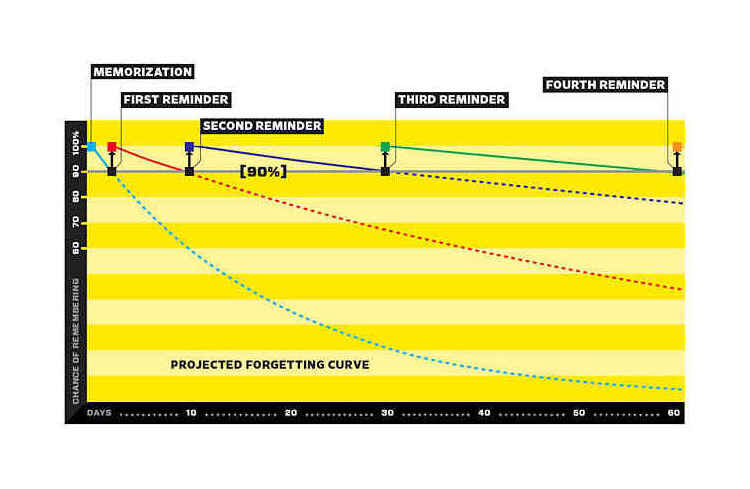
The first time this hit HN I did an experiment of learning the US state capitals with spaced repetition. Within a couple of weeks, I knew them by heart. So I stopped, and now can barely remember any. Memory is a funny thing! The very infrequent revisiting of stored knowledge beyond the initial learning does appear to be critical.

If this image is correct then after a couple weeks the forgetting curve is still fairly steep: https://www.gwern.net/images/spacedrepetition/forgetting-cur...

Re: Spaced repetition

#60
post #9

Earlier quoted context omitted.

Agreed. It doesn't matter how efficient the algorithm is if people get bored and stop using it. At Polly Lingual ( https://pollylingu.al ) we tried to tune our space-repitition flashcards for this. We aimed for small lessons that move more quickly, with optional follow up for difficult items. For casual learners this doesn't deter them, and for advanced students, they can still go back and see where they need improve…

Fascinating, how come I never heard of your site? Is it fairly young? It looks interesting and a big selection of languages (I'm looking at Arabic). But i just wanted to comment to mention that i like the pricing model - it seems small enough to be painless and still like a real price. Will definitely try it out.

Thanks, it's been around in various forms for a few years, recently moved from "Salaam Arabic" https://itunes.apple.com/us/app/learn-arabic-salaam/id646808... to a the unified Polly Lingual. It's been a lifestyle company and sort of priced that way. The goal has always been to not be annoying, but maybe that's been bad for business.
Post reply on HN