I made a simpler example of k-means clustering in JavaScript. Demonstrating the concept.
Introduction to K-means Clustering
11–20 of 21 posts
Re: Introduction to K-means Clustering
#12In my experiments K-Means clustering proved to be super useful to detect malicious activities, cyberattacks and all kind of suspicious behaviors without knowing any rules or patterns in advance. Here's how K-Means with K=20 detected malicious activity within real world, live web server - just by selecting smallest clusters (bottom table shows specifics about what fallen into smallest clusters - all hits but the first…
I wonder if that's really Kmeans, as it tend to work well only when the size of the clusters are approximately the same.
Or maybe splunk labels it as Kmeans when it really is some other algorithm.
Re: Introduction to K-means Clustering
#13In my experiments K-Means clustering proved to be super useful to detect malicious activities, cyberattacks and all kind of suspicious behaviors without knowing any rules or patterns in advance. Here's how K-Means with K=20 detected malicious activity within real world, live web server - just by selecting smallest clusters (bottom table shows specifics about what fallen into smallest clusters - all hits but the first…
I wonder if that's really Kmeans, as it tend to work well only when the size of the clusters are approximately the same. Or maybe splunk labels it as Kmeans when it really is some other algorithm.
Actually it K-Means applied after PCA (to reduce dimensionality) and after Standard Scaling.
Re: Introduction to K-means Clustering
#14That is a lot of text for such a simple algorithm, the regular implementation:
1. K observations are chosen randomly from the dataset as initial means.
2. K clusters are created by associating every observation with its nearest mean.
3. The centroid of each of the K clusters becomes the new mean.
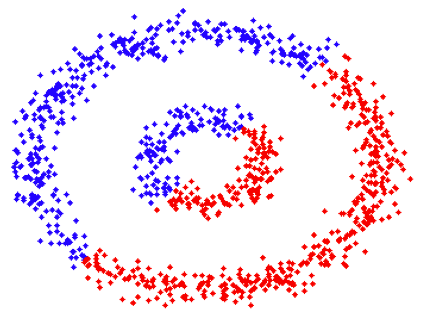
Steps 2 and 3 are repeated until we reach convergence. Very simple cases are badly clustered with this algorithm: https://cdn-images-1.medium.com/max/1200/1*BGSo8t0ktVLDn4Chv... (an example with K=2). However, it is the simplest clustering algorithm thus a good start for people who want to start learning about this field!
Re: Introduction to K-means Clustering
#15If you find this interesting, you may also enjoy my introduction to k-means clustering, in which I implement Lloyd's algorithm and use it to classify handwritten digits:
Re: Introduction to K-means Clustering
#16Earlier quoted context omitted.
What about data that generally follows something more like a power law distribution? How would you cluster that?
scikit-learn's materials (amazing in general) has a nice overview of their clustering methods and how they perform with some test data sets: http://scikit-learn.org/stable/modules/clustering.html How would you even cluster a power law distribution? There's nothing that distinguishes in two or more groups?
A lot of online engagement data looks like a power law distribution on large platforms. The mean (obviously) has huge variance. Say you have multiple metrics per user like this. You can still apply k-means but the huge variance makes it rather ineffective. That's what I've found, anyway.
Re: Introduction to K-means Clustering
#17That is a lot of text for such a simple algorithm, the regular implementation: 1. K observations are chosen randomly from the dataset as initial means. 2. K clusters are created by associating every observation with its nearest mean. 3. The centroid of each of the K clusters becomes the new mean. Steps 2 and 3 are repeated until we reach convergence. Very simple cases are badly clustered with this algorithm: https://…
> until we reach convergence
You forgot to explain why (if) this algorithm converges.
Re: Introduction to K-means Clustering
#18I created a visualization of k-means for some people at my school a few months ago. I'll put it here for anyone who might be interested. https://github.com/tylerhou/kmeans
I've also done a visualization:
http://www.darynr.com/kmeans.htm
Re: Introduction to K-means Clustering
#19K-means is based on some quite wild assumptions - your data follows a specific case of the Gaussian distribution. Plus side is that the algorithm is relatively easy to understand and implement so it is a good starting point into clustering. When you got this, then next step is probably to consider if the centroid is really a good representation of the distribution of your data. If you still believe that your data is…
What is it about k-means that means it doesn't work on other distributions?
I find it easy to come up with other (contrived) distributions where K-means produces the results that a human would produce. E.g. disjoint (and distant) circles, each containing uniform random distribution of points.
Can you explain what you meant in more detail?
Re: Introduction to K-means Clustering
#20In a previous life I've implemented news clustering algorithms for a couple of companies.
I wasn't impressed with the results with k-means and I've always found that agglomerative clustering algorithms to work better for natural text documents.