Live data from Hacker News

Nvidia on new self-driving system: “basically 5 years ahead and coming in 2017”

electrek.co

21–30 of 174 posts

Re: Nvidia on new self-driving system: “basically 5 years ahead and coming in 2017”

#21
NVIDIA's Drive PX 2 has too high power consumption and too low perf/W for the moment. They're winning this space because they are there more than that they are the best possible solution.

And they may continue to win because successful execution of an 80% product is worth far more than a 90+% powerpoint processor cough TenSilica et al. cough, or because this is such a huge potential market, it might actually go to a successful competitor. 2018 and beyond will be very interesting.

For while it's really desirable have the deep learning equivalent of x86 assembly language (CUDA) across a full stack from training to inference, in the end, IMO cost will be king. I'm not a big fan of $150K high-end servers filled with $5000 GPUs that can be bested with clever code on a $25K server fill with $1200 consumer GPUs. But I am a huge fan of charging what you can while you are unopposed. It's just that I think that state is temporary.
Re: Nvidia on new self-driving system: “basically 5 years ahead and coming in 2017”

#22
post #20

I'm still not happy with self-driving on vision alone, or vision augmented with radar. There are too many hard cases for vision. Everybody who has good self-driving right now - Google, Otto, Volvo, GM - uses LIDAR. Self-driving is coming to the first end users in 2017, in Volvo's test of 100 vehicles. Volvo has multiple LIDARs, multiple radars, multiple cameras, redundant computers, and redundant actuators. They're b…

What's a hard case for vision? That's how our eyes work. LiDAR has problems with precipitation too.

Re: Nvidia on new self-driving system: “basically 5 years ahead and coming in 2017”

#23
Could someone who understands this space weigh in on how technically interesting this is? (Or isn't?) In particular, their research paper on "End to End Learning for Self-Driving Cars"[1] seems to yield a system that requires an unacceptable amount of manual intervention: in their test drive, they achieve autonomous driving only 98% of the time. But I have no real expertise in this space; perhaps this result is impressive because it was end-to-end or because of the relatively little training? Is such a system going to be sufficiently safe to be used in fully autonomous systems? Or is NVIDIA's PX 2 interesting but not at all for the way it was used in their demonstration system?

[1] http://images.nvidia.com/content/tegra/automotive/images/201...

Re: Nvidia on new self-driving system: “basically 5 years ahead and coming in 2017”

#24
post #21

NVIDIA's Drive PX 2 has too high power consumption and too low perf/W for the moment. They're winning this space because they are there more than that they are the best possible solution. And they may continue to win because successful execution of an 80% product is worth far more than a 90+% powerpoint processor cough TenSilica et al. cough , or because this is such a huge potential market, it might actually go to a…

Is 10 watts the correct figure?

The powertrain uses 300+ Watts, so it seems like a manageable number if it is correct.

Re: Nvidia on new self-driving system: “basically 5 years ahead and coming in 2017”

#25
post #22
post #20

I'm still not happy with self-driving on vision alone, or vision augmented with radar. There are too many hard cases for vision. Everybody who has good self-driving right now - Google, Otto, Volvo, GM - uses LIDAR. Self-driving is coming to the first end users in 2017, in Volvo's test of 100 vehicles. Volvo has multiple LIDARs, multiple radars, multiple cameras, redundant computers, and redundant actuators. They're b…

What's a hard case for vision? That's how our eyes work. LiDAR has problems with precipitation too.

Depth map extraction from vision in real time depends on accurate algorithmic merging of past frames, color gradients and motion vector extraction to come up with a 3D map of what's around the vehicle. Contrast this with LIDAR, which can present a depth map in real time by sending out an array of light pulses and timing how long they take to come back to the IP.

Which method is more likely to have implementation errors?

Re: Nvidia on new self-driving system: “basically 5 years ahead and coming in 2017”

#26
post #22

Earlier quoted context omitted.

What's a hard case for vision? That's how our eyes work. LiDAR has problems with precipitation too.

Depth map extraction from vision in real time depends on accurate algorithmic merging of past frames, color gradients and motion vector extraction to come up with a 3D map of what's around the vehicle. Contrast this with LIDAR, which can present a depth map in real time by sending out an array of light pulses and timing how long they take to come back to the IP. Which method is more likely to have implementation erro…

So its not just 2 cameras? Fun, do you have a (entry level) link ?

Re: Nvidia on new self-driving system: “basically 5 years ahead and coming in 2017”

#27

Earlier quoted context omitted.

Depth map extraction from vision in real time depends on accurate algorithmic merging of past frames, color gradients and motion vector extraction to come up with a 3D map of what's around the vehicle. Contrast this with LIDAR, which can present a depth map in real time by sending out an array of light pulses and timing how long they take to come back to the IP. Which method is more likely to have implementation erro…

So its not just 2 cameras? Fun, do you have a (entry level) link ?

Stereo adds just another layer of data to merge, yeah.

I should add a disclaimer: I'm waaaaay out of date. The last time I worked on this stuff was back in 2005 during the DARPA Grand Challenge. And while I'm fairly confident that the basics are still the same (the fact that we're still discussing monocular vs. stereo vs. LIDAR is testament to that...), I'm going to defer to someone more up-to-date to provide more recent research/documentation.

Re: Nvidia on new self-driving system: “basically 5 years ahead and coming in 2017”

#28
post #22
post #20

I'm still not happy with self-driving on vision alone, or vision augmented with radar. There are too many hard cases for vision. Everybody who has good self-driving right now - Google, Otto, Volvo, GM - uses LIDAR. Self-driving is coming to the first end users in 2017, in Volvo's test of 100 vehicles. Volvo has multiple LIDARs, multiple radars, multiple cameras, redundant computers, and redundant actuators. They're b…

What's a hard case for vision? That's how our eyes work. LiDAR has problems with precipitation too.

There are a number of interesting examples in computer vision and psychology literature which document difficult cases for visual perception, see for example slides 14-19 in [0]. Ultimately, vision is a holistic process with edge cases that require knowledge of physics, human psychology, and so-called "common-sense reasoning" in order to resolve. Depending on how one phrases the objective of what a computer vision system should do, the problem can go from a tractable subset of automated reasoning to an intractable general AI task, often with very subtle changes to the problem statement.

[0] http://www.cs.toronto.edu/~urtasun/courses/CV/lecture01.pdf

Re: Nvidia on new self-driving system: “basically 5 years ahead and coming in 2017”

#29
post #21

NVIDIA's Drive PX 2 has too high power consumption and too low perf/W for the moment. They're winning this space because they are there more than that they are the best possible solution. And they may continue to win because successful execution of an 80% product is worth far more than a 90+% powerpoint processor cough TenSilica et al. cough , or because this is such a huge potential market, it might actually go to a…

Wait, who cares about the power consumption in a car?

perf/W is a useful number if you are trying to stack a data center full of these things and electricity (incl for cooling) is essentially your only cost. But if a car is using 300Wh/mile or, in an ICE, generating 100kW in excess heat it is an entirely pointless metric.

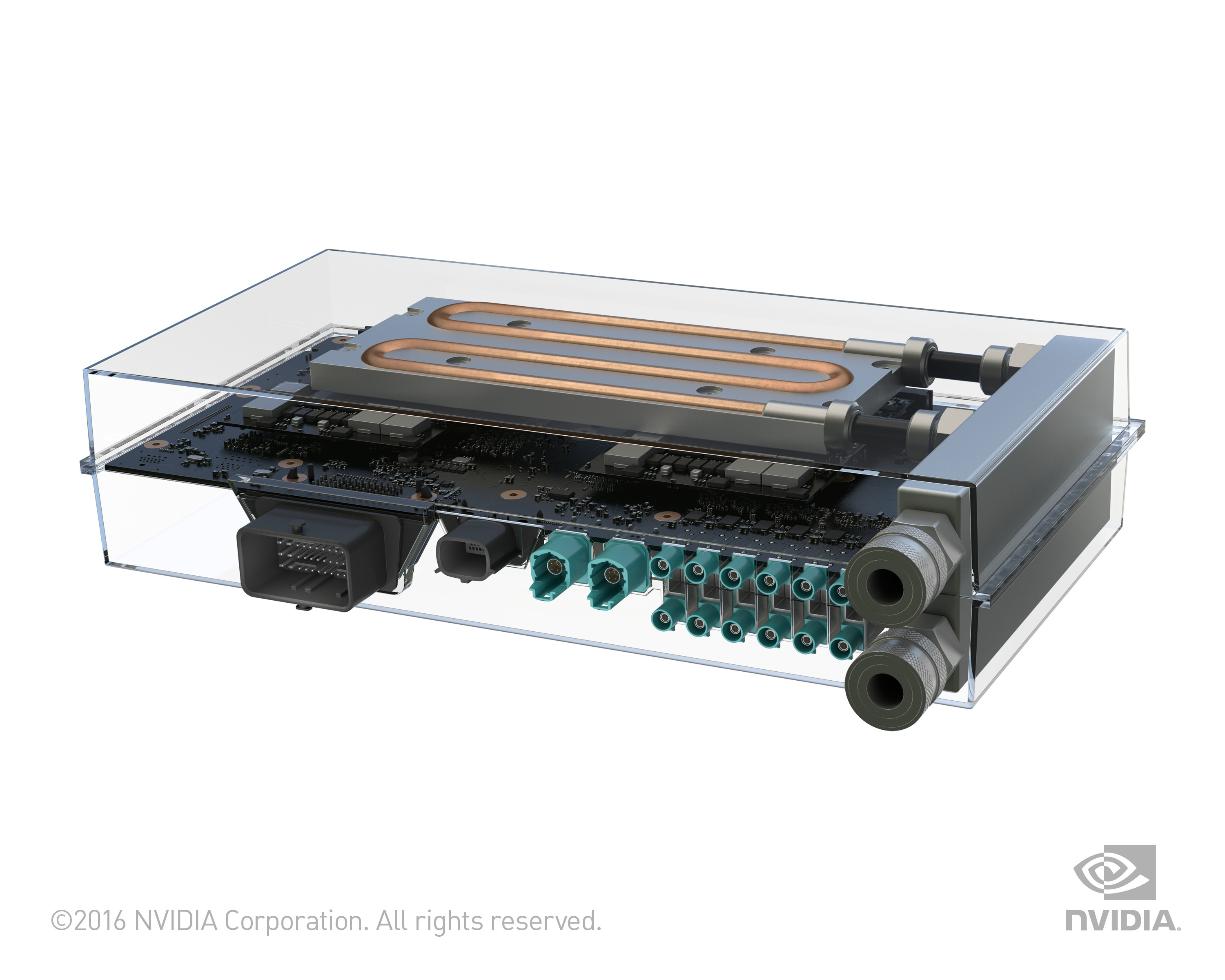
(Just for clarification: no one is using the Drive PX2 in a data center. Just look at these connectors:

http://images.anandtech.com/doci/9903/NVIDIA_DRIVE-PX-2.jpg )

Re: Nvidia on new self-driving system: “basically 5 years ahead and coming in 2017”

#30
post #15
post #8

Earlier quoted context omitted.

Many people. And I still don't expect to see general-purpose (secondary roads/cities, range of weather conditions) for decades.

This exactly. I did robotics in the late 90's and it's interesting to see how many fundamental problems still remain unsolved. And the trajectory of tech advancement is positive for sure, but not _nearly_ as fast as popsci and marketing articles suggest.

Not to mention that, since you did robotics in the 90s, there might just be another point where the entire field of AI falls off a cliff, again.
Post reply on HN