Live data from Hacker News

The bizarre role reversal of Apple and Microsoft

backchannel.com

81–90 of 220 posts

Re: The bizarre role reversal of Apple and Microsoft

#81
post #72
post #71

Earlier quoted context omitted.

>a developer who needs a Unix-based OS. Windows 10 includes binary compatibility. bit-for-bit, checksum-for-checksum Ubuntu ELF binaries running directly in Windows. all of Ubuntu user space. a full copy of ubuntu built in. Windows not working as a unix-like os for developers isnt reality anymore.

I have Windows 10 on my desktop machine, so I'll try it out. However, all that means (assuming it works perfectly, as you seem to suggest) is that Windows is usable to me. That's not enough of a reason for me to get a Surface Book. I'm less than thrilled with Windows right now because just the other day the built-in Mail app started crashing within a few seconds of opening; it's now unable to connect to my Exchange a…

My MBP periodically crashes any app that tries to invoke an open/save dialog. Its great when I try to download a file, accidentally make preview think I edited something, or try to save a document.

You can pick individual bugs to complain about all day. Every OS has plenty. Sorry to hear about your issues with the mail app though.
Re: The bizarre role reversal of Apple and Microsoft

#82

Earlier quoted context omitted.

Well to be fair HiDPI issues are application issues as opposed to core Windows issues.

It's first and foremost a bad DPI independence API design, largely due to a terrible backwards compatibility of an even more terrible legacy stack. It is fixed somewhat in their modern stacks, such as WPF and UWP, but the vast majority of Windows software is not written with these frameworks. While it is understandable why the legacy baggage is there and cannot be removed, the end result is a big mess, still to this…

As most new apps start to be built on UWP that issue will go away.

Also, I am not sure what DPI issues you're facing but I have run W10 on my rMBP for quite some time and it's been thoroughly pleasant. Perhaps your issues are fuzzy text due to mixed DPI, multi monitor setup?

Re: The bizarre role reversal of Apple and Microsoft

#83

Earlier quoted context omitted.

> Apple's biggest challenge seems to be convincing their current customers they need a new phone at all. That's not much of a challenge for Apple. There is always a laundry list of features that people want but that aren't necessarily mature (e.g. Wireless Charging, NFC, waterproofing) and Apple keeps those in it's back pocket incubating. Occasionally it pulls one out and slaps it on one of their devices to boost sal…

Pretty sure iPhones today have NFC, it's just not available for anything other than Apple Pay.

That's why so many payment terminals work with Apple Pay

Re: The bizarre role reversal of Apple and Microsoft

#84
post #54

Earlier quoted context omitted.

Do they still have tons of high-DPI bugs where some apps work with it and some get all garbled?

Well to be fair HiDPI issues are application issues as opposed to core Windows issues.

Microsoft took ages to fix first-party applications that shipped with the OS: https://www.thurrott.com/windows/windows-10/83964/microsoft-....

Microsoft's inability to execute is mind-boggling.

Re: The bizarre role reversal of Apple and Microsoft

#85

Earlier quoted context omitted.

Well to be fair HiDPI issues are application issues as opposed to core Windows issues.

It's first and foremost a bad DPI independence API design, largely due to a terrible backwards compatibility of an even more terrible legacy stack. It is fixed somewhat in their modern stacks, such as WPF and UWP, but the vast majority of Windows software is not written with these frameworks. While it is understandable why the legacy baggage is there and cannot be removed, the end result is a big mess, still to this…

> a much better designed API without a 20-30 year old baggage.

Apple's API dates back to the 1980s, just like Windows'. If you want to nitpick, Windows was developed in the early-mid 1980s while Next was developed in the mid-late 1980s.

Re: The bizarre role reversal of Apple and Microsoft

#86

Thursday's reveal of new MacBooks was so lackluster I am rethinking my loyalty to Apple. The Apple platform has always been the most productive platform for me. But other firms seem to be innovating and iterating on things quicker than Apple has: rumor has it that Apple will more or less copy the edge-to-edge display of Chinese handsets or the rounded edges of the S7 Edge, wtf, what happened to doing really bold thin…

> I guess we might have just hit peak-phone handset.

This is what happens in mature product segments. The first iPhone was released 9 years ago, and that was the last real revolution -- a smartphone whose front was pretty much all screen. Everything Apple and everyone else has done since then has been incremental -- better screens, larger screens, better cameras, faster processors, thinner chassis -- but definitely the same paradigm.

The same thing happened to laptops before that. Some of the older laptops had pretty odd and uncomfortable designs. Sometime in the 90s, everyone standardized on the clamshell laptop with a 4:3 screen (later moving to widescreen), a low-profile keyboard, and a central trackpad below that. If you compare a 20-year-old laptop to a new one, you'll see the same incremental changes that happened to phones -- larger, better screens, faster processors, thinner chassis.

I think the bottom line is that the smartphone market has become as mature and predictable as the laptop market.

Re: The bizarre role reversal of Apple and Microsoft

#87
post #64

[deleted]

I'll down-vote you just for pointing out that you'd like not to be down-voted. If you weren't so over-protective of your ego, you wouldn't feel the need to bring it up, which inherently drives the discussion away from the things you claim to want to drive it toward.

Treat your upvotes as a currency that you can spend on controversial opinions and phrasing. Accusing down-voters of being 'angry people who don't engage in discussion' is certainly immature and hypocritical of you. Generally speaking, there are dozens of great reasons to down-vote someone and not type a reply.

Re: The bizarre role reversal of Apple and Microsoft

#88
The Surface Studio is a major coup for Microsoft not because it'll necessarily sell well (although I think it has the potential to) but because it's made Microsoft cool.

I showed the video to my wife and she was so impressed that she looked at all the videos Microsoft did detailing the development. She's been a mac user for more than 20 years and tt's the first time she's ever looked at a Microsoft product.

Apple during the Steve Jobs era had a reputation for taking risks, for coming up with new products that impressed and that people just wanted.

A lot of people I know were excited by the announcement of new products and tried to watch the keynotes or follow the live coverage. In the past year, none of my friends care about them anymore. I only cared about yesterday's event because I've been waiting to upgrade my macbook pro and the event was lackluster. For better or worse, by not taking risks and not introducing new products, Apple seems less cool than it used to be and Microsoft showing off the Surface studio highlighted this. It's a huge blow for Apple in term of marketing.

(As an out of topic aside, Apple even sucks at doing boring incremental improvements, the iMac, Mac Pro and Mac Mini are languishing and the new macbook pro 15 inch design choices are non-sensical for professionals)

Re: The bizarre role reversal of Apple and Microsoft

#89
post #51
post #42

Earlier quoted context omitted.

>Who doesn't have a laptop that hasn't been modeled after the macbook. As soon as they can pack the power i'm looking for in my laptops into an apple style case, i'll be there. Until then i'll be sticking with my boxy black Clevo.

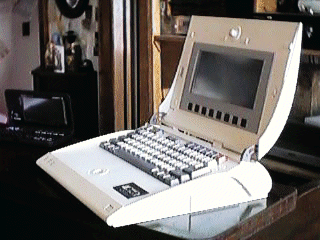
Surprise: Virtually all laptops are modelled after an Apple machine. The boxy black ones are PowerBook clones. Apple established the dedign language used by every laptop manufacturer since, in the early 90s: clamshell case, hinge at the rear, keyboard towards the back of the lower half with the trackpad front and center and all that wonderful blank space on either side usable as wrist rests.

Surprise: Apple wasn't the first with a "clamshell case, hinge at the rear, keyboard towards the back of the lower half...all that wonderful blank space on either side usable as wrist rests."

1983: http://cosy.com/language/cosyhard/cosyhard.htm - http://cosy.com/language/cosyhard/ampropn.gif (note: no trackpad - but then, the original powerbook didn't, either: https://en.wikipedia.org/wiki/PowerBook_100, and that round trackball is in just the same position as that round lid latch...)

Apple does a great job integrating elements that may have existed before, and is definitely a trendsetter in styling, but they also get credit for creating a lot of elements that existed before. ("Great artists steal.")

Re: The bizarre role reversal of Apple and Microsoft

#90

Earlier quoted context omitted.

It's first and foremost a bad DPI independence API design, largely due to a terrible backwards compatibility of an even more terrible legacy stack. It is fixed somewhat in their modern stacks, such as WPF and UWP, but the vast majority of Windows software is not written with these frameworks. While it is understandable why the legacy baggage is there and cannot be removed, the end result is a big mess, still to this…

As most new apps start to be built on UWP that issue will go away. Also, I am not sure what DPI issues you're facing but I have run W10 on my rMBP for quite some time and it's been thoroughly pleasant. Perhaps your issues are fuzzy text due to mixed DPI, multi monitor setup?

I am not using UWP apps. Most of the software I use on Windows are either MFC or Windows Forms. These can also be DPI aware and render correctly, but they require proactive developer support, which is not something that is happening in the Windows developer world right now. Either software is abandonware (but still works), or issues are open and remain open or are simply closed with "won't fix" status. Most developers see this as a non-issue or very low priority. I mean, even Chrome does not support high DPI from what I remember. It looked terrible.

Linux world is in the same boat. It's even worse there, because a lot of the toolkits don't support high DPI modes or are buggy, and developers there are even less interested or have the know-how to fix issues.

With the emergence of cheaper 4K monitors, perhaps we'll see a change to the better, who knows.

Multi-monitor support is another issue entirely.

Post reply on HN