Rolls-Royce’s single-crystal turbine blade casting foundry
theengineer.co.uk
Rolls-Royce’s single-crystal turbine blade casting foundry
1–10 of 75 posts
Re: Rolls-Royce’s single-crystal turbine blade casting foundry
#2There is a cool How It's Made on these parts. Not sure if it's RR, but it shows the complexity: https://www.youtube.com/watch?v=Qh9nvoRicKc
Re: Rolls-Royce’s single-crystal turbine blade casting foundry
#3There is a cool How It's Made on these parts. Not sure if it's RR, but it shows the complexity: https://www.youtube.com/watch?v=Qh9nvoRicKc
It shows a box at the end with the GE logo. Crazy how precise the manufacturing is.
Re: Rolls-Royce’s single-crystal turbine blade casting foundry
#4Here's a recommendation if you are interested in understanding the basics of turbine engines:
https://www.youtube.com/user/AgentJayZ
This guy, calling himself AgentJayZ, is a technician (not a designer) working on mostly older industrial and military jet engines, and he's showing a lot of the innards, and explaining a lot of the basics of operation of turbine engines. Also: Loads, and loads of footage of running engines in test-stands, which of course gets boring over time...
Re: Rolls-Royce’s single-crystal turbine blade casting foundry
#5This was a super fun read, and it felt nice to take the time to carefully read it to understand the very complex processes it was describing.
That said, can someone explain how the pigtail accomplishes the following?:
> "The crystals grow in a straight line in the direction that the mould is being withdrawn, but because of the pigtail’s twisted shape, all but the fastest-growing crystals are eliminated."
Re: Rolls-Royce’s single-crystal turbine blade casting foundry
#6Not to take away from the engineering marvel that these parts and process represent, but the timing of this article is interesting - seems PR related. I recently read about problems ANA faced with Rolls Royce engines, specifically the turbine blades failing. There have been at least 3 incidents of engine failure, flights have been cancelled an all 787 engines have to be retrofitted with new blades.
http://www.reuters.com/article/us-ana-rolls-royce-hldg-boein...
http://www.bloomberg.com/news/articles/2016-09-05/ana-said-t...
Re: Rolls-Royce’s single-crystal turbine blade casting foundry
#7Not to take away from the engineering marvel that these parts and process represent, but the timing of this article is interesting - seems PR related. I recently read about problems ANA faced with Rolls Royce engines, specifically the turbine blades failing. There have been at least 3 incidents of engine failure, flights have been cancelled an all 787 engines have to be retrofitted with new blades. http://www.reuters…
The article was published a year ago; I came across it because I got curious about single-crystal turbines after seeing them mentioned in the comments about the AN-225 story posted earlier today.
Re: Rolls-Royce’s single-crystal turbine blade casting foundry
#8This is the best documentary on how RR makes the jet engine and the blades. 1 hour long but once you click it, it would be hard to stop!
Re: Rolls-Royce’s single-crystal turbine blade casting foundry
#9On this topic, I'd like to ask how 3D printed parts fair in the new engines being built. [1]
I'd love to hear about this from a Metallurgical Engineer or a Material Science Expert.
[1] http://qz.com/667477/ge-fires-up-worlds-largest-commercial-j...
Re: Rolls-Royce’s single-crystal turbine blade casting foundry
#10For context: https://upload.wikimedia.org/wikipedia/commons/thumb/7/75/Tu....

The blade in the first picture would sit in the high-pressure turbine, just behind the combustion chamber. Note that the flow path of a jet engine corresponds directly to the pressure-temperature transitions of the Brayton cycle, which governs the operation of gas turbines: https://www.grc.nasa.gov/www/k-12/airplane/Images/braytonts.....
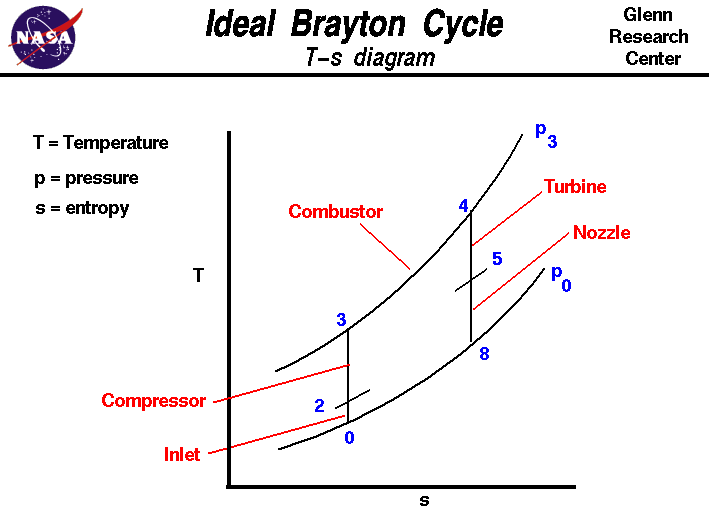
If you're wondering why Rolls Royce goes to so much trouble to build turbine blades that can handle high temperatures, see: http://web.mit.edu/16.unified/www/SPRING/propulsion/notes/no....
Also note that difference in size between the XWB's fan in the second picture (of the article) and the turbine blade in the first picture. The XWB is a high-bypass-ratio turbofan, which means almost all the air taken in by the 3-meter-diameter fan bypasses the core of the engine, generating thrust at low exit velocity. Only about 1/10th the air goes through the core of the engine. There, it is compressed, so by the time you get to the HPT, the flow path is quite narrow. As the turbine section removes energy from the hot air, it cools and expands, and the flow path gets wider.