Live data from Hacker News

Artist Peter Doig victorious as court agrees '$10m' painting is not his work

theguardian.com

41–50 of 72 posts

Re: Artist Peter Doig victorious as court agrees '$10m' painting is not his work

#41
post #30

Earlier quoted context omitted.

The third to last paragraph > The artist’s lawyers said they identified the real Pete Doige, whose records matched Fletcher’s description. Doige died in 2012, but his sister, Marilyn Doige Bovard, testified at the trial that the work was created by her late brother. Suggests that there was reason for the corrections officer to believe he had a genuine painting, and not a counterfeit. However as this made it to court…

Note spellings: Peter Doig vs Pete Doige.

Yep. Took me a while to find a copy of the signature [0]. I would happily follow the argument that the e character is embellishment from the end of the g. However all doubt is removed when presented with Doige's signature [1]. For comparison I also looked up Doig's signature [2], of course this could never be evidence that his signature at 16 wasn't the one presented.

[0] http://i.cbc.ca/1.3675486.1468348236!/cpImage/httpImage/imag...

[1] http://liverampup.com/uploads/images/362E348700000578-0-imag...
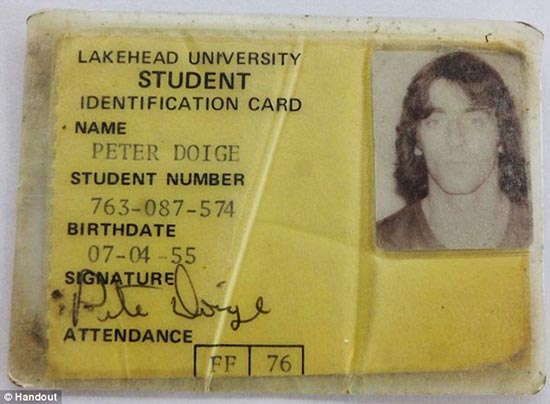
[2] https://www.wengcontemporary.com/cdn/uploads/default_site/ar...

Re: Artist Peter Doig victorious as court agrees '$10m' painting is not his work

#42
post #19

What if he really had painted it? What duty does he have to authenticate it?

This is complicated because the transaction occurred in Canada but the case was heard in Chicago. But the argument is the same as forgery: the court may not be able to force Doig to authenticate it, but if the officer can prove Doig sold him the painting under the pretence of being his then Doig has sold him a forgery (selling a claimed Doig which truly is not) and is liable for it. It does not matter that the name Doig did not mean anything back then, because the forgery constitutes a loss of future earnings.

Of course this is all hypothetical because Doig obviously did not paint this given what has come out in court.

Re: Artist Peter Doig victorious as court agrees '$10m' painting is not his work

#43
post #22

And just when will court punish people wrongly suing artists that denies you make money with counterfeits ? Even worse is the greediness of these art dealers that just want to make money whatever the cost to artists. Art market is sick.

This isn't a counterfeit. It is a case of mistaken identity and a lot of money on the line. A Pete Doig did in fact paint the picture. The problem is that Pete Doig is not Peter Doig.

Also it's Pete Doige vs Peter Doig. Last names AND first names are a letter apart, and the court documents showed the signatures of both. The fact that the suitor didn't drop when presented with the evidence and let it go to trial anyway is pretty ridiculous.

Re: Artist Peter Doig victorious as court agrees '$10m' painting is not his work

#44
post #37

First, let me say that this looks like mistaken identity or worse; and that I myself am an artist, and like most part-time artists I'm very sympathetic to the interests of full-time artists. However, this sentiment is unrealistically simple: "I feel a living artist should be the one who gets to say yea or nay and not be taken to task and forced to go back 40 years in time." The way the art market works, attribution (…

What's interesting here is how the art isn't valued on its own artistic merits, but by its authorship. The artist's ability to control the value of a work by testimony is weird, but only because the underlying work's value is weird.

Re: Artist Peter Doig victorious as court agrees '$10m' painting is not his work

#45
post #37

First, let me say that this looks like mistaken identity or worse; and that I myself am an artist, and like most part-time artists I'm very sympathetic to the interests of full-time artists. However, this sentiment is unrealistically simple: "I feel a living artist should be the one who gets to say yea or nay and not be taken to task and forced to go back 40 years in time." The way the art market works, attribution (…

What's interesting here is how the art isn't valued on its own artistic merits, but by its authorship. The artist's ability to control the value of a work by testimony is weird, but only because the underlying work's value is weird.

It's been that way for a long time, though authorship and merits were (and arguably still are) very intermingled. It started with the simple fact that really good artists were those that made really good art, and once somebody had a reputation it would be both to the artist's benefit and the collector's to have that front and center: for the artist, as advertisement to attract buyers, and for the collector to brag about.

I think the things that are very different now (i.e. since about the 80's) are:

1. Much, much more money is involved.

2. In many cases there is a huge gap between what insiders would consider the "underlying work's value" and what average people would find inspiring.

3. Media, obviously, and the Internet.

(And of course even insiders can differ on #2: there are plenty of cases where the market says Yes but the academics say No. The market works hard to "correct" this in its favor.)

Here's a great article on a great artist whose name recognition was a big part of his career in the 1500's, for instance:

http://www.nybooks.com/articles/2016/08/18/mystery-of-hieron...

Re: Artist Peter Doig victorious as court agrees '$10m' painting is not his work

#46
post #37

First, let me say that this looks like mistaken identity or worse; and that I myself am an artist, and like most part-time artists I'm very sympathetic to the interests of full-time artists. However, this sentiment is unrealistically simple: "I feel a living artist should be the one who gets to say yea or nay and not be taken to task and forced to go back 40 years in time." The way the art market works, attribution (…

Then it's a perverse market where people have ceased to sell objects, and are now just trading financial instruments. I support the right of the author to disclaim the authorship of any work at any time, despite any evidence to the contrary. He should be able to choose whether he wants his name used as a vehicle in a financial transaction. Not whether it will be, because if some insurance company or law firm wants to back it as a work by him, it's entirely up to them. He should not be forced to endorse that transaction, and if their valuation relies on that enforcement, their valuation should be dependent on his consent.

The opposite has always been true. I can endorse that painting as an original pessimizer, without caveat. That doesn't imply that I own the image in terms of copyright, any more than R.Mutt endorsing a urinal as his own work, or Jeff Koons claiming various arrangements of vacuum cleaners as his own work gives them any power over any patents covering the design of the object.

Re: Artist Peter Doig victorious as court agrees '$10m' painting is not his work

#47
post #37

First, let me say that this looks like mistaken identity or worse; and that I myself am an artist, and like most part-time artists I'm very sympathetic to the interests of full-time artists. However, this sentiment is unrealistically simple: "I feel a living artist should be the one who gets to say yea or nay and not be taken to task and forced to go back 40 years in time." The way the art market works, attribution (…

What's interesting here is how the art isn't valued on its own artistic merits, but by its authorship. The artist's ability to control the value of a work by testimony is weird, but only because the underlying work's value is weird.

Welcome to art! The only difference between Fountain and the, ah, similar works on display in the art museum men’s room is an official nod by DuChamp.

Re: Artist Peter Doig victorious as court agrees '$10m' painting is not his work

#48
post #33
post #8

Earlier quoted context omitted.

> Nor were all of the mentioned facts in the pre-trial coverage. Which actually should never have mattered, because the trial never should have happened. Doig said, no, that is not my painting. That should have been the end of it, but the other party didn't like that and tried to get the court to say otherwise because they thought they had basically won the lottery.

One can imagine scenarios where an artist disclaims that they created something out of spite (with family or whatever) and that disclaiming greatly decreases the value of some sold item. If that painting or whatever was fairly obviously the artist's work, would you still feel the same? This case seems odd based on the news coverage though (based on the coverage in respectable publications like The New York Times and…

One of the benefits of being a living artist is the ability to disavow anything as their work.

Re: Artist Peter Doig victorious as court agrees '$10m' painting is not his work

#49
post #40

Earlier quoted context omitted.

To be safe, I think the picture should be awarded to Peter Doig. Perhaps on the grounds that the owner admits it confusable with his brand..

So if I make art "in the style of artist ", then all my work belongs to that artist? (I'm not talking about blatant copies.)

Normally no, but here the "owner" was claiming it is the artist's work, not a facsimile or reproduction. So this is an exact case of the normally theoretical ill that trademark and brand related law is supposed to protect against: something that is honestly confused with the work of a manufacturer with a substantial cost to that manufacturer.

Try doing this at the border with a "rolix" and that offended manufacturer has rights to protect their interests not a responsibility to show up to convince customs that your rolix is a real rolex from back when they had trouble spelling. So I'd say this is an example of different justice for different relative social status.

Re: Artist Peter Doig victorious as court agrees '$10m' painting is not his work

#50
post #38

Earlier quoted context omitted.

The third to last paragraph > The artist’s lawyers said they identified the real Pete Doige, whose records matched Fletcher’s description. Doige died in 2012, but his sister, Marilyn Doige Bovard, testified at the trial that the work was created by her late brother. Suggests that there was reason for the corrections officer to believe he had a genuine painting, and not a counterfeit. However as this made it to court…

Yeah it sounded like the plaintiffs had a decent reason to believe it was his painting at first. But then the defendants found the "real" Pete Doige. At that point the planitiffs should have verified it and dropped the lawsuit, but for some reason they chose to keep going.

10 million reasons according to the article.
Post reply on HN