Live data from Hacker News

Japanese writing system basics

candyjapan.com

71–80 of 347 posts

Re: Japanese writing system basics

#71
post #25

Sometimes I wonder if all these people that criticize or that think that a Latin alphabet can be adapted seamlessly to all languages have tried to study past a beginner level any logographic language.

I have studied Japanese, and still think that a logographic writing system was a mistake. Consider the time and effort it takes for native speakers to become literate. I also think that the Latin alphabet could be easily used for Japanese, which does not contain any sounds that do not have an obvious equivalent in English, and even if it did, we could always repurpose a character or sequence of characters for that so…

Native speakers seem to do fine. Learning a language while growing up, having the Hiragana as a helper, while all your media is written in Japanese makes everything easier. When they finish school they know enough Japanese to go by. It's obviously different for non-native people.

Also, it's not like you stop learning even after school. For example English has according to the Oxford dictionary 171,476 words in current use excluding inflections, and several technical and regional vocabularies. Does all English university students know these words?
Re: Japanese writing system basics

#72

This was an interesting symbol to choose for an internet explanation. It took me a while to realise that the rectangle is actually the symbol that I'm supposed to see, rather than a missing glyph.

That rectangle denoting a missing glyph is called "tofu" because it looks like it, so there is a connection to Japanese anyway.

It's not clear whether or not that naming for that character originated in Japan.

Re: Japanese writing system basics

#73
post #52
post #44

Earlier quoted context omitted.

It's not a very good choice to use "食” to represent "eat" here. In modern Chinese we say "吃", and you can see that "吃" has a square part, which is exactly "口". And "食" also means "food", but "吃" doesn't. Also, since ancient Chinese people thought eclipse was caused by a "dog in the sky" eating the moon, it's reasonable for them to use "食" to describe it. But modern Chinese almost always say "月食", meaning eclipse of t…

It's probably because it's a Japanese website and 食 does make sense to represent 'eat' in Japanese.

True. And it also makes sense in Chinese despite its "ancient" feel. I just didn't realize it's a Japanese website :/

Re: Japanese writing system basics

#74
post #38

If 口 substitutes for mouth -- the adjective form of "mouth" is "oral", an etymologically (and audibly!) distinct word. Should that use 口 too? If king is 王, kingly is 王ly, and royal is 王al, what is regal? If mouth is 口 and mouthed is 口ed, why would ate be 食t rather than 食ed? Japan misinterpreted the Chinese writing system (already terrible) into easily the worst writing system known to mankind. It won't look cute when…

That's because you're thinking in English. "Kingly" is a very English way of thinking of things (as in king-like behaviour for example). In Chinese and Japanese, there simply isn't a way to describe it as elegantly as in English In Chinese it'd be 王道 (the tao of the King if translated directly to English), which has a completely different connotation (it's more holistic in concept (i.e. it has an overloaded meaning)…

>"Kingly" is a very English way of thinking of things.

I'm not sure about that. Japanese has adjectival nouns (commonly referred to as na-adjectives), and the 的 suffix.

Additionally, as you identify, the の particle also serves this function; but you give it a much more restrive role that it actually has (as is typically in English language Japanese learning material. In general, の marks the genitive case, which simply means that the first noun modifies the following noun in some way. It is often used to show possesion, but can also be used in a way close to ~ly in English.

Re: Japanese writing system basics

#75

If 口 substitutes for mouth -- the adjective form of "mouth" is "oral", an etymologically (and audibly!) distinct word. Should that use 口 too? If king is 王, kingly is 王ly, and royal is 王al, what is regal? If mouth is 口 and mouthed is 口ed, why would ate be 食t rather than 食ed? Japan misinterpreted the Chinese writing system (already terrible) into easily the worst writing system known to mankind. It won't look cute when…

>If 口 substitutes for mouth -- the adjective form of "mouth" is "oral", an etymologically (and audibly!) distinct word. Should that use 口 too?

Yes. And that's exactly what they do in Japan. Rather uncommonly among languages, English is a fusion between romance and germanic stems. Often you'll see two phonographic bases for the same concept: Easy ones are food: Pork/Swine, Cow/Beef, but Oral/Mouth, etc.

Japanese is similar, many words have both their Japanese native stem and an imported chinese sound. The imported chinese character was assigned to the Japanese native word, even though it sounds totally different. I imagine it's makes Japanese quite frustrating to learn as a chinese speaker, but Chinese is really easy to learn for a Japanese speaker.

Take for example 食 (eat, from the article)

https://en.wiktionary.org/wiki/食#Japanese

can be read: i, ji, jiki, shoku (which derive from chinese, imported twice during two dynastic periods, corresponding to chinese ji/yi/zi)

but also deriving from native japanese words: ku-, ha(mu) ta(beru) o(su), uka, uke, ke, shi, (last five are very rare).

All of these uses mean variously "to eat". The pronunciations are entirely contexual.

Re: Japanese writing system basics

#76

Slightly off-topic but can anyone here comment on the candies they ship? Are they just ordinary sweets? I've never heard about Japan being famous about candies like Switzerland is about chocolate.

Japan isn't famous for candies per se but they do have a lot of very interesting/sometimes bizarre treats that you won't find anywhere else in the world.

E.g. Yuzu KitKat, chilli KitKat, caramel lamb, chocolate squid, coffee bubblegum, caramel chips, cake soda, DIY candy, etc.

Re: Japanese writing system basics

#77

How many symbols are there? And how would the keyboard look like though?

Here's a hilarious design for a keyboard with a key for most Japanese symbols: https://japan.googleblog.com/2010/04/google.html

It's an April Fool's joke, obviously. For Japanese you can use romaji or some other phonetic system; for Chinese you can use pinyin or bopomofo.

Re: Japanese writing system basics

#79
post #13

Earlier quoted context omitted.

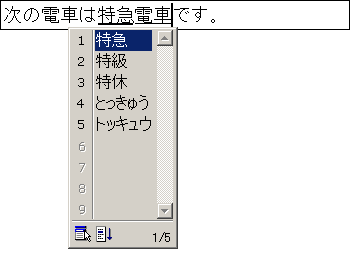
Hah, and there's the kicker. In Japanese the most common input method is phonetic, either with a latin alphabet keyboard or a hiragana keyboard. The IME kicks in and has you select the ideogram you mean, so in reality it would save you no time typing and actually cost you time.

I highly doubt that's true, based on my experience with Chinese pinyin IMEs. A Japanese phonetic IME should have enough local context to guess which Kanji is correct. You type, then go back and quickly proofread later.

It's been about 10 years, but I used the IME in Windows 2k quite extensively.

http://blog.gatunka.com/img/Convert3.gif

I recall this window strongly, with ~10 items in it being common. Playing with it now in OS X perhaps it's improved in recent years.

Re: Japanese writing system basics

#80
post #57

This was an interesting symbol to choose for an internet explanation. It took me a while to realise that the rectangle is actually the symbol that I'm supposed to see, rather than a missing glyph.

It's not exactly a rectangle though, the two downward strokes extend slightly past the bottom horizontal stroke.

In handwriting, or calligraphy, it might be rendered like this, in fact:

       2
      --------+
  1 \        /
     \ ---- /
        3
The three strokes not all connected, and the left and right sides tapering downward a bit (exaggerated in the ASCII above).

Image search for "kuchi-no kanji + shodou (calligraphy)":

https://www.google.com/search?q=%E5%8F%A3%E3%81%AE%E6%BC%A2%...

It seems there are two schools on the relationship between stroke 2 or 3: 2 can extend downward past 3, or 3 can underscore 2.

Post reply on HN