Live data from Hacker News

Doctors issue warning about effects of LED streetlights on health

theconversation.com

51–60 of 89 posts

Re: Doctors issue warning about effects of LED streetlights on health

#51

The article is saying "cool it and dim it" but I think they mean to say "warm it and dim it". They suggest the temperature should not be above 3000 kelvin.

Yes. It's the blue component (large with high color temperature lights) that is thought to most strongly affect human melatonin secretion and sleep. Here's one of many studies that indicate this: http://www.ncbi.nlm.nih.gov/pubmed/8979406

Studies involving 5 subjects are not capable of being rigorous. Considering this with equal weight as LHC discoveries is harmful. Please stop.
Re: Doctors issue warning about effects of LED streetlights on health

#52

Earlier quoted context omitted.

You can just use a different color of LED. Honestly people in Seattle, where these LED lamps were first piloted, have been raising these concerns for at least 4 years. This is the product of some combination of bad design, a lack of user-centered thinking at the utilities, and less than ideal incentives. For example, daylight led's were touted as making it easier to identify cars involved in criminal activity because…

Really? Who complains about the new lights? I live in Seattle and I really like the new lights, they're way better than the dingy orange HPS lights. It's easier for my eyes to adjust when walking out of a bright apartment, and I can see more details. Anecdotally, I've also seen fewer vagrant types in the newly lit areas.

Also a Seattle resident. Who's complaining? Neither the Times, PI, nor Real Change have mentioned this recently. I've been enjoying the brighter streets at night.

Re: Doctors issue warning about effects of LED streetlights on health

#53

> "In addition to its impact on drivers, blue-rich LED streetlights operate at a wavelength that most adversely suppresses melatonin during night." I wonder if this ends up saving thousands of lives by decreasing fatigue in drivers. The blue light argument seems like absolute hogwash; we're exposed to orders of magnitude brighter blue light every day. It's called daylight, and the streetlights dont't even emit UV.

If you don't get tired at night, you don't sleep well, and sleep deprivation is much worse than being tired. If you think the problem with light at night is hogwash you need to read it again. Bright light, especially blue light makes your body react like it's daytime . Do you really think people have forgotten about the sun? You only hurt your own understanding by being so quick to dismiss others.

Please quote a study verifying this with at least a few hundred people, if not a few thousand. The reason we think it's hogwash is because supporting studies involve only single-digit groups. The study I performed, involving 3 males and 2 females between 18-34, found blue light does not impact ability to sleep.

Re: Doctors issue warning about effects of LED streetlights on health

#54
post #18

Earlier quoted context omitted.

Related: https://justgetflux.com/research.html

Perhaps not the most neutral source for information. I found their summaries of paywalled articles to be a bit... misleading. They'll sell you Swarovski crystals and Himalayan salt lamps though.

They do provide abstracts, which is nice. From those, you can see how few subjects are used in these studies.

Re: Doctors issue warning about effects of LED streetlights on health

#55
post #4

What does the AMA know about LEDs and health? There's nothing in this article about why they made these recommendations. And the article compares LED lighting to 'before electricity', instead of to for instance existing sodium lamps? It is an opportune moment to make the recommendation, since folks are converting to LED so rapidly.

Actually they specifically say why: glare and impact on circadian rhythms. Both of these are very well studied issues with light concentrated in the blue end of the spectrum (as opposed to sodium lamps that have very little blue emissions). BTW, they also failed to mention increased light pollution due to scattering.

How well studied are these topics? How many studies involved more than 1000 people?

Re: Doctors issue warning about effects of LED streetlights on health

#56

What does the AMA know about LEDs and health? There's nothing in this article about why they made these recommendations. And the article compares LED lighting to 'before electricity', instead of to for instance existing sodium lamps? It is an opportune moment to make the recommendation, since folks are converting to LED so rapidly.

This is just a fluff piece with a clickbait title, run by a new up-and-coming news site looking to earn some easy advertising revenue.

Re: Doctors issue warning about effects of LED streetlights on health

#57
post #38

I would argue that people with those crazy LED headlights are even worse. Since I often work late, I get the pleasure of being temporarily blinded as a white dwarf passes by at 45mph regularly.

And don't even get me started on the LED eye melters that cyclists are running these days. Some are about as bright as car headlights, but the spread and aim are inferior - especially since the folks that run those invariably seem to point them up from the horizontal. I keep thinking about mounting a 8 D cell maglight on a gimbal on my handlebars to give them a photon in-kind response.

If you see the biker then I think the lights did a good job. I suppose you could make an argument that it could blind people and they hit someone/something but I never heard of that happing - I only hear bikers getting hit because they were not seen.

Re: Doctors issue warning about effects of LED streetlights on health

#58

Title is misleading; it's not LED streetlights, it's the color temperature of LED streetlights. While the article raises a few good points, color temperature isn't new; it's not like LEDs have some inherent issue that impacts health.

True, but there's a real problem with people and places using lights with far too high a temperature, and even when shopping for home LED lights it's surprisingly difficult to find low temperature lights that aren't low on lumens output. Pretty much anything over 3000K looks horribly blue at night, and if it wasn't such a massive pain to find them I'd prefer <2000K.

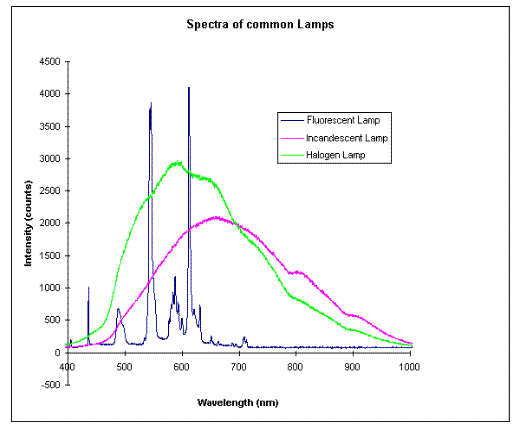
I have a bigger issue with fluorescent lights: They have a discontinuous spectrum[0] that can mess with your perception of colour as well as a noticable flicker that gets worse as the tubes age.

Some of the newer "warm tone" CFL bulbs appears to do better better on these aspects. [0]: http://minerva.union.edu/newmanj/Physics100/Light%20Producti...

Re: Doctors issue warning about effects of LED streetlights on health

#59

Earlier quoted context omitted.

Yes. It's the blue component (large with high color temperature lights) that is thought to most strongly affect human melatonin secretion and sleep. Here's one of many studies that indicate this: http://www.ncbi.nlm.nih.gov/pubmed/8979406

Studies involving 5 subjects are not capable of being rigorous. Considering this with equal weight as LHC discoveries is harmful. Please stop.

At posting, I didn't have time to provide more references. You'll see I've given three more references below. Sources include Acta Physiologica, SPIE, and Neuroscience Letters. They discuss different effects of illumination color temperature in human systems.

I posted the initial reference as an entry point to follow literature on potential effects of illumination color temperature on human sleep, or perhaps circadian rhythms, through action on a hormone known to be critically involved in sleep. I didn't suggest it was the end of the story. My post was on topic and it contributed to the discussion.

Would be glad to review data you think interesting.

http://onlinelibrary.wiley.com/doi/10.1111/apha.12552/abstra...

http://proceedings.spiedigitallibrary.org/proceeding.aspx?ar...

http://www.sciencedirect.com/science/article/pii/S0304394008...

Re: Doctors issue warning about effects of LED streetlights on health

#60

Earlier quoted context omitted.

If you don't get tired at night, you don't sleep well, and sleep deprivation is much worse than being tired. If you think the problem with light at night is hogwash you need to read it again. Bright light, especially blue light makes your body react like it's daytime . Do you really think people have forgotten about the sun? You only hurt your own understanding by being so quick to dismiss others.

Please quote a study verifying this with at least a few hundred people, if not a few thousand. The reason we think it's hogwash is because supporting studies involve only single-digit groups. The study I performed, involving 3 males and 2 females between 18-34, found blue light does not impact ability to sleep.

Not to diminish your study, but a simple "blue light circadian sleep" search in google scholar suggests a pretty mature understanding of the phenomenon, both at biochemical and phisiological level. My little study shows that after covering with black electrical tape each and every blue and white status led around the house everyone involved sleeps better.
Post reply on HN