Earlier quoted context omitted.
This is very human-centric point of view. How many species will be lost forever as a direct cause of this event ? Sure, it happens all the time, but typically over a much longer period meaning other species can evolve to fill the gaps. There is no time for evolution to work over the 200 years this last change happened. Another thing to consider is that the less diversity exists the harder it is for life to continue.
> This is very human-centric point of view. How many species will be lost forever as a direct cause of this event ? Actually, it's your view that's human-centric. Species? Diversity? These are human concepts and mores. > There is no time for evolution to work over the 200 years this last change happened. Evolution doesn't "work". It's merely the process of natural and sexual selection. The flora and fauna are constan…
Antarctic CO2 Hit 400 PPM for First Time in 4M Years
131–140 of 315 posts
Re: Antarctic CO2 Hit 400 PPM for First Time in 4M Years
#132I've been having a bit of an existential crisis about this recently. Is sustainability even possible anymore? We are obviously living beyond the capacity of the earth to cope right now. But is it even possible to sustain this many people (at current standards of living with foreseeable technology)?
Re: Antarctic CO2 Hit 400 PPM for First Time in 4M Years
#133Earlier quoted context omitted.
But will we be able to eat the different organisms that will thrive in this environment? What happens when today's staple crops no longer produce the yields we need to sustain our civilization?
Get ready to enjoy eating things made from jellyfish. Like, a lot of them.
Re: Antarctic CO2 Hit 400 PPM for First Time in 4M Years
#134I've been having a bit of an existential crisis about this recently. Is sustainability even possible anymore? We are obviously living beyond the capacity of the earth to cope right now. But is it even possible to sustain this many people (at current standards of living with foreseeable technology)?
1. We don't need to sustain this many people 2. We don't need to sustain this standard of living
The first one is pretty straight forward, although it's going to take another 100 years to sort out (barring a major disaster). Shifting child bearing years from the early 20's to the early 30's and changing cultural habits so that each family has only 1 or 2 children will do this for us. However to fix this problem, people need to be willing to share the wealth of the world a little bit more equitably. Improving the situation of women around the world has to be a very high priority as well. But if you look at what's happened in the last 50 years or so, it's pretty impressive. I actually have a lot of confidence that we will reach a slightly declining population within the next century. Either way, I just don't see a problem. Fixing this issue will make the world better, not worse. Obviously there are difficult economic challenges to consider, but again I think if we solve them it will only make life better for everyone.
Standard of living is similar. I think we're probably going to have to cut back a certain amount. But I don't think this is bad in any way. We're used to doing things like driving anywhere we want to go in a personal car. But if you go to Europe these days you will find that many cities and towns have opted to do away with cars in their town centres. This reduces some convenience, but massively improves the centre of the town. It means you have to park on the outskirts and either walk or take public transit into the centre.
Likewise we can get rid of a lot of things we don't need. I would literally ban clothes driers if I were king of the world. What a useless waste of energy. You are very slightly inconvenienced by having to hang your clothes outside. Of course you can't do that immediately because many apartment buildings have no access to the outside. Again, over 100 years we can dramatically improve this situation.
Other things are the way we heat/cool/light buildings. Why should it be 21 degrees C every single day inside regardless of the weather outside? What the heck is wrong with having seasons? What's wrong with having a night time? Some people would obviously rather have it the way it is now, but given that I personally live with an apartment that goes above 30C in the summer and below 5C in the winter, I can attest that it doesn't dramatically affect my standard of living. In many ways I prefer it. I was in Tokyo a few weeks ago. There are many more people on the streets in Ueno at 2am than at lunch time. Yes, it's fun, but is this really essential to our culture? Do we really suffer as a society by having to sleep during the night?
Most of our energy usage is in manufacturing and transporting things. We may have to do with less. But imagine if goods were 2 or 3 times the price they are now. Suddenly there is a reason to make higher quality goods with craftsmanship. If energy is priced higher than labour, suddenly there is a reason to train people to do a craft/skill. Suddenly there is a reason to buy a frying pan and not throw the damn thing out until well after you are dead. Seriously, do we need to buy crappy furniture, cooking utensils, clothes, etc, etc and replace them every 2 or 3 years??? Is this really a higher standard of living?
I remember reading a small book on the ecology of older cultures. You would buy 1 or 2 nice sets of clothes. When they got worn, you would wear them for every day use. When they got too worn for that, you would cut them up and make cleaning rags out of them. When they got too worn/dirty for that, you burned them for heat. Is this really worse that having a closet full of clothes from 30 years ago, waiting for a revival of that style? Good grief, clothes end up in land fill and we manufacture brand new rags for cleaning which also end up in land fill. It's almost criminal.
Enough rant :-) Like I said, from my previous rants on the subject, I realise it is not such a popular viewpoint, but I invite you to consider that dealing with constraints does not necessarily make your life worse. We're spoiled to a certain degree and having to do without has the potential to let us grow as a culture.
Re: Antarctic CO2 Hit 400 PPM for First Time in 4M Years
#135I wonder why it was at 400ppm 4m years ago. Presumably the Earth survived the last time.
It's the transition speed that is most important to consider. Past climatic changes have caused extinction events of varying degrees, but they happened on a timescale of tens to hundreds of thousands of years. We are changing the world's environments in equally or even more dramatic ways (ocean acidification, climate change, habitat destruction, deforestation, overfishing) on a timescale of just a couple hundred year…
Re: Antarctic CO2 Hit 400 PPM for First Time in 4M Years
#136Earlier quoted context omitted.
> This is very human-centric point of view. How many species will be lost forever as a direct cause of this event ? Actually, it's your view that's human-centric. Species? Diversity? These are human concepts and mores. > There is no time for evolution to work over the 200 years this last change happened. Evolution doesn't "work". It's merely the process of natural and sexual selection. The flora and fauna are constan…
I find it odd to see people criticizing each other because their comments are too human-centric. I happen to be human, and I believe the same is true of most of the commenters here. I don't really care very much about what happens to the Earth as a whole, but the survival and prosperity of humanity matters a great deal to me.
Just curious about what drives that particular viewpoint. Why do you care about the survival of the species? When you die, the world ends. It doesn't really matter what happens after that, does it? You could be dead two milliseconds and then a big rock hits the Earth and everything is gone. Still it doesn't impact you, because you are dead. And I am asking for the sake of discussion, purely.
Re: Antarctic CO2 Hit 400 PPM for First Time in 4M Years
#137Earlier quoted context omitted.
I find it odd to see people criticizing each other because their comments are too human-centric. I happen to be human, and I believe the same is true of most of the commenters here. I don't really care very much about what happens to the Earth as a whole, but the survival and prosperity of humanity matters a great deal to me.
> the survival and prosperity of humanity matters a great deal to me Just curious about what drives that particular viewpoint. Why do you care about the survival of the species? When you die, the world ends. It doesn't really matter what happens after that, does it? You could be dead two milliseconds and then a big rock hits the Earth and everything is gone. Still it doesn't impact you, because you are dead. And I am…
Re: Antarctic CO2 Hit 400 PPM for First Time in 4M Years
#138Earlier quoted context omitted.
Get ready to enjoy eating things made from jellyfish. Like, a lot of them.
I would venture that seaweed or algae is more likely.
I think it's much more plausible that we'll go the route Asimov predicted in "Caves of Steel" - genetically modified and processed yeasts, which are much more calorie dense than seaweed, and much better suited to the sort of industrial process that feeding 10+ billion people requires.
Re: Antarctic CO2 Hit 400 PPM for First Time in 4M Years
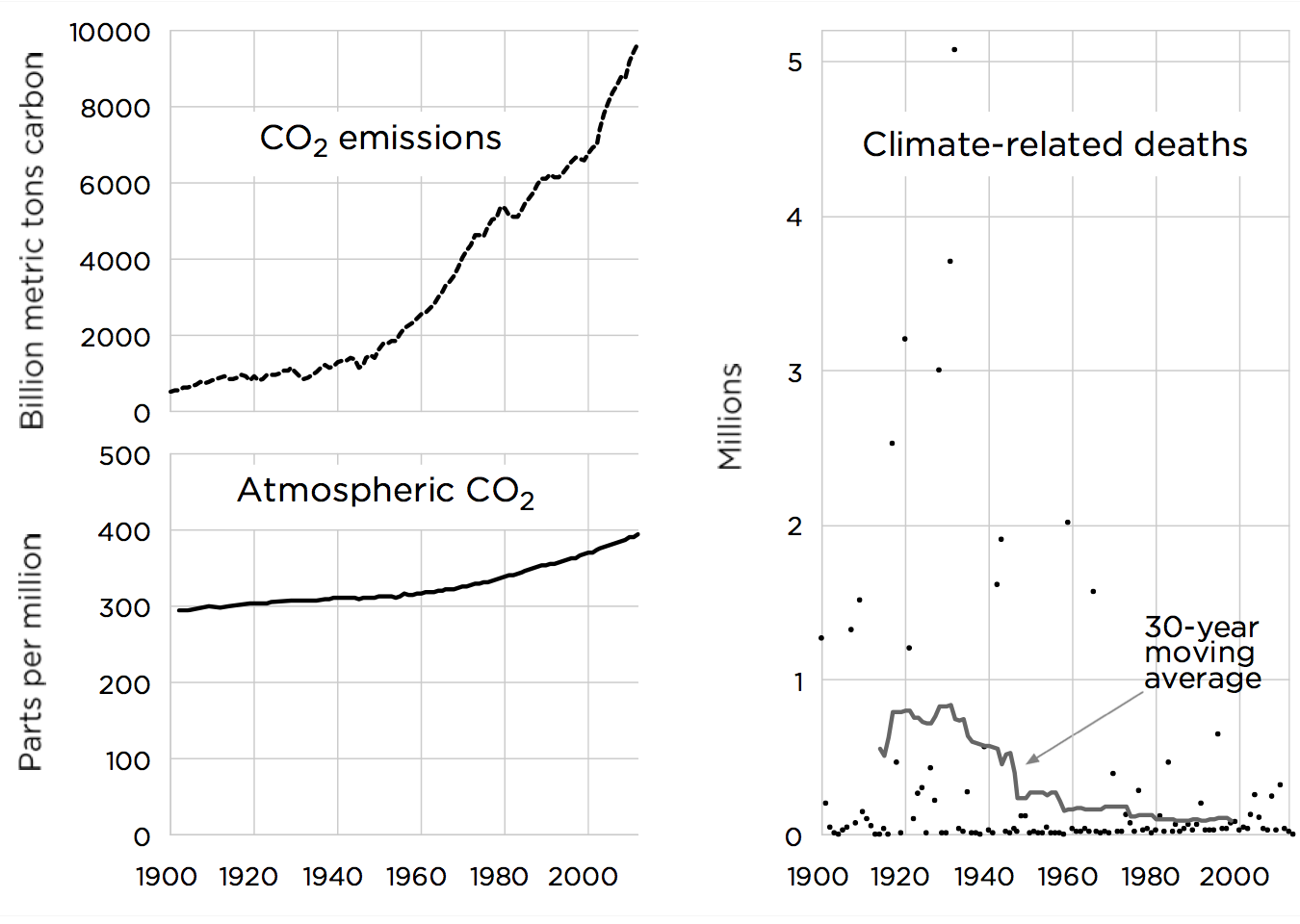
#139But no, I don't deny or ignore the apparent trends. That's why I also don't feel (as others have expressed here) any sense of grave alarmism or fear about the effects of warming. When climate-related deaths have steadily decreased in recent history[1], shouldn't we really be more concerned with adapting (or continuing to adapt) our own environments to deal with the earth's climate? That doesn't mean we shouldn't be environmentally conscious; just the opposite. We should be conscious of our environment, both in terms of what nature provides and in terms of how we adapt to it. Surely, very few people alive today would be suited to living in many populous places in the world without the protections afforded by human invention - today or pre-industrialization. Technological progress (much of which is a product of fossil fuels) has enabled us to live significantly longer lives, and fewer people are in climate-related danger now than ever before in history. In my view, that's a good thing.
[1] http://www.cato.org/sites/cato.org/files/wp-content/uploads/...
Re: Antarctic CO2 Hit 400 PPM for First Time in 4M Years
#140Forgive my ignorance on this issue but Earth has various feedback mechanisms that forestalls CO2: getting absorbed back into rocks and consumption by flora. Is comparing CO2 levels to 4 mya disingenuous because that is just one variable we are isolating? Are we sure that rising CO2 is producing these effects attributed to climate change and not some complicated combination of factors that is evidenced by Earth histor…
So we can either hope that some mysterious feedback mechanism will appear that puts this all right, or we can figure out how to fix this.
And we've actually done this before. In the 1980s, scientists started raising concerns that the ozone layer was being depleted, and an international response reduced our CFC use to levels where we are now seeing the ozone layer recovering. In my cynical moments, I do wonder if the difference between then and now is that the oil lobby is much more powerful than the refrigeration lobby, but actually I think the problem is that reducing CO2 is a much harder problem and so more people just bury their head in the sand.
So you can choose - bury your head in the sand (that's really what dreaming of mysterious negative feedback mechanisms is), or get fixing. I have kids and would hope that their kids have as good a life as I do, so I'm fixing.