Live data from Hacker News

A London Subway Experiment: Please Don’t Walk Up the Escalator

nytimes.com

41–50 of 53 posts

Re: A London Subway Experiment: Please Don’t Walk Up the Escalator

#41

You know, I've lived in London all my life and I've never encountered this "London Subway".

You occasionally see signs around for them (though not so much in town, more often a little further out); where the path takes pedestrians under the road ;-)

Interesting though, because it subtly demonstrates that some NYP sub-ed is strongly convinced of the provincial nature of New Yorkers.

Re: A London Subway Experiment: Please Don’t Walk Up the Escalator

#42
post #14
post #2

As the article points out, letting people walk up should probably be faster. What causes the block is people misbehaving. Blocking the left line because they want to go on the right line. Stopping for directions at the end of the escalator. Blocking the left line with bags or packages. But the solution should be better education, not slowing everyone down. It's like letting people out of a car before getting in. In m…

This has been discussed here before: standing people pack tighter than walking people, therefore all standing ends up with more throughput, at the expense of lower individual latency (for the would-be walkers). But you only need that optimization when escalators are at full utilization. In many cities, escalator discipline is low enough that the walk/stand lane pattern deteriorates when the escalator approaches maxim…

> standing people pack tighter than walking people, therefore all standing ends up with more throughput, at the expense of lower individual latency (for the would-be walkers)

If the would-be walkers derive much greater than average utility from a quick journey, isn't it likely that the all-standing regimen achieves higher average throughput at the expense of lower average utility?

Re: A London Subway Experiment: Please Don’t Walk Up the Escalator

#43
post #37
post #14

Earlier quoted context omitted.

This has been discussed here before: standing people pack tighter than walking people, therefore all standing ends up with more throughput, at the expense of lower individual latency (for the would-be walkers). But you only need that optimization when escalators are at full utilization. In many cities, escalator discipline is low enough that the walk/stand lane pattern deteriorates when the escalator approaches maxim…

London has sufficient loud walkers prepared to yell "Excuse ME!" when blocked.

And not enough of them in my opinion! It is a population where people will endure a lot of things before they lose their courtesy. People eating smelly food, stinking up a whole car. I have even seen some dude getting in a car with a bucket full of fresh fish and no one made any remark. A few angry eyes at most.

Re: A London Subway Experiment: Please Don’t Walk Up the Escalator

#44
At least part of the problem with Holborn is the station's horrific design. Each platform has only one entrance, and if you want to change from the Central to the Picadilly line (which many do) you have to walk directly through a flow of people who queuing for the escalator to exit the station.

This is compounded by the high number of tourists using the station (usually on their way to Covent Garden, or doing the aforementioned change.) For such an important station in London's infrastructure, the actual station design is terrible.

Re: A London Subway Experiment: Please Don’t Walk Up the Escalator

#45
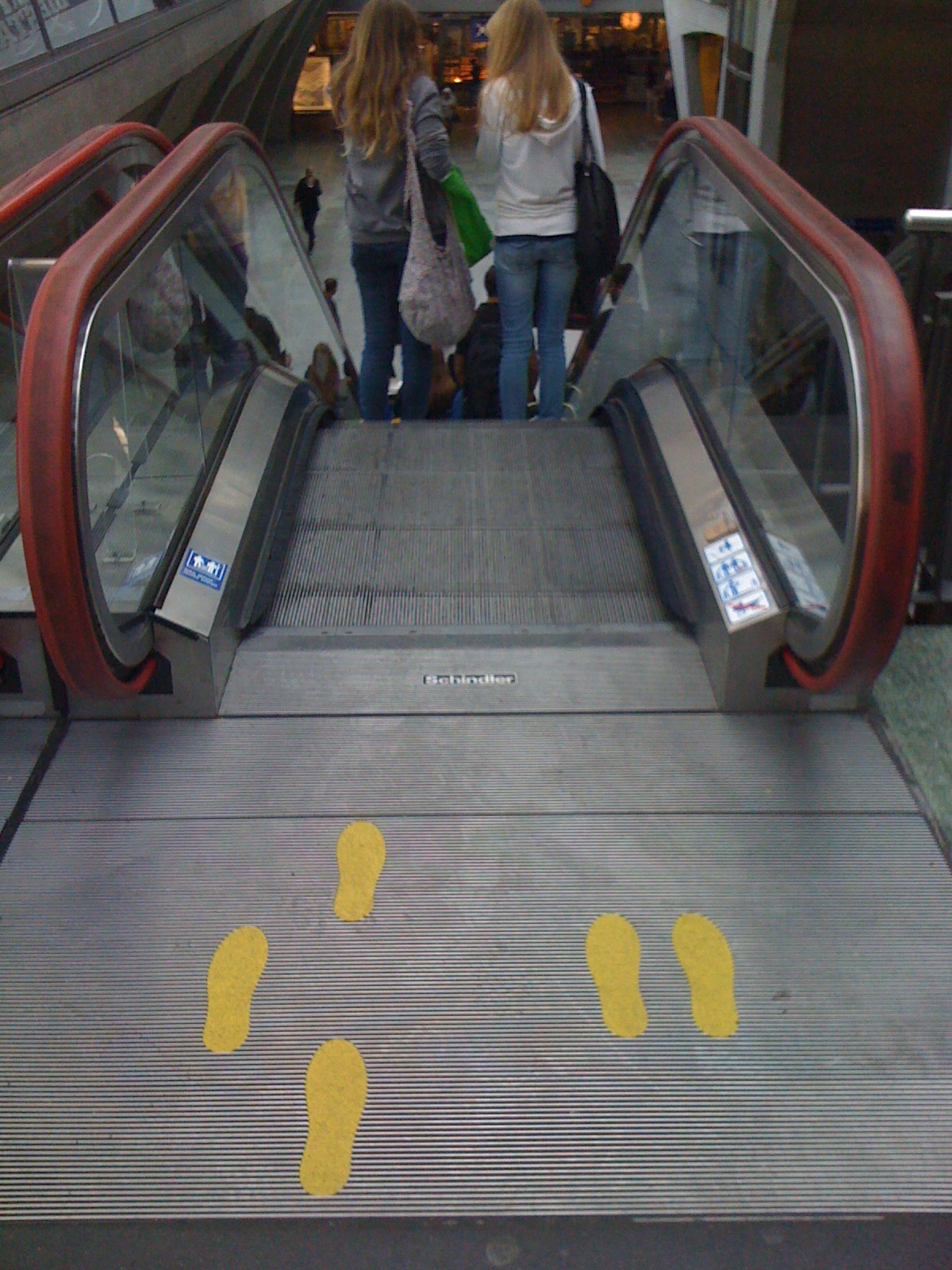
In Switzerland they were and are trying hard to educate people:

http://www.tageswoche.ch/images/cache/3264x2448/fit/images%7...

http://files.newsnetz.ch/story/1/7/5/17591954/35/topelement....

http://www.dicconbewes.com/wp-content/uploads/2011/10/img_05...

http://www.dicconbewes.com/wp-content/uploads/2011/10/Links-...

Officially, the results were mixed. It often happens that someone is just unaware of the situation and blocks the whole escalator. But personally I think that it works really well, moreso during rush hour. I only have a couple of minutes to switch trains and always ask people in a friendly manner to let me pass and they always respond well. I think it's good to raise awareness.

Re: A London Subway Experiment: Please Don’t Walk Up the Escalator

#46
post #29
post #20

I commute to this station every day, at rush hour. There is an 'avatar' (a projection of a person) repeatedly asking people to stand on both sides. Recently she has started becoming more sarcastic, I think they are A/B testing her instructions as there are quite often people counting at the top of the flight. It is very, very difficult standing on the left, it goes against every fibre of my being to do so, but I've m…

It's easier to stand on the left if there's someone in front of you blocking your path. In other words I will will stand on the left if there is other people there too. I will walk up the left until I'm blocked though. (Usually, to tell the truth I am travelling in non peak times with a wheely bag so have to stand anyhow)

Same here. I'll walk on the left whenever I can. And I'll stand on the left whenever I need to.

Re: A London Subway Experiment: Please Don’t Walk Up the Escalator

#47
post #4

I really feel like more effort should be put into tube automation. In Singapore, all the lines are automated. Each platform has those safety double-elevator type doors the trains line up with (The Jubilee line is automated in London and has this same setup at most platforms). This allows Singapore to run a lot more trains. I don't think I ever waited for more than five minutes. Automation is possible in London. The D…

The DLR and Jubilee lines are automated.

The Northern and Central lines were automated within the last few years. The Victoria was automated since it first opened in 1968. Once the sub-surface signaling upgrade is completed, the Circle, District, Hammersmith and City, and Metropolitan lines will also be automated.

Automated in this sense means "driver controls doors and presses button to send train to the next station". When the rolling stock is next refreshed, the cab might be axed and instead it'll follow a similar model to the DLR today - a single person roaming the train checking fares etc and issuing the "close doors/move to next station" command from a panel near each set of doors.

Re: A London Subway Experiment: Please Don’t Walk Up the Escalator

#48
post #4

I really feel like more effort should be put into tube automation. In Singapore, all the lines are automated. Each platform has those safety double-elevator type doors the trains line up with (The Jubilee line is automated in London and has this same setup at most platforms). This allows Singapore to run a lot more trains. I don't think I ever waited for more than five minutes. Automation is possible in London. The D…

5m is an age in London! Most tubes arrive 1.8-3m apart at peak times (meaning average wait times of half that), and even at non-peak times it is rare to wait more than 3m. Unless on an outer branch of a line that must share its service between multiple such branches outside of the central metro area.

Most lines are having automated operation rolled out to them gradually as well; they just retain a driver to keep everyone happy. The busiest lines already are: Victoria, Jubilee, Central and Northern. The latter two were retrofits.

Notably, the Victoria line has no such doors, and currently runs more trains per hour than the Jubilee line, although this is slated to change, though it won't lead by much after the upgrade.

Re: A London Subway Experiment: Please Don’t Walk Up the Escalator

#49
post #4

I really feel like more effort should be put into tube automation. In Singapore, all the lines are automated. Each platform has those safety double-elevator type doors the trains line up with (The Jubilee line is automated in London and has this same setup at most platforms). This allows Singapore to run a lot more trains. I don't think I ever waited for more than five minutes. Automation is possible in London. The D…

There are two problems with this. (1) Unions. (The tube driver's union is able to stop London and they are not afraid to do so.) (2) It's not actually very easy to do for several of London's tube stations. Several of the tube stations have curved platforms making it rather harder to install the safety double elevator doors.

(1) Blame union for every next suicide.

(2) Skip automation on these stations.

Re: A London Subway Experiment: Please Don’t Walk Up the Escalator

#50
post #27
post #20

I commute to this station every day, at rush hour. There is an 'avatar' (a projection of a person) repeatedly asking people to stand on both sides. Recently she has started becoming more sarcastic, I think they are A/B testing her instructions as there are quite often people counting at the top of the flight. It is very, very difficult standing on the left, it goes against every fibre of my being to do so, but I've m…

I, for one, am going to ask you to step aside if I need to get up the escalator, and damn the glass avatar. Your instincts are correct.

There's still the leftmost escalator for you.

(I read about this before, and thought: why don't they still allow walking on the leftmost escalator? Seems they indeed do, according to TFA.)

Post reply on HN