I ran into an idiom last month. Something like food computing. A trendy name for everything about home automation regarding growing vegetables. Anybody can confirm ?
Autonomous Plant Watering
41–50 of 51 posts
Re: Autonomous Plant Watering
#42So we have computers watering plants, and maybe feeding animals etc.
And that kind of makes me think we are implementing some sort of new, unnatural ecosystem where energy is expended by robots. But will it be self sufficient and sustainable?
Re: Autonomous Plant Watering
#43The Wifi outlet seems like mega overkill to run a schedule. Couldn't you just use one of these? https://www.google.co.uk/search?q=socket+timer+us&safe=off&b...
From TFA: "A Word on WiFi Sockets: They suck. They take the simplest operation of closing a circuit and abstract it in a shitty smartphone app that only works half the time." Short interval timers are a bit harder to come by, as several others have mentioned, but they do exist and aren't very expensive. E.g. this one can go as short as one minute per week: http://plumbdeal.com/product_info.php/grasslin-digital-plugi.…
This one appears to be able to do seconds http://smile.amazon.com/Digital-Programmable-Socket-Energy-S...
Re: Autonomous Plant Watering
#44In the real world we call this rain
Re: Autonomous Plant Watering
#45Or just use a $2 Arduino clone, a 12V pump and a 50¢ TTL MOSFET.. And you'll even be able to add soil moisture sensors to compensate for external factors like air temperature/humidity
That's exactly the point, he got a reliable system with off the shelf components that is more reliable than your proposed solution (no water = burned pump, can mix anythig in the water, etc)
Re: Autonomous Plant Watering
#46I built my own little system yesterday that use no electricity. An upsidedown 2L bottle sits above a reservoir and if the water gets too low it glubs out some more water. Air gets in, water comes out, now more air can't get in because the reservoir water is too high. A set of aquarium tubes keeps the water level even between the reservoir and each plant. The plants are all in double planters, with water in the bottom…
Plants will die without air to the soil/roots. Many plants require wet/dry cycles. You should start seeing fungus gnats in a week or so.
Hrm. Interesting.
I based this system off a large number of videos showing the double-bucket wicking system. Folks in those said they had lots of success using them. Does that only affect certain plant types?
Edit: some material I found suggests that because the surface soil stays dry, the fungus gnats have a hard time getting into the roots, propagating.
http://www.insideurbangreen.org/2010/07/subirrigated-planter...
Re: Autonomous Plant Watering
#47Earlier quoted context omitted.
Also called "raised-bed gardening"? At least it looks like the same or very similar concept.
Traditional raised bed gardens don't hold water well and require artificial watering almost every day due to how they drain - At least in my experience. Hugels hold water and slowly allow plants to wick the moisture when it is needed. They really start working well at year 2-3.
> Traditional raised bed gardens don't hold water well
You should probably dig (loose a little the soil) the base of the raised bed garden before build it, or maybe to choose better your species list to fit your climate.
Re: Autonomous Plant Watering
#48Earlier quoted context omitted.
I wonder if you could chain two timers, picking their periods and durations appropriately to get a much longer combined period with the correct duration.
Well, you could use 2 timers with the same period, if they are accurate. You would plug in timer 1, so that its output (output 1) is on. You would set timer 2 so that output 2 would turn on as soon as timer 2 receives power. When there are only 30 seconds left in timer 1's on cycle, you would plug timer 2 into a separate outlet. Since they are synced, but only overlap by 30 seconds, they will only both be on for 30 s…
Plugging one into the other would provide an AND.
Re: Autonomous Plant Watering
#49Earlier quoted context omitted.
Well, you could use 2 timers with the same period, if they are accurate. You would plug in timer 1, so that its output (output 1) is on. You would set timer 2 so that output 2 would turn on as soon as timer 2 receives power. When there are only 30 seconds left in timer 1's on cycle, you would plug timer 2 into a separate outlet. Since they are synced, but only overlap by 30 seconds, they will only both be on for 30 s…
Plugging one into the other would provide an AND.
The second in series would not be powered continuously, so it would only work for the first cycle.
You'd need to separate the timer power from the switched power. Easy to do, but not how the cheap ones work.
Also, the settings are not precise enough to get a repeatable interval across two devices.
On the other hand, it's a very simple DIY electronics project. Arduino is extreme overkill, but will also work.
Re: Autonomous Plant Watering
#50Earlier quoted context omitted.
Plants will die without air to the soil/roots. Many plants require wet/dry cycles. You should start seeing fungus gnats in a week or so.
Hrm. Interesting. I based this system off a large number of videos showing the double-bucket wicking system. Folks in those said they had lots of success using them. Does that only affect certain plant types? Edit: some material I found suggests that because the surface soil stays dry, the fungus gnats have a hard time getting into the roots, propagating. http://www.insideurbangreen.org/2010/07/subirrigated-planter..…
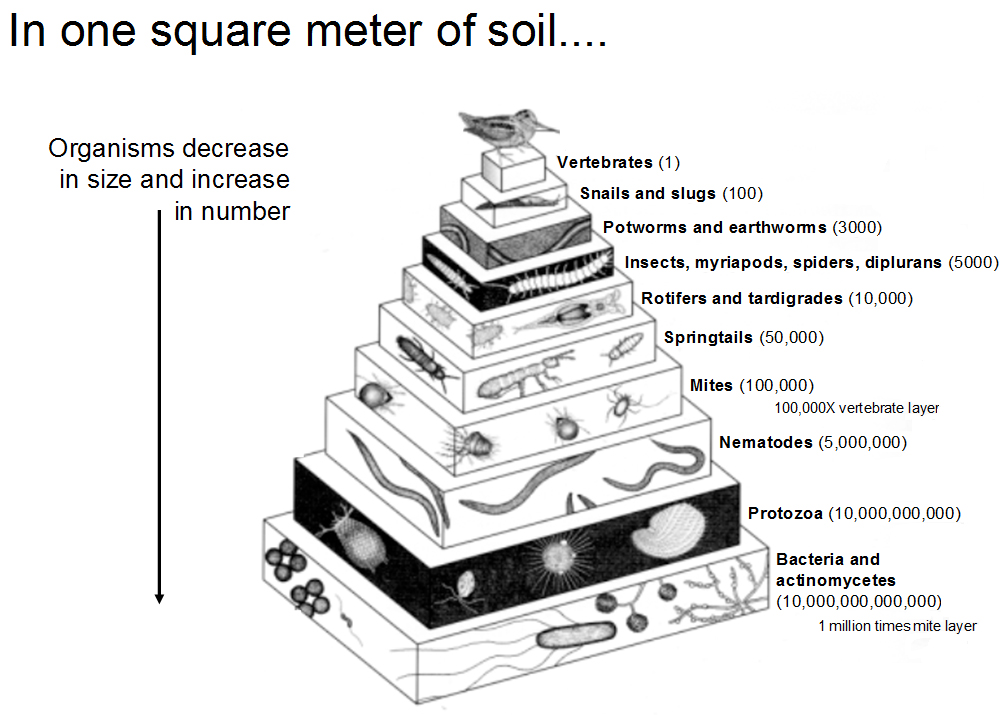
As the plant kingdom is diverse, there is no yes/no. Though you can say this is a general problem in common soil. You can imagine jungle/pond plants are more tolerant of wetness, but not of the possible pests... The ecosystem of any given soil is quite complex [0]; the environment, symbiotics, pests and predators keep things in balance.
0 http://www.osoils.com/wp-content/uploads/compost-tea-41.jpg