Earlier quoted context omitted.
Google has always been strategic about announcing what it was doing, even since the early days (I used to work there too). Think about the impact the first MapReduce and GFS/BigTable papers had. My guess as to why they're announcing the TPU is that they are feeling the pressure from Facebook and other AI labs, and want to reinforce their reputation as being the best place to do AI research. By revealing that AlphaGo…
It really boosts Google Cloud Platform with image and prestige, they're coming out with what is pretty much tensorflow as a service with their machine learning product. Coming out saying they can give you a service no one else can right down to a custom chip may sway a few buyers in the market. https://cloud.google.com/ml/
Google supercharges machine learning tasks with TPU custom chip
141–150 of 283 posts
Re: Google supercharges machine learning tasks with TPU custom chip
#142Earlier quoted context omitted.
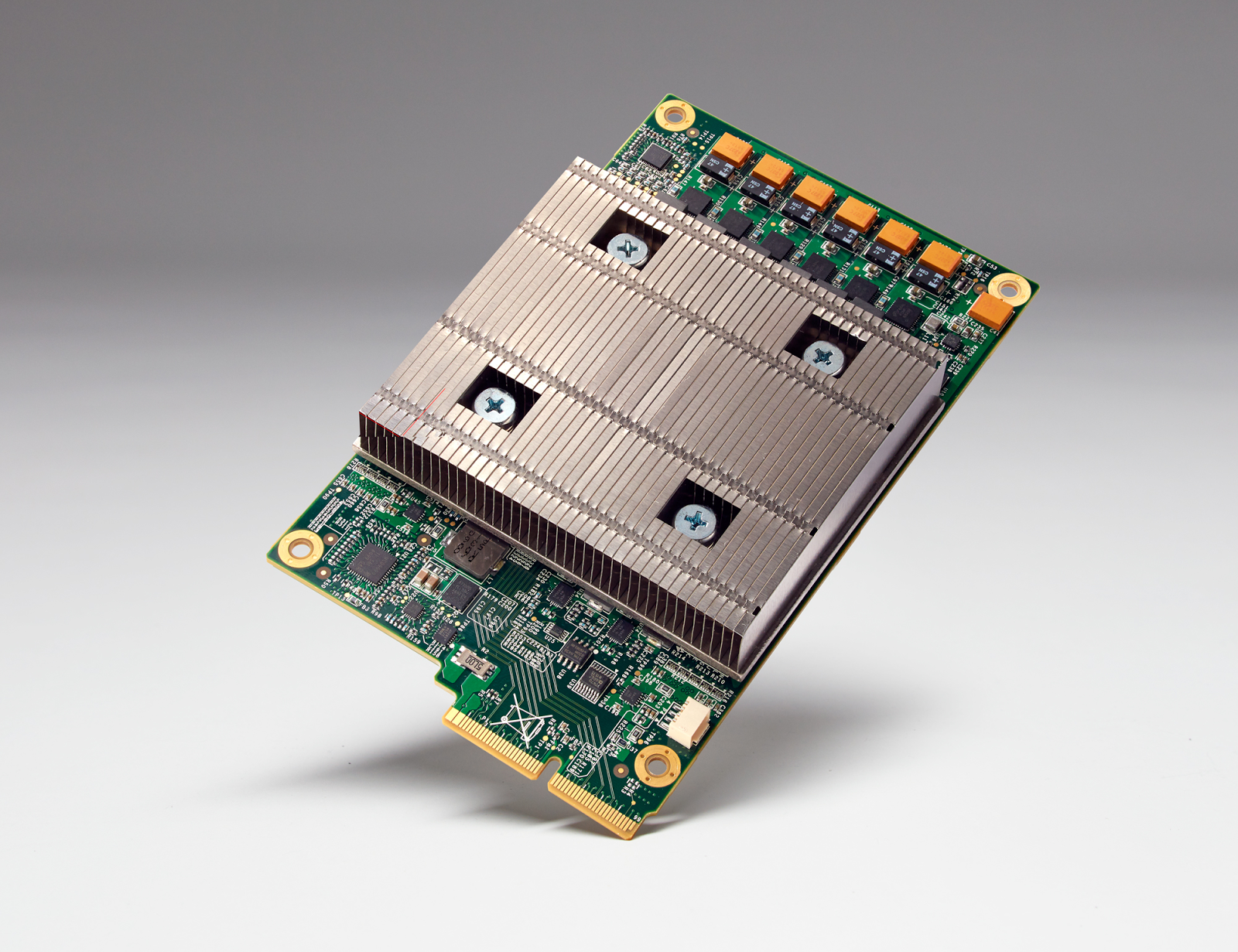
From the article: "TPU is tailored to machine learning applications, allowing the chip to be more tolerant of reduced computational precision, which means it requires fewer transistors per operation."
Do you reckon that means it's using small floats?
In addition, there's a lot of literature on optimizing hardware implementations of fundamental arithmetic operations like addition and multiplication. I recall seeing a paper a while ago which talked about reducing the number of gates by allowing some bounded imprecision in the results - unfortunately, I don't remember the title right now, but it sounds like that's what they may be doing.
Re: Google supercharges machine learning tasks with TPU custom chip
#143http://www.thetalkingmachines.com/blog/2016/5/5/sparse-codin...
I wonder how general the gains from these ASIC's are and whether the performance/power efficiency wins will keep up with the pace of software/algorithm-du-jour advancements.
Re: Google supercharges machine learning tasks with TPU custom chip
#144https://2.bp.blogspot.com/-z1ynWkQlBc8/VzzPToH362I/AAAAAAAAC...
They probably didn't mean to use this version of the image for their blog - but I wonder what they were trying to indicate/measure there.
Re: Google supercharges machine learning tasks with TPU custom chip
#145I'm happy to hear that this is finally public so I can actually talk about the work I did when I was at Google :-). I'm a bit surprised they announced this, though. When I was there, there was this pervasive attitude that if "we" had some kind of advantage over the outside world, we shouldn't talk about it lest other people get the same idea. To be clear, I think that's pretty bad for the world and I really wished th…
Re: Google supercharges machine learning tasks with TPU custom chip
#146I'm guessing that the performance / watt claims are heavily predicated on relatively low throughput, kind of similar to ARM vs Intel CPUs - particularly because they're only powering it & supplying bandwidth via what looks like a 1X PCIE slot. IOW, taking their claims at face value, a Nvidia card or Xeon Phi would be expected to smoke one of these, although you might be able to run N of these in the same power envelo…
Re: Google supercharges machine learning tasks with TPU custom chip
#147What is the capabilities that a piece of hardware like this needs to have to be suitable for machine learning (and not just one specific machine learning problem)?
AFAIK 16-bit "half-precision" floating point.
Re: Google supercharges machine learning tasks with TPU custom chip
#148I'm happy to hear that this is finally public so I can actually talk about the work I did when I was at Google :-). I'm a bit surprised they announced this, though. When I was there, there was this pervasive attitude that if "we" had some kind of advantage over the outside world, we shouldn't talk about it lest other people get the same idea. To be clear, I think that's pretty bad for the world and I really wished th…
OK, so what is it? The announcement neither says what a TPU actually is nor what it can do. It's a magic black box. No specs. No price.
It's a "more details to follow" type of thing. Pretty standard actually.
Re: Google supercharges machine learning tasks with TPU custom chip
#149Perf/W, the official metric of slow but efficient processors. How many times must we go down this road? Let's see this sucker train AlexNet...
Google's always been cautious about the balance of speed and efficiency, out of concerns about programmer productivity, parallelization, and generality. See, for example, Urs's article in response to my and a few other people's crazy-academic research on using "Wimpy" nodes: http://static.googleusercontent.com/media/research.google.co... - vs http://www.cs.cmu.edu/~fawnproj/
There's a big difference between just cranking down the GHz and going for ASIC specialization. GPUs, for example, already represent a point on this spectrum -- it's true that they run at reduced GHz compared to high-end CPUs, but they're arithmetic monsters. The blog post notes, in fact, that the use of TPUs in AlphaGo let them do more searching. So why would you assume automatically that they're slow?
Re: Google supercharges machine learning tasks with TPU custom chip
#150Microsoft explored something similar to accelerate search with FPGAs [2]. The results show that the Arria 10 (20nm latest from Altera) had about 1/4th the processing ability at 10% of the power usage of the Nvidia Tesla K40 (25w vs 235w). Nvidia Pascal has something like 2/3x the performance with a similar power profile. That really bridges the gap for performance/watt. All of that also doesn't take into account the ease of working with CUDA versus the complicated development, toolchains, and cost of FPGAs.
However, the ~50x+ efficiency increase of an ASIC though could be worthwhile in the long run. The only problem I see is that there might be limitations on model size because of the limited embedded memory of the ASIC.
Does anyone have more information or a whitepaper? I wonder if they are using eAsic.
[1]: http://ieeexplore.ieee.org/xpl/login.jsp?tp=&arnumber=701142...
[2]: http://research.microsoft.com/pubs/240715/CNN%20Whitepaper.p...