Curious, because I'm not a mathematician: is it typical to say "proof" something versus "prove" something? I noticed you used that twice now. My brain keeps autocorrecting it, but I'm ignorant and would love to update my rules if needed. :)
No. I make that typo all the time though. It's just that due to my accent I do not differentiate between "prove" and "proof" and always voice the words as "proof" so I always write "proof".
Oh, okay. My bad. Thought that's how mathematics may have preferred to talk.
Without even looking I guarantee that the Periodic Table of Finite Simple Groups is garbage --- there's no way that the space of finite simple groups have the same structure as the space of atoms.
Without even looking I guarantee that the Periodic Table of Finite Simple Groups is garbage --- there's no way that the space of finite simple groups have the same structure as the space of atoms.
Without even looking I guarantee that the Periodic Table of Finite Simple Groups is garbage --- there's no way that the space of finite simple groups have the same structure as the space of atoms.
Yeh, I know, the idea that mathematics could in any way model reality is garbage.
A pet peeve of mine is when mathematics itself is described as a language, instead of distinguishing mathematics from mathematical language. It's like saying Neuromancer is just a language, that Neuromancer is just English.
There is content in mathematics that is independent of the language used to express it. Mathematical notation is also incidental. It is not mathematics itself.
Doesn't surprise me. I spent my youth thinking math was impenetrable, and only when I started programming later in life I realized that mathematicians shouldn't be naming things.
Doesn't surprise me. I spent my youth thinking math was impenetrable, and only when I started programming later in life I realized that mathematicians shouldn't be naming things.
Mathematics is a lot more rigorous than programming. But considering I'm learning Group and Ring Theory with the 1999 textbook 'Learning Abstract Algebra with Mathematica [Library]' I don't exactly disagree. Working with abstract structures in a more concrete way is a crystal-shattering way to intuit them -- I don't know if it will be an ultimate downfall though yet. As a programmer it just seemed natural to me to be able to manipulate these structures as if they are instances of an abstraction -- of a type. If it peels out for me, I will have a unique perspective among mathematicians. I just see a large sect between those who appreciate the abstractions, and those who bastardize them for utility. I didn't have love and enigmatic affinity for mathematics until I realized that even up to Calc II, the number-crunching utilitarian bastardization of mathematics was conveyed and taught to me -- not the beauty or philosophy of mathematical approach and thinking. Unfortunately, when only results and empirical justifications fill a programmers' mind, the beauty is lost. I feel there is definitely a more mastered perspective by being both a programmer and an inspired mathematician that is lost by being in exclusively one camp or the other. Until education reform is had, this unique perspective will just be for those who incidentally stroll down the path.
A pet peeve of mine is when mathematics itself is described as a language, instead of distinguishing mathematics from mathematical language. It's like saying Neuromancer is just a language, that Neuromancer is just English. There is content in mathematics that is independent of the language used to express it. Mathematical notation is also incidental. It is not mathematics itself.
It might be incidental but the history of mathematics is rich with dissent and conflicting methodologies and syntaxes. Just even the initial mathematical symbols that started to be used were quite the ambitious effort by Peano. [1] That reading will take you down the wormhole of efforts for a "universal language" between mathematicians based on latin. And then you'll end up reading about 20 different other takes on the ideas. No, it's not just incidental -- there were international congresses of mathematicians about these issues and the adopted solutions were mostly elegant and looked upon favorably. There are always going to be some dissenters though, and they have some validity - but well, conventions are usually a compromise between effectiveness and majority opinion. There is still huge rift in mathematics on the issue of constructive proofs vs intuitionistic proofs. There are a lot of camps in formal mathematics. Kinda like functional programmers and the constant "tripes" they'll knack on. Whimsical stuff :-)
Without even looking I guarantee that the Periodic Table of Finite Simple Groups is garbage --- there's no way that the space of finite simple groups have the same structure as the space of atoms.
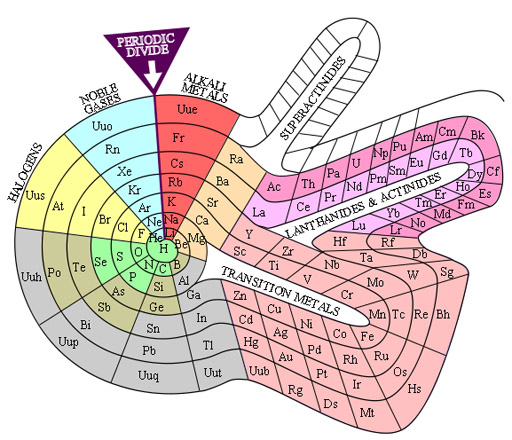
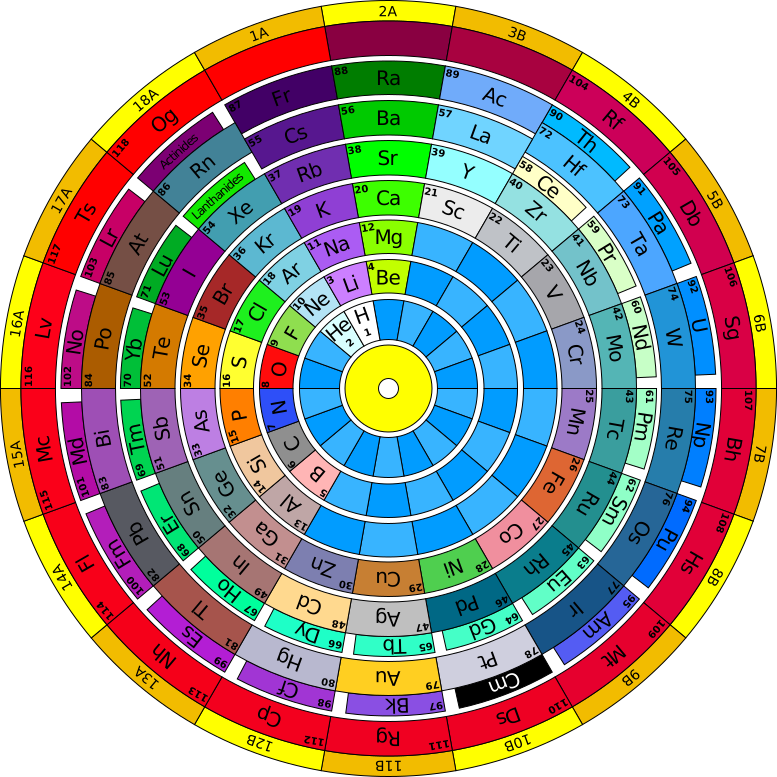
A little silly to speak with such overconfidence considering the only similarity is the "table" paradigm. The actual periodic table is poor for its use anyways, and there have been valid criticisms that call for a more abstract grouping, like a spiral/ring table [1] [2]
But in any case, the properties of numbers are intrinsic to the relationship between space and time - the ability to store a number physically [in memory] and then act on it at a later time. You can try to claim that physics transcends mathematics -- but I would argue that the properties of numbers, and hence algebras, are more fundamental than even physical field theories are.
This will probably sound wacky but here's what I think: There are two steps to conveying a thought in a language: 1. recall the grammar rules and vocabulary 2. form the sentence The steps are fundamentally different in that the first one is an exercise in recollection whereas the second one is a "creative" process of some sort. To prove a mathematical fact you go through the same two steps: 1. you recall all the past…
Have you ever listened to humans talk? Most sentences are improper, they're riddled with disfluencies, and usually they don't even finish what they're saying.
Ever read a math paper /s
Seriously though, most of the papers I've read require significant interpretation, filling in gaps and dealing with ambiguous terminology or use of symbols.