Persian will have three dots in a triangle above a single upward stroke or below the line. Arabic only has the three dot combo above the script on a multiple upward stroke grouping (sometimes a flat line between upstrokes).
Identify Any Language Written in the Roman Alphabet at a Glance
31–40 of 95 posts
Re: Identify Any Language Written in the Roman Alphabet at a Glance
#32Additional bonus: Korean uses lots of basic angles, squares, and lines and many Hangul have "three parts" eg. 한국어의 It's a beautifully simple writing system. You can go quite a long comment chain in Japanese without seeing の. I always tell people "look for lots of simple characters that can be written with only 2 or 3 lines mixed in between a bunch of really complex characters". 来週は学校に行きません For those who don't know Ja…
Another quirk about the の thing is that some Chinese-speaking people, in Taiwan at least (not sure about the mainland) use の as a colloquial replacement for 的, presumably due to Japanese cultural influence. So it's not completely impossible to see の in a Chinese-language text. (They still pronounce it "de", only the writing is different.)
Friendlier link: https://en.wikipedia.org/wiki/Martian_language
Re: Identify Any Language Written in the Roman Alphabet at a Glance
#33Earlier quoted context omitted.
On a meta level I find that just a little troubling. It sounds to me like "Crap, I agreed with this until I noticed it was an opinion from a tribe I don't identify with - so I can't agree with it". Maybe theweek.com is some uniquely evil thing I haven't heard about?
"Upvote" means something different than "agree"; one of the things it means is "I endorse people visiting this". I can imagine quite a few sources that I wouldn't want to direct traffic to even if they published something where I agree with the sentiment.
But what's wrong with theweek?
Re: Identify Any Language Written in the Roman Alphabet at a Glance
#34Earlier quoted context omitted.
What problem do you have with it?
来週は学校に行きません roughly translates as "Next week, I won't go for school." The correct usage is 来週は学校*へ*行きません "Next week, I won't go to school."
Hi, I'm a gainfully employed translator of Japanese and linguist.
Short answer: the sentence is fine as it stands, although your alternative is equally grammatical (if less idiomatic - "学校へ行かない" gets about 1/4 of the ghits of "学校に行かない" by my count, and personally I'd never use へ).
Long answer: Japanese draws a distinction between verbs of A→B movement (e.g. 行く to go; 引っ越す to move house; 移動する to move/change location) and verbs that describe the manner of motion (e.g. 歩く to walk; 走る to run). The A→B verbs can happily take an indirect object complement (a に phrase) as the destination, because there's really no other possible meaning. You can't "go for school", as you put it.
Verbs of motion, on the other hand, are less flexible. These can't take an indirect object complement, and need a more expressly destinatory case (think へ、へと、まで). The reason for this is that a change of location is not implied in the verb, however counterintuitive that might seem to an English speaker.
Interestingly, motion verbs can take a direct object (を), such as in 街を歩く 'to walk around town'. Another indication that they're not strictly destinatory. Also they can take adverbs that further qualify motion, such as ぽつぽつ歩く 'to dawdle/mosey/toddle'(? tough to translate), whereas 行く can't. A→B verbs can however take adverbs that qualify the speed, like ゆっくり行く 'to go unhurriedly' - but this is different from ゆっくり歩く 'to walk in a slow manner'.
This is my first ever comment on HN so I've tried to be as informative as possible... If you have any counterexamples I'd be happy to try to explain them.
Re: Identify Any Language Written in the Roman Alphabet at a Glance
#35Earlier quoted context omitted.
What problem do you have with it?
It's nonsensical and an actual error for one. ;) If you search for "来週は学校に行きません" on Google this thread is the only result.
The reason for this is contextual (internet posts), not grammatical. You'll get more results if you remove the polite ending and/or the topic particle (try "来週学校に行かない").
Re: Identify Any Language Written in the Roman Alphabet at a Glance
#36Correction to the article: There is no Ů in Czech (except for CAPS LOCKED words) - The longer "u" is written as "Ú/ú" as the first letter in a word, and "ů" in other positions (strange for sure, but because of historical reasons)
The article is correct, though: if you see Ů, it's Czech.
Re: Identify Any Language Written in the Roman Alphabet at a Glance
#37Only tangentially related, but why can't spelling check software automatically figure out which language I'm typing in? I write mostly in English but sometimes I write in French or in a mix of both languages and I usually struggle with the spelling corrector which keeps bothering me.
SwiftKey (Android keyboard) does an amazing job of this. I routinely switch between French and English, and usually by the end of the first word in the other language my autocorrect and suggestions are both in the right language.
Re: Identify Any Language Written in the Roman Alphabet at a Glance
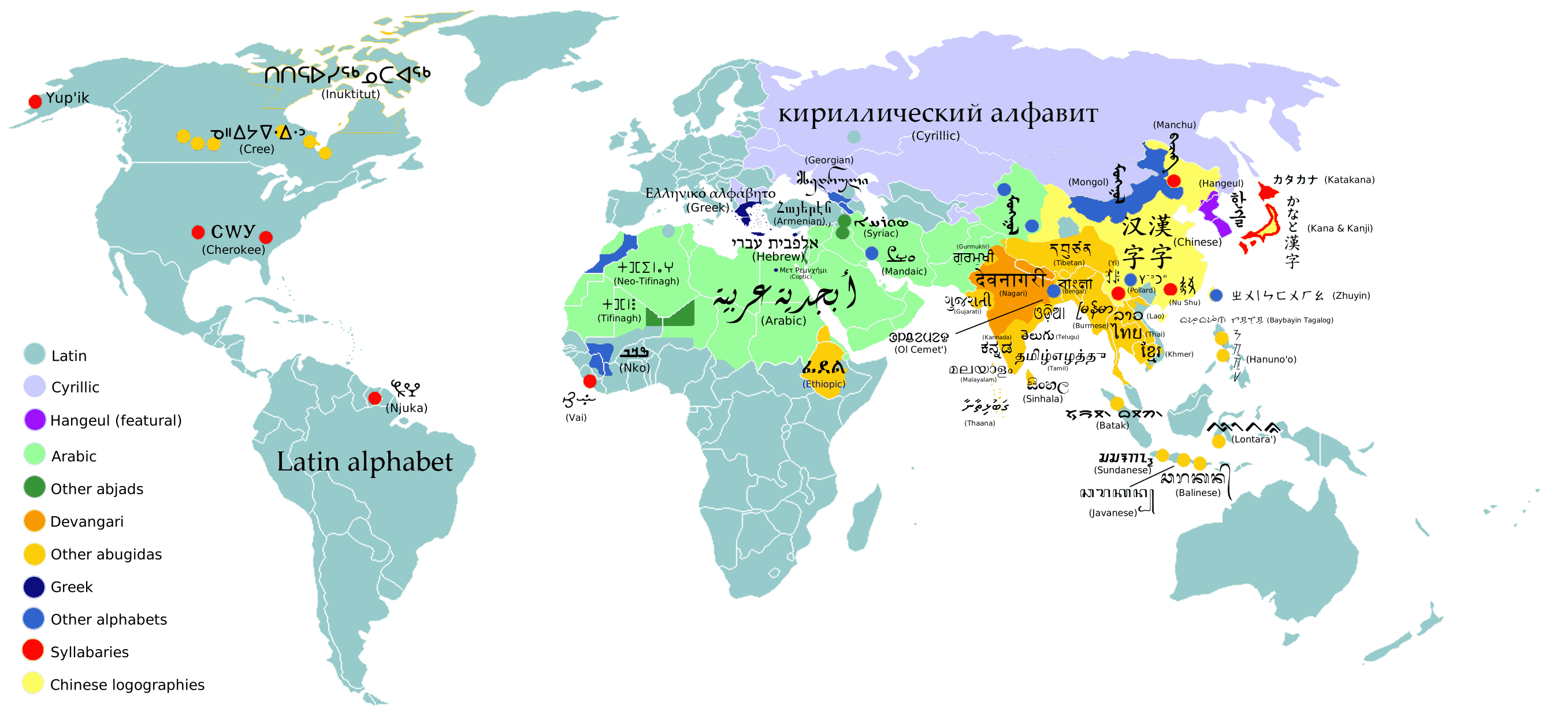
#38This reminds me of this fine map, "List of writing systems"
https://upload.wikimedia.org/wikipedia/commons/a/aa/World_al...
Re: Identify Any Language Written in the Roman Alphabet at a Glance
#39Earlier quoted context omitted.
What problem do you have with it?
It's nonsensical and an actual error for one. ;) If you search for "来週は学校に行きません" on Google this thread is the only result.
Actually, since not wanting to go to school is a common sentiment, it can end up simplified into something with no particles at all:
https://twitter.com/k_y02240/status/613690896916201472
I hope you don't find it nonsensical, though, I understood it just fine.
And checking ghits for plain forms shows:
"学校に行く" - 3,680,000
"学校へ行く" - 444,000
so I think the other way is actually the variant!
BTW, I feel like "学校に行く" - where に means "for/into" - has a sense of "going to school to go to class", but "学校へ行く" - where へ means "towards" - has a sense of "going to the school building as a physical place".
Here's a forum thread about it:
Re: Identify Any Language Written in the Roman Alphabet at a Glance
#40Earlier quoted context omitted.
来週は学校に行きません roughly translates as "Next week, I won't go for school." The correct usage is 来週は学校*へ*行きません "Next week, I won't go to school."
Hi, I'm a gainfully employed translator of Japanese and linguist. Short answer: the sentence is fine as it stands, although your alternative is equally grammatical (if less idiomatic - "学校へ行かない" gets about 1/4 of the ghits of "学校に行かない" by my count, and personally I'd never use へ). Long answer: Japanese draws a distinction between verbs of A→B movement (e.g. 行く to go; 引っ越す to move house; 移動する to move/change location)…
Japanese N1 and JETRO biz japanese here.
Yeah sure, in vernacular construct, which explains more Google results.