Live data from Hacker News

The Idiocy of Hacker Keyboards (2010)

xahlee.info

41–50 of 55 posts

Re: The Idiocy of Hacker Keyboards (2010)

#41
post #16

Is the "double click" the sound of the keycap hitting the keyboard, or is it coming from the switch itself?

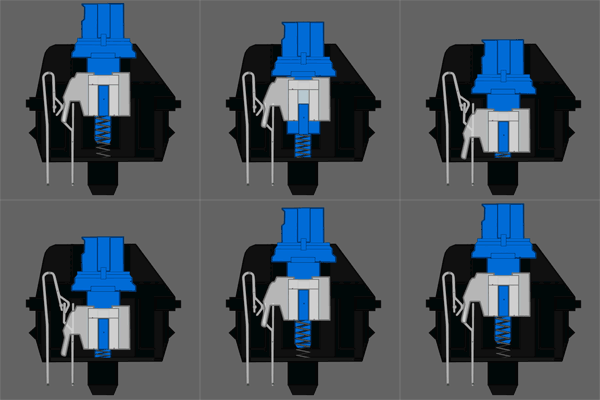
Based on my experience with blues, "double click" with blues is both of those. The click from the switch, and then bottoming out a few 10ths of a second later.

There's no need to bottom out with mechanical switches, but most people do out of habit with cheaper rubber dome switches.

Re: The Idiocy of Hacker Keyboards (2010)

#42
post #8

Is there any purpose to this article besides complaining about the keyboard preferences of other people? Some people like the way certain things look or feel, and they pay money for it. I agree that having a "hacker keyboard" probably won't make you a better programmer, but then people pay thousands of dollars for top-end laptops when they could probably do just as well with lower-end ones.

> Is there any purpose to this article besides complaining about the keyboard preferences of other people?

Making money from affiliate links? Trolling the internet at large? Based on previous interactions with Xah Lee on usenet, I'd say both are quite possible.

Re: The Idiocy of Hacker Keyboards (2010)

#43

Earlier quoted context omitted.

> the mushy feel of rubber dome switches. Yes. I find rubber dome keybaords much more tiring. It's not really clear when the key activates; I wind up essentially mashing the keys. I pretty much refuse to use them. Scissor key (laptop style) keyboards are a great compromise for me: cheap and precise. Almost as good as mechanical keys for me. Mechanical keyboards are best for me, but not always practical due to noise a…

Is there any downside to using o-rings? How come no keyboards seem to ship with them by default? I just ordered an MX Brown keyboard, wondering if I should buy o-rings.

None whatsoever in my opinion.

The people who dislike them seem to really enjoy slamming their keys down all the way; they say O-rings makes the keyboard "mushy."

I'm not going to say anybody's using their keyboard incorrectly; it's all personal preference. But imho they're missing the entire intended purpose of mech keyboards; they offer tactile/aural feedback when the key activates so you don't have to slam the damn key all the way down.

Again, if anybody disagrees, you're not wrong... type however you like. :)

> How come no keyboards seem to ship with them by default?

Good question. I know some manufacturers like WASD let you order them preinstalled as an option.

Answer is probably because it wouldn't be profitable. They're pretty time-consuming to put on, honestly. I've done it to two keyboards and it took me a half hour or so. No big deal really, I just did it while I was watching TV or something.
Re: The Idiocy of Hacker Keyboards (2010)

#44

Earlier quoted context omitted.

Is there any downside to using o-rings? How come no keyboards seem to ship with them by default? I just ordered an MX Brown keyboard, wondering if I should buy o-rings.

I have only one downside: if you use your keyboard to play games, it feels weird to hold keys like shift down if you have an o-ring on them, because it compresses slightly. I found my hands getting fatigued after a while of running this way, and have since removed all the rings.

This hasn't been my personal experience; I don't find they really compress much.

That's not to say you're wrong or anything. Everybody's hands and preferences are different of course!

Just out of curiosity, which o-rings are you using? Here are the ones I'm using: http://www.amazon.com/Cherry-Rubber-Ring-Switch-Dampeners/dp...

Re: The Idiocy of Hacker Keyboards (2010)

#45
post #38

Earlier quoted context omitted.

As far as I know, sound is actually so slow that you don't need to average the noise and make an educated guess as to what to filter. Acoustic noise filtering in headphones should work by detecting the outside noise with a microphone and playing the cancelling wave form as soon as the sound wave reaches the interior of your headphone. In contrast, you can't do that for the noise of a car on the road because here the…

Considering the fact that it takes about 60 microseconds for sound to travel about 2cm, you only have about 900 cycles (assuming the same clock speed as an Arduino: 16MHz) to process the input sound, do a fast Fourier transform of the noise, and output the cancellation wave. I severely doubt that it can be implemented to be that fast. And not to mention that spikes in sound aren't nicely dealt with in Fourier transfo…

I doubt that there are analog-digital, digital-analog converters and an FFT module in there. I would have assumed that there's only some analog circuit. You don't even need spectral analysis. It just needs to invert the amplitude and delay the output for those 60 microseconds, right? This would also make the problems of spikes and Fourier transforms go away.

Re: The Idiocy of Hacker Keyboards (2010)

#46
post #28

I am thinking of buying (somehow. because these things doesn't exist in my country, and I am thinking I will have to build it from scratch) a MX Brown keyboard... Anyone here know if their clicking is less obnoxious, or if they click at all? I do want the tactile feedback, when you feel the key giving away and can release it immediately, but I don't want to annoy other people (myself I don't get bothered by the noise…

I've been using an MX brown keyboard for over 3 years now, and switched from MX blues. As another poster said, MX browns do not have that extra click [0] but go straight down. Now while they don't have that extra click, they are still much louder than your average keyboard. If you really try, you can type kind of quietly if you don't bottom out on your keys too hard, but make no mistake, when you're furiously typing away you'll be heard.

[0]-http://www.keyboardco.com/blog/wp-content/uploads/2012/10/Bl...

Re: The Idiocy of Hacker Keyboards (2010)

#48
post #38

Earlier quoted context omitted.

Considering the fact that it takes about 60 microseconds for sound to travel about 2cm, you only have about 900 cycles (assuming the same clock speed as an Arduino: 16MHz) to process the input sound, do a fast Fourier transform of the noise, and output the cancellation wave. I severely doubt that it can be implemented to be that fast. And not to mention that spikes in sound aren't nicely dealt with in Fourier transfo…

I doubt that there are analog-digital, digital-analog converters and an FFT module in there. I would have assumed that there's only some analog circuit. You don't even need spectral analysis. It just needs to invert the amplitude and delay the output for those 60 microseconds, right? This would also make the problems of spikes and Fourier transforms go away.

Sadly, both of you are quite wrong. ANC can easily cancel wideband sudden sounds. It may have problems at very high frequencies due to frame sizes and required group delay precision. Computing FFT or even more complex transforms with very low latency is possible, as is combining time domain and frequency domain processing. You cannot do analogue ANC at high frequencies, as the internal reflections in the headphone/ear system ruin it, while a digital system can measure these and respond well enough while not damaging the sound. Plus it is very hard to represent psychoacoustics without digital processing and those help preserve sound quality immensely.

Re: The Idiocy of Hacker Keyboards (2010)

#49
post #17
post #3

I'm sorry but how does having no key labels, improve speed and accuracy? I haven't looked at my keyboard in probably twenty years, and most of the keys are worn off on the current one now. Will erasing the existing ones somehow speed me up?

removing the labels helps people who are learning to touch type. Or they could just put a tea-towel over their hands.

In 2005, in a personal quest to improve his own typing speed and accuracy, Metadot Corporation founder and self-proclaimed “Uber Geek” Daniel Guermeur asked to have a totally blank keyboard created. To his surprise, his typing speed doubled after just a few weeks of use.

An existing proficient typer claims he was able to double his speed without keys being labeled.

Post reply on HN