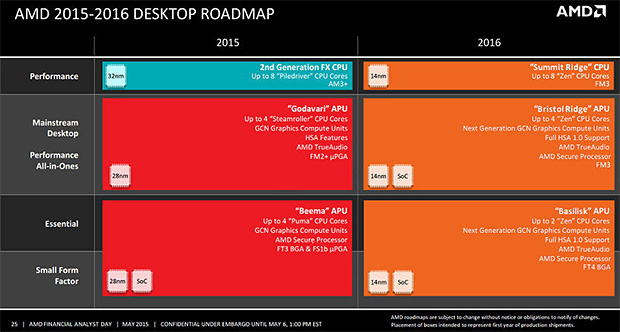
I was just thinking these past few days how AMD is highly undervalued and would likely see a big boost from the launch of Zen. Since Zen is still not launched yet, I think there's opportunity for the stock to grow even up to 100% or more from where it was.
As a little side note, I think it's fantastic that AMD is replacing its E-series APUs that used Atom-like CPU cores in low-end notebooks, at a time when Intel is doing the exact opposite by replacing the Core micro-architecture in Celerons and Pentiums with Atom, so it can sell what are essentially $30-$40 chips for $107-$160.
http://fudzilla.com/images/stories/2015/April/amd-desktop.jp...
Intel did this because it thought AMD is no real competition technically, but more importantly from a brand point of view (Intel thought people will keep buying its chips at the same price points even if it replaces them with a much weaker core with many fewer hardware features). With Zen in general (thank you Jim Keller! [1]), but also with Zen in the low-end of the market, AMD just called Intel's bluff - and I think it will win this one while Intel is stuck with Atom in Celerons and Pentiums for the next few years.
The dual-core Zen CPUs in the E-series should absolutely trash the Atom-based Celerons and Pentiums, and likely the scammy $280 Core M chip as well. APUs like the A4 and A6 were already destroying Atom-based Celerons in terms of price/performance.
Looking forward to the quad-core/8 thread Zen APUs that will compete against the dual-core/4-thread Core i3 and Core i5 as well, and may even beat them on single-thread performance, if the price is equalized. From some calculations I've seen Zen may come within 10% of Intel's IPC at the same clock speed, even for Kaby Lake. But you may be able to get say an AMD chip that has the same performance as Core i3 in single-thread, almost twice the performance in multi-thread, and still cost 10% less.
As another side note, I really hope Qualcomm ends up buying AMD, though it probably should've done it last year, and it may have done it, too, if it wasn't for their own Snapdragon 810 blunder, which almost got its board to sell the chip division (a huge mistake, which I'm glad they eventually rejected).
Now the price is going to increase by 2x or more. Hopefully AMD's shareholders won't get greedy and sell for cheap, because AMD needs an infusion of cash as well, so it can adopt the latest process nodes as quickly as they are available, and so it can develop and launch multiple lines of products at the same time. That's how it can become much more competitive.
I think Qualcomm would be a good steward of AMD (it already bought the mobile GPU division from AMD a decade ago, and has taken full advantage of it). It has the commitment and incentive to want to beat Intel and go after its profits in the PC and server markets, while operating on much lower cost structures (Innovator's Dilemma and all that). But it can't do that with ARM chips alone, in part because Windows' universal apps are still a no-show for now, and in part because ARM's entrance into the server market is going to be a very slow and long process. Qualcomm's entrance into those markets would be much accelerated through an AMD acquisition (as long as it's not bank-breaking one that starves Qualcomm out of resources to invest).
Another decent buyer would be Samsung, but I only hope they do it if they are truly committed to being a chip powerhouse and to compete against Intel toe-to-toe, no matter how much it costs them to do it, otherwise it's better to stay out of it.
[1] https://en.wikipedia.org/wiki/Jim_Keller_(engineer)