I mean, if they've paid you to write this, I presume you have reasonable hardware to run it on. Bog standard BSD sockets TCP on Linux is down around the 10 microsecond range now. What on earth are you doing with the other 4.99ms?
Writing a very fast cache service with millions of entries in Go
81–90 of 92 posts
Re: Writing a very fast cache service with millions of entries in Go
#82Earlier quoted context omitted.
Yes, Spanner does exist. Spanner also does not satisfy what I said in #1.
Can you elaborate on this?
For another it would be really weird for Spanner to expose something CRDT shaped since Spanner is a strongly-consistent distributed database which depends heavily on global order and read/write locks driven by meticulously coordinated multi-site global wall-clock time and consensus groups.
In some ways it's almost the opposite of what I want... with exception of the fact that it's also distributed. I want extreme availability with lazy, weak coordination.
Re: Writing a very fast cache service with millions of entries in Go
#83Earlier quoted context omitted.
Uses Raft. Not highly-available enough unfortunately. Availability > Consistency for the use case that matters to me (basically a service message bus where all ACK'd writes will eventually be read by some consumer(s), but I don't care when or in what order, just that they all eventually get consumed, and where as long as any node in the cluster is up, it'll ACK a write).
> Uses Raft. Not highly-available enough unfortunately. Did you test this or is it just a general view? What sort of write rate are you looking for, per topic?
I care that as long as even one node in the system is alive, it will accept writes, and those writes will eventually propagate and converge on the union set of all writes ever observed, without obliterating any ACK'd observed writes, as the system as a whole moves toward a less degraded state.
I'd want topics themselves to be able to be basically "free" to create, and the write latency to remain stable over arbitrarily large datasets. Write rate isn't really much of a consideration since it's almost embarrassingly low (hundreds per second).
Re: Writing a very fast cache service with millions of entries in Go
#84Earlier quoted context omitted.
> Uses Raft. Not highly-available enough unfortunately. Did you test this or is it just a general view? What sort of write rate are you looking for, per topic?
Raft requires both a stable leader and a majority of replicas to be reachable in order to advance the consensus protocol. I'd like to be able to lose more than a majority of replicas and require no leaders because I don't care about consistency. I care that as long as even one node in the system is alive, it will accept writes, and those writes will eventually propagate and converge on the union set of all writes eve…
Fair nuff, I asked because I was curious if you were assuming that eventual consistency was necessary for high availability.
> Write rate isn't really much of a consideration since it's almost embarrassingly low (hundreds per second).
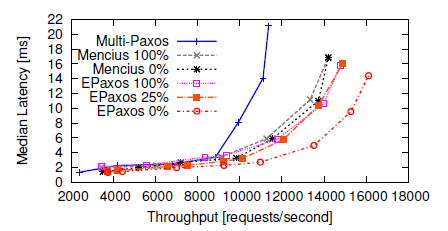
Yup, looks like my concern above is the case. A single consensus replica set will do that no problem. I'd use raft if you're in a single geo location or epaxos otherwise (the epaxos source is a little early and needs eyeballs/production diversity testing, but the algorithm is absolutely solid). There's no reason to borrow all the troubles of CRDT's when it's not needed.
Edit:
Example from the epaxos paper, this is latency vs throughput for 3 replicas in one geo location: http://charap.co/wp-content/uploads/2015/10/latency_over_thr...
Re: Writing a very fast cache service with millions of entries in Go
#85Earlier quoted context omitted.
Raft requires both a stable leader and a majority of replicas to be reachable in order to advance the consensus protocol. I'd like to be able to lose more than a majority of replicas and require no leaders because I don't care about consistency. I care that as long as even one node in the system is alive, it will accept writes, and those writes will eventually propagate and converge on the union set of all writes eve…
> I don't care about consistency. Fair nuff, I asked because I was curious if you were assuming that eventual consistency was necessary for high availability. > Write rate isn't really much of a consideration since it's almost embarrassingly low (hundreds per second). Yup, looks like my concern above is the case. A single consensus replica set will do that no problem. I'd use raft if you're in a single geo location o…
Re: Writing a very fast cache service with millions of entries in Go
#86Earlier quoted context omitted.
> I don't care about consistency. Fair nuff, I asked because I was curious if you were assuming that eventual consistency was necessary for high availability. > Write rate isn't really much of a consideration since it's almost embarrassingly low (hundreds per second). Yup, looks like my concern above is the case. A single consensus replica set will do that no problem. I'd use raft if you're in a single geo location o…
What happens when I don't have a majority of Raft replicas alive?
You seem extremely concerned about a fault tolerant system experiencing more faults than the majority, which I think is quite easily dealt with, and utterly blithe about making inconsistency your best case.
At this kind of request rate I'd honestly just shove things in postgres and call it good. There's just no reason to build out a bunch of CRDT complexity when you don't _need_ it.
Re: Writing a very fast cache service with millions of entries in Go
#87Earlier quoted context omitted.
What happens when I don't have a majority of Raft replicas alive?
Then raft locks until you do again. We live in the era of on demand infrastructure. With even just 3 replicas and some reasonable automation it's extremely unlikely you'll see any unavailability. Or run 5 way across two different systems (ie 3 at google, 2 at AWS). That setup is less than $100/month to run now. You seem extremely concerned about a fault tolerant system experiencing more faults than the majority, whic…
Does that give you a better perspective for my availability concerns?
I also don't have "on demand" infrastructure. I have to deploy to a fixed footprint of bare metal hardware.
I'm "utterly blithe" about inconsistency being my best case for a variety of reasons:
1) I know my use case extremely well.
2) I know that within that use case there are several places where availability is the #1, #2, and #3 priority because the system being unavailable for any time at all has a non-trivial direct financial impact.
3) I know within that use case where there are necessary points of consistency and how to move them out of the critical path that requires extreme availability.
4) I know exactly the problem that CRDTs solve for me, and exactly why I need them in this case, and how to avoid them with simpler immutable/idempotent write patterns where possible.
5) I have to be able to tolerate very high proportion of the infrastructure experiencing temporary and/or permanent failure because the places I have to deploy into are no where near the level of reliability of even a low-mid tier data center in the US. Janky telcos, natural disasters, malicious operators, and flimsy power delivery are the norm.
Re: Writing a very fast cache service with millions of entries in Go
#88Earlier quoted context omitted.
Then raft locks until you do again. We live in the era of on demand infrastructure. With even just 3 replicas and some reasonable automation it's extremely unlikely you'll see any unavailability. Or run 5 way across two different systems (ie 3 at google, 2 at AWS). That setup is less than $100/month to run now. You seem extremely concerned about a fault tolerant system experiencing more faults than the majority, whic…
The system that's my benchmark to go up against has seen 6 seconds of downtime in 25 years. Does that give you a better perspective for my availability concerns? I also don't have "on demand" infrastructure. I have to deploy to a fixed footprint of bare metal hardware. I'm "utterly blithe" about inconsistency being my best case for a variety of reasons: 1) I know my use case extremely well. 2) I know that within that…
Edit: I see you edited in a longer comment after my question above. I was just curious, not looking to pick a fight. Suffice it to say we have very different perspectives on how to attack those requirements. I'm bowing out now, cheers!.
Re: Writing a very fast cache service with millions of entries in Go
#89Earlier quoted context omitted.
Can you elaborate on this?
Well, for starters Google Spanner has almost nothing to do with CRDTs. For another it would be really weird for Spanner to expose something CRDT shaped since Spanner is a strongly-consistent distributed database which depends heavily on global order and read/write locks driven by meticulously coordinated multi-site global wall-clock time and consensus groups. In some ways it's almost the opposite of what I want... wi…
No, it's slightly more lazy in that that. It does timestamp coordination, but retrospectively.
Re: Writing a very fast cache service with millions of entries in Go
#90Earlier quoted context omitted.
The system that's my benchmark to go up against has seen 6 seconds of downtime in 25 years. Does that give you a better perspective for my availability concerns? I also don't have "on demand" infrastructure. I have to deploy to a fixed footprint of bare metal hardware. I'm "utterly blithe" about inconsistency being my best case for a variety of reasons: 1) I know my use case extremely well. 2) I know that within that…
And what consistency assurances does it provide? Edit: I see you edited in a longer comment after my question above. I was just curious, not looking to pick a fight. Suffice it to say we have very different perspectives on how to attack those requirements. I'm bowing out now, cheers!.
1) Anything that is suggested which avoids data loss via consistency models is going to reduce my availability to unacceptable levels.
2) Anything that is suggested which keeps my availability up where it needs to be and doesn't use CRDTs, and/or a sufficiently similar semantic guarantee, is going to silently lose data due to "lost-updates" (ACK'd writes that get obliterated during conflict merges and are now gone forever).
At a minimum I need sibling behavior for conflicting writes to ensure that some half-baked LWW strategy that's barely better than "pick at random" doesn't kill my data (which has very high regulatory and audit requirements around it), and then taking that a step further CRDTs, implemented correctly, provide me a nice interface for interacting with multiple version conflicts and resolving them in coherent ways without forcing me, or my other developers, to have to think up case-by-case resolution strategies and verify their correctness.
There really isn't a tremendous amount of complexity to using CRDTs. That's the point of them. They're easy to use. The complexity I'd really like to avoid if possible by avoiding CRDTs is the cognitive burden my team needs to have around distributed data and all it's horrible nuances to satisfy our use case. The knowing when and why to use them, not so much the how.
"At this kind of request rate I'd honestly just shove things in postgres and call it good." is very, very far away from a workable solution because my problem isn't request rate. The number of ops/sec could be hundreds or millions, and it doesn't really change my actual problem. No matter what the request rate is I could just write to a bunch of postgres instances that have a chash ring overlaid onto them... except now I have to deal with my actual problem still, which is redundancy, and local consistency in any postgres replica doesn't guarantee me much, I can't introduce a strong coordinator like a consensus protocol over the top of them, because it dumps my availability, and so I have to figure out how to safely deal with merge conflicts between the replicas... now I'm stuck figuring out how to build CRDTs on top of postgres anyway. So... what exactly did I win?