Where's my petabyte disk drive?
bit-player.org
Where's my petabyte disk drive?
1–10 of 101 posts
Re: Where's my petabyte disk drive?
#2Note in the early 1990s you could read hard drive content pretty easily with a scanning probe microscope, in fact the bits were lozenge shaped and if you looked close you might find the edges of bits that had been written before and weren't perfectly aligned. (i.e. scientists had tools in their labs that were better at reading a hard drive than the read head)
Back then it was possible you could smash the plates and somebody could reassemble some of the data.
Then by 2005 or so the density of the data was high enough that the scanning probe microscope wasn't much better than the read heads, and at that point extreme methods of data extraction got much much harder.
Re: Where's my petabyte disk drive?
#3It's in the "Cloud" ...
Re: Where's my petabyte disk drive?
#4Excellent post. Great information. I have a question about SSDs, though. Google has published their information about hard drive and SSD survival in their data centers. It can be viewed here: http://www.datacenterdynamics.com/servers-storage/googles-ss... So my question is how we mere mortals can deal with all the maintenance. It may well be that spinning hard drives are best for us.
Re: Where's my petabyte disk drive?
#5It's in the "Cloud" ...
I thought it was in my quantum computer...
Re: Where's my petabyte disk drive?
#6Excellent post. Great information. I have a question about SSDs, though. Google has published their information about hard drive and SSD survival in their data centers. It can be viewed here: http://www.datacenterdynamics.com/servers-storage/googles-ss... So my question is how we mere mortals can deal with all the maintenance. It may well be that spinning hard drives are best for us.
You assume HDs will die. Keep 3 copies of all data, at least 1 far away, and diff regularly. If a HD lasts 2 years vs 10 in average, doesn't really change the best practice to keep your data.
Re: Where's my petabyte disk drive?
#7We appear to be slashdotting the server; here's some cached copies:
Just text (loads instantly):
http://webcache.googleusercontent.com/search?q=cache:Jr34hZX...
Images etc. loaded from the site (seems to work, albeit slowly):
http://webcache.googleusercontent.com/search?q=cache:Jr34hZX...
Re: Where's my petabyte disk drive?
#8The reason why spinning disks still stick around is not just because of the price. Often, it is the case that you do not need 200-500MBit/s and ~100+ are enough. I have my OS on a (small) SSD and my spinning disks filled with my documents, music, movies. All of this does not need high speed, so it would be wasted money to buy an SSD for it. I'd rather buy twice the storage and do RAID1 (which I did).
Re: Where's my petabyte disk drive?
#9Massive hard drives only useful for archival purposes, under this argument: if your hard drive is being used for live queries, you want to access all the data on it. Even if you have have all the pieces in place to stream 1gig per sec off of the drive, a 1pb drive would still take 1 million seconds = ~11.5 days to read.
So in practice in production it's more useful to have smaller hard drives in more places to work on the data in parallel. And in the truly archival cases there are other concerns (like redundancy) that mean there isn't as much demand for a single massive drive.
Re: Where's my petabyte disk drive?
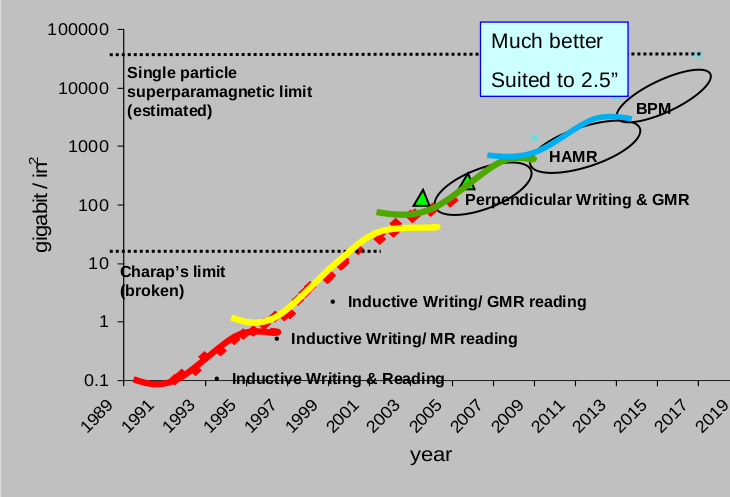
#10The growth in hard drive space is called Kryder's Law [0] (like Moore's law). There's a paper from 2012 on the cost of long-term storage [1].. and here's a quote from the researchers blog[2]:
Here is a graph I got from Dave Anderson [director of strategic planning at Seagate] years ago. It shows that what looks like a smooth Kryder's Law curve is actually the superposition of a series of S-curves, one for each successive technology generation. Naturally, because the easy transitions get done first, the cost of each successive transition increases, perhaps even exponentially. Since margins are constrained and so, these days, are volumes, to generate a return on the investment in each transition requires that the technology be kept in the market longer. The longer interval between transitions translates to a lower Kryder rate.
http://4.bp.blogspot.com/-bkuDDrBpcZE/TpMsLTEspsI/AAAAAAAAA9...
0. https://en.wikipedia.org/wiki/Mark_Kryder
1. http://www.lockss.org/locksswp/wp-content/uploads/2012/09/un...
2. http://blog.dshr.org/2012/10/storage-will-be-lot-less-free-t...