Live data from Hacker News

Lee Sedol Beats AlphaGo in Game 4

gogameguru.com

301–310 of 471 posts

Re: Lee Sedol Beats AlphaGo in Game 4

#301
GoGameGuru just published a commentary of the game with some extra insight https://gogameguru.com/lee-sedol-defeats-alphago-masterful-c...

The author thinks that Lee Sedol was able "to force an all or nothing battle where AlphaGo’s accurate negotiating skills were largely irrelevant."

[...]

"Once White 78 was on the board, Black’s territory at the top collapsed in value."

[...]

"This was when things got weird. From 87 to 101 AlphaGo made a series of very bad moves."

"We’ve talked about AlphaGo’s ‘bad’ moves in the discussion of previous games, but this was not the same."

"In previous games, AlphaGo played ‘bad’ (slack) moves when it was already ahead. Human observers criticized these moves because there seemed to be no reason to play slackly, but AlphaGo had already calculated that these moves would lead to a safe win."

Which, I add, is something that human players also do: simplify the game and get home quickly with a win. We usually don't give up as much as AlphaGo (pride?), still it's not different.

"The bad moves AlphaGo played in game four were not at all like that. They were simply bad, and they ruined AlphaGo’s chances of recovering."

"They’re the kind of moves played by someone who forgets that their opponent also gets to respond with a move. Moves that trample over possibilities and damage one’s own position — achieving less than nothing."

And those moves unfortunately resemble what beginners play when they stubbornly cling to the hope of winning, because they don't realize the game is lost or because they didn't play enough games yet not to expect the opponent to make impossible mistakes. At pro level those mistakes are more than impossible.

Somebody asked an interesting question during the press conference about the effect of those kind of mistakes in the real world. You can hear it at https://youtu.be/yCALyQRN3hw?t=5h56m15s It's a couple of minutes because of the translation overhead.
Re: Lee Sedol Beats AlphaGo in Game 4

#303
post #260
post #259

Earlier quoted context omitted.

They've said it doesn't require that, AlphaGo running on a single machine beats the cluster they're using 25% of the time.

So based on current data, Lee Sedol is exactly as good AlphaGo running on a single machine.

Probably better. If we assume a uniform distribution across possible win rates of Sedol vs AlphaGo, then update it with bayes rule, we get 33% chance that Sedol will win the next match.

That's not factoring in other information, like Sedol now being familiar with alphaGo's strategies and improving his own strategies against it.

So there is a good chance he is now evenly matched with AlphaGo, and likely much better than the single machine version.

Re: Lee Sedol Beats AlphaGo in Game 4

#304
post #255

Earlier quoted context omitted.

It feels really weird to see someone being showered with congratulations for beating a computer program. What exactly is he being congratulated for? For probably triggering and then capitalizing on a bug in AlphaGo's AI? For showing that human resolve, perseverance and a "fighting spirit" can trump a flawed AI, at least until the AI gets fixed? For giving DeepMind extremely valuable test data that will only accelerat…

Lee Sedol will forever be known as the first human to defeat AlphaGo in Game 4, and potentially the last one too. That's quite an accomplishment.

Maybe they should fork version 18 as the hard but human betable version of alphago

Re: Lee Sedol Beats AlphaGo in Game 4

#305

Earlier quoted context omitted.

Wouldn't "-Unknown" convey the same sense without the possible confusion?

NN is (was) also used in neapolitan comedy, derived from earlier use throughout the Roman Empire and Middle Age. The "figlio di NN", or "son of NN" means someone who was found and adopted (typically by nuns) and whose parents were unknown. NN can be used in general for people whose origin is uncertain. I think in this specific case it's a bit misleading - although the wikipedia article seems to suggest that NN can al…

So NN can be used as an school version of anonymous?

Re: Lee Sedol Beats AlphaGo in Game 4

#306
post #260
post #259

Earlier quoted context omitted.

They've said it doesn't require that, AlphaGo running on a single machine beats the cluster they're using 25% of the time.

So based on current data, Lee Sedol is exactly as good AlphaGo running on a single machine.

Doubtful; I don't think comparing such small W/L distributions will be illustrative.

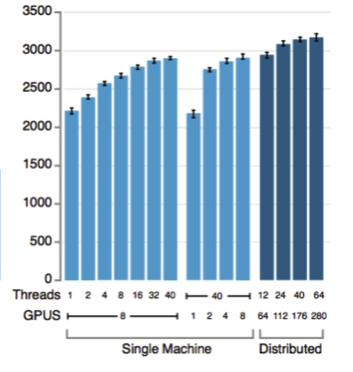
On the other hand, the Nature paper shows the single 8 GPU machine performs similar to the 64 GPU cluster, but the larger clusters perform a comfortable margin better. [0]

By a single machine winning many games relative to the distributed version, really it's just saying that the value/policy network is more important than the monte carlo tree search. The main difference is the number of tree search evaluations you can do; it doesn't seem like they have a more sophisticated model in the parallel version. The figure suggests that there are systematic mistakes that the single 8 GPU machine makes compared to the distributed 280 GPU machine, but MCTS can smooth some of the individual mistakes over a bit.

[0] http://www.milesbrundage.com/uploads/2/1/6/8/21681226/877172...

Re: Lee Sedol Beats AlphaGo in Game 4

#307

Earlier quoted context omitted.

Actually, it's a tradition that both Players should replay the game after the match, discuss about good moves, bad moves and what they were thinking during the match. I felt so sorry for Lee Sedol when I saw him lose the second match, facing an empty chair ,and he could only ask one of his friend to review the game. https://zh.wikipedia.org/wiki/%E5%A4%8D%E7%9B%98

He made $30k for losing that game, so I don't feel too sorry for him.

The best (like absolute best) football|basketball|baseball players in the world make approximately what per game?

Re: Lee Sedol Beats AlphaGo in Game 4

#308
We were discussing the probability that Sedol would win this game. Everyone, including me, bet 90% that no human would ever win again, let alone this specific game: http://predictionbook.com/predictions/177592

I tried to estimate it mathematically. Using a uniform distribution across possible win rates, then updating the probability of different win rates with bayes rule. You can do that with Laplace's law of succession. I got a 20% that Sedol would win this game.

However a uniform prior doesn't seem right. Eliezer Yudkowsky often says that AI is likely to be much better than humans, or much worse than humans. The probability of it falling into the exact same skill level is pretty implausible. And that argument seems right, but I wasn't sure how to model that formally. But it seemed right, and so 90% "felt" right. Clearly I was overconfident.

So for the next game, with we use Laplace's law again, we get 33% chance that Sedol will win. That's not factoring in other information, like Sedol now being familiar with AlphaGo's strategies and improving his own strategies against it. So there is some chance he is now evenly matched with AlphaGo!

I look forward to many future AI-human games. Hopefully humans will be able to learn from them, and perhaps even learn their weaknesses and how to exploit them.

Depending how deterministic they are, you could perhaps even play the same sequence of moves and win again. That would really embarrass the Google team. I hear they froze AlphaGo's weights to prevent it from developing new bugs after testing.

Re: Lee Sedol Beats AlphaGo in Game 4

#309

In the post-game press conference I think Lee Sedol said something like "Before the matches I was thinking the result would be 5-0 or 4-1 in my favor, but then I lost 3 straight... I would not exchange this win for anything in the world." Demis Hassabis said of Lee Sedol: "Incredible fighting spirit after 3 defeats" I can definitely relate to what Lee Sedol might be feeling. Very happy for both sides. The fact that p…

Yep! As someone who was rooting for DeepMind, I like this result, for two reasons: Lee Sedol earned it - he's behaved like a true sportsman all the way - and it gives us some interesting information (yesterday we only had a lower bound on AlphaGo's strength; today we also have an upper bound).

>yesterday we only had a lower bound on AlphaGo's strength; today we also have an upper bound

I think it's premature, establishing bounds with good confidence interval requires tens or hundreds of games. Specifically, 3:2 result would be really inconclusive.

Re: Lee Sedol Beats AlphaGo in Game 4

#310
post #82

Earlier quoted context omitted.

If the value/policy model is predictive with a dataset containing only amateur games, but fails to generalize to unseen data with professional games, that seems like a case of overfitting to a dataset only containing amateur games. In this case the expected value network may be different for amateur games than professional games. Is there something I'm missing?

The value/policy model includes a few hundred thousand amateur games, and a few hundred million games of self-play. Once AlphaGo beat Fan Hui those would have been games of self-play versus the equivalent of a professional. So overfitting is probably not a problem. I think it's a basic incentive mismatch - MCTS algorithms tend to like close games, whereas humans will try crazy moves when losing to throw off their opp…

Wouldn't a million self play games exacerbate overfitting by learning it's own play style which it initially learned from amateur games? I
Post reply on HN