Live data from Hacker News

If you're alive in 30 years you might be in 1000 years too

haakonsk.blogg.no

181–190 of 230 posts

Re: If you're alive in 30 years you might be in 1000 years too

#181
post #106

Unfortunately, no, this is pure wishful thinking. Using life expectancy is a misleading argument, and I believe intentionally so. Life expectancy is a function of early mortality. Longevity is the average age at death of people who die only of old age, and it doesn't vary much and hasn't for thousands of years. https://en.m.wikipedia.org/wiki/Longevity Ray Kurzweil and Aubrey De Grey are playing on the hopes and fear…

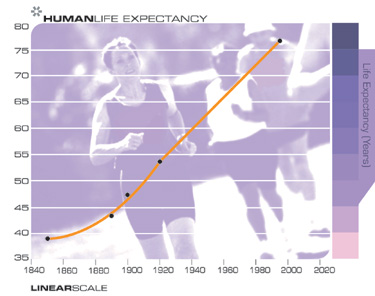
Direct link to the graph: http://www.kurzweilai.net/images/chart33.jpg.

It shows… 5 data points.

Re: If you're alive in 30 years you might be in 1000 years too

#182
post #114

Earlier quoted context omitted.

No technology has ever extended life. The so-called gains in life expectancy have only come about by reducing the causes of early mortality and slowing down the diseases of ageing.

I don't see the difference.

I'm not the commenter you're replying to, but maybe they meant that we've only reduced early causes of death like disease etc, but not done anything to affect our internal biological processes that cause aging. As an example, reducing skin cancer by staying out of the sun keeps you from prematurely aging, but it doesn't stop your hair from turning white and your wrinkles from forming.

Re: If you're alive in 30 years you might be in 1000 years too

#183

Earlier quoted context omitted.

There are a great number of books that explore this subject. Robert A. Heinlein's https://en.wikipedia.org/wiki/Methuselah%27s_Children is an early treatment. As you say at least one society (I'm sorry I don't remember the book) became increasingly risk-averse and added to an ever-growing list of death penalty crimes to feed the organ banks. Rather than utopia my fear is that would be closer to the truth.

I don't see death penalty happening in a society where a lifetime could be thousands of years. Its just too harsh, with so much to lose. Perhaps sentencing would grow to centuries.

Go read a few Philip K. Dick novels and see if you change your mind. Take current examples of selfish actors with essentially unlimited funds (billionaries, big business, whatever gets your goat) and envision the world after 1,000 years of uninterrupted influence. It's easy to envision a dystopia where caste returns and you're born into a wage slave job at .

Re: If you're alive in 30 years you might be in 1000 years too

#184
post #106

Unfortunately, no, this is pure wishful thinking. Using life expectancy is a misleading argument, and I believe intentionally so. Life expectancy is a function of early mortality. Longevity is the average age at death of people who die only of old age, and it doesn't vary much and hasn't for thousands of years. https://en.m.wikipedia.org/wiki/Longevity Ray Kurzweil and Aubrey De Grey are playing on the hopes and fear…

> Ray Kurzweil and Aubrey De Grey are playing on the hopes and fears of people to make arguments about the fountain of youth that won't come to pass. I wish they would, but they won't. Oh but they will. Most certainly. It's a question of when , not if. The body is nothing but a very quirky, very complex bit of machinery. Our task is to scientifically probe that complexity until we have such a great understanding of i…

>Oh but they will. Most certainly. It's a question of when, not if. The body is nothing but a very quirky, very complex bit of machinery. Our task is to scientifically probe that complexity until we have such a great understanding of it that we can manipulate and improve that machinery in vivo.

And who told you it's a given that we'll manage to have such an understanding?

Re: If you're alive in 30 years you might be in 1000 years too

#185
post #149

Earlier quoted context omitted.

Kurzweil and DeGrey are arguing that it's already happening. It is not, there is no evidence to date that we've moved longevity in a meaningful way, nor that technology is involved in anything other than improvements in health and medicine and environment, further delaying death. To be clear, I'm not saying it can't ever happen, I'm saying that DeGrey's and Kurzweils claims that it is happening and will come to pass…

>Kurzweil and DeGrey are arguing that it's already happening. It is not, there is no evidence to date that we've moved longevity in a meaningful way, nor that technology is involved in anything other than improvements in health and medicine and environment, further delaying death. This is absolutely incorrect, unless you are being exceedingly facetious about the scientific process. There have been some truly remarkab…

You don't have to believe me. I'm only relaying what is the currently accepted scientific understanding, that so far we've only treated the symptoms of aging, not increased the potential for longevity.

"The U.S. Census Bureau view on the future of longevity is that life expectancy in the United States will be in the mid-80s by 2050 (up from 77.85 in 2006) and will top out eventually in the low 90s, barring major scientific advances that can change the rate of human aging itself, as opposed to merely treating the effects of aging as is done today." (emphasis mine)

https://en.wikipedia.org/wiki/Longevity

> surely you're not suggesting that longevity decreased on average between 1920-2000?

You've completely lost me here. This is a straw man argument, I didn't say a thing about what happened to longevity this century, and the data clearly shows it has gone up slightly. Experts agree it will reach an asymptotic peak unless some science magic happens. But no science magic has yet happened, and while I agree we should pursue it, we have no scientific reasons to suspect that it will aside from human curiosity, desire to live longer, and fear of death.

> Kurzweil is overly optimistic about these things

Now that's just funny. There's a world of difference between being optimistic and overtly lying to prove a point that doesn't exist.
Re: If you're alive in 30 years you might be in 1000 years too

#186
post #179

Earlier quoted context omitted.

I imagine absurdly conservative politics and a completely ossified power structure. How are you supposed to advance if your boss has 500 years more experience and will be in that position for another 8000 years? I mean in the current world rich assholes do eventually die and sometimes their replacements are better (or worse, but in a way that destroys their power base). Do you really want to live in a world where the…

Still not creative enough. If everybody realizes there's no way to advance because of the old people, everyone will react to that fact. Something will happen. Actually, lots of somethings, with varying levels of success and failure. But there certainly will not be 99.9% of the long-lived human race just sort of sitting around for centuries at a time going "Oh well, guess I'm going to be a loser for the next thousand…

>Still not creative enough. If everybody realizes there's no way to advance because of the old people, everyone will react to that fact.

Except everyone (the majority) could be old people too.

If you can live for 5000 years for example, you don't need as many reproduction going on (besides the huge overpopulation that would already be going on).

Re: If you're alive in 30 years you might be in 1000 years too

#187

Earlier quoted context omitted.

> Ray Kurzweil and Aubrey De Grey are playing on the hopes and fears of people to make arguments about the fountain of youth that won't come to pass. I wish they would, but they won't. Oh but they will. Most certainly. It's a question of when , not if. The body is nothing but a very quirky, very complex bit of machinery. Our task is to scientifically probe that complexity until we have such a great understanding of i…

> Oh but they will. Most certainly. It's a question of when, not if. The body is nothing but a very quirky, very complex bit of machinery. Our task is to scientifically probe that complexity until we have such a great understanding of it that we can manipulate and improve that machinery in vivo. And who told you it's a given that we'll manage to have such an understanding?

Who's "we"?

Humanity, or whatever we create to succeed us?

Re: If you're alive in 30 years you might be in 1000 years too

#188

Earlier quoted context omitted.

Population growth has been declining since the 60s. UN estimates are that we'll peak at 10 billion. Besides that it's already happening, reducing population growth isn't necessarily a good thing, in econimic terms of aggregate "utility." Is there a difference between preventing birth and causing death?

That estimated peak is based on existing and projected death rates. Even Japan's population would grow if death from old age and age-related disease ceased.

Correct. The projection is a projection. If the projection is wrong, the projection will be wrong.

I just give slightly more credence to the UN's projection than Aldring's.

Re: If you're alive in 30 years you might be in 1000 years too

#189

Earlier quoted context omitted.

> Ray Kurzweil and Aubrey De Grey are playing on the hopes and fears of people to make arguments about the fountain of youth that won't come to pass. I wish they would, but they won't. Oh but they will. Most certainly. It's a question of when , not if. The body is nothing but a very quirky, very complex bit of machinery. Our task is to scientifically probe that complexity until we have such a great understanding of i…

> Oh but they will. Most certainly. It's a question of when, not if. The body is nothing but a very quirky, very complex bit of machinery. Our task is to scientifically probe that complexity until we have such a great understanding of it that we can manipulate and improve that machinery in vivo. And who told you it's a given that we'll manage to have such an understanding?

[deleted]

Re: If you're alive in 30 years you might be in 1000 years too

#190
post #44
post #35

Earlier quoted context omitted.

You wouldn't want population growth to outgrow your capacity. Also, usually, the longer someone lives, the more their ideology defines them. Could be a problem too

Your argument is "we don't want more old people because I disagree with them ideologically." Shoddy at best.

People's brains change as they age. There are definite differences between the way older people and younger people think. This isn't a generalization about old people having bad politics, but rather a comment on the tendency of people's minds to be harder to change over time.

Personally, I think one of the biggest challenges to transitioning to a low-birthrate, ultra-long-lived society is that a constant influx of young blood seems to be a necessary engine for new ideas and progress. There's a combination of not knowing better[1] and not having as much to lose that makes young people more willing to take big risks and push for more egalitarian societies over time. Left to their own devices, accumulation of wealth and status tend to ossify people's belief systems and reduce their incentives to throw everything out and start over.

[1] by this I mean not having the same accumulated beliefs about what is best. Sometimes those beliefs turn out to be unfounded, and you discover that by challenging them.

Post reply on HN