Live data from Hacker News

A cheating scandal in the world of professional bridge

newyorker.com

51–60 of 72 posts

Re: A cheating scandal in the world of professional bridge

#51
post #48
post #29

I have never played bridge so my opinion is of a complete outsider's. You can also see me as the devil's advocate. What if we just accepted "cheating" to be part of the game? Such that every team is allowed to devise their own way to communicate in subtle manners (barring the use of electronic devices). And so part of the game would be to figure out the opposing team's code. There is really no way to prevent communic…

If you take that to a logical extreme (and humans do take things to logical extremes... ) it becomes a game more about electronics intelligence (jamming, jam evasion, cryptography, steganography... ) which, don't get me wrong, would be amazingly amusing to watch if you even could watch it, but would devalue the relative contributions of the card players and would put more emphasis on having money for equipment and th…

Something race leagues know all about.

Re: A cheating scandal in the world of professional bridge

#53

I enjoy bridge, but high level competitive bridge sounds like a nightmare. "Expert poker players often take advantage of a skill they call table feel: an ability to read the facial expressions and other unconscious “tells” exhibited by their opponents. Bridge players rely on table feel, too, but in bridge not all tells can be exploited legally by all players. If one of my opponents hesitates during the bidding or the…

"gentleman sport", while cheating might be simple and undetectable, you simply do not do it as it would take out the fun and challenge.

Money seem to corrupt many such sports though.

Re: A cheating scandal in the world of professional bridge

#54
post #3

An interesting subject is what can be done to stop cheating? It seems that separators are insufficient. Each player must be in a completely enclosed room, preferably a Faraday cage, lead box? Furthermore, all moves must be submitted digitally, with a time limit, and the actual move will only be displayed at the end of that limit. Even then, we'll probably hear about a bug in the software used.

However, that will render an incredibly boring game

Re: A cheating scandal in the world of professional bridge

#55
post #24

I enjoy bridge, but high level competitive bridge sounds like a nightmare. "Expert poker players often take advantage of a skill they call table feel: an ability to read the facial expressions and other unconscious “tells” exhibited by their opponents. Bridge players rely on table feel, too, but in bridge not all tells can be exploited legally by all players. If one of my opponents hesitates during the bidding or the…

It's actually fairly easy for a few reasons: 1) Anybody playing at even a remotely competitive level has their bid and play conventions so well down that answering the question "what would I have played had I not seen my partner hesitate?" is not hard. 2) Varying your tempo will get the director called to the table regardless of whether or not it conveys information; playing at a steady rate is part of the game. 3) I…

If the play is so standard and automatic then where does skill come in? Or just skill just correlate highly with how many situations one has observed before and potentially memorized?

Re: A cheating scandal in the world of professional bridge

#56

I enjoy bridge, but high level competitive bridge sounds like a nightmare. "Expert poker players often take advantage of a skill they call table feel: an ability to read the facial expressions and other unconscious “tells” exhibited by their opponents. Bridge players rely on table feel, too, but in bridge not all tells can be exploited legally by all players. If one of my opponents hesitates during the bidding or the…

> How can you possibly play like this, and expect others to play like this, in a genuinely competitive setting?

Honesty is not as hard or unusual as people think. There is a notion that people will do anything to win but if you look at humanity, most people are honest, follow the rules (and laws), and have little interest in cheating. Not everybody feels and acts that way, and nobody does it all the time, but it's hardly uncommon.

Re: A cheating scandal in the world of professional bridge

#57
This is why bridge always seemed stupid to me: You're not allowed to communicate with your partner, but you are allowed to communicate through card plays, but then you aren't allowed to have secret communication through card plays (you have to tell your opponants your communication system)...

It's artificial and ridiculous. Given how easy it is to secretly communicate you're basically trusting people not to cheat.

Re: A cheating scandal in the world of professional bridge

#59
post #55
post #24

Earlier quoted context omitted.

It's actually fairly easy for a few reasons: 1) Anybody playing at even a remotely competitive level has their bid and play conventions so well down that answering the question "what would I have played had I not seen my partner hesitate?" is not hard. 2) Varying your tempo will get the director called to the table regardless of whether or not it conveys information; playing at a steady rate is part of the game. 3) I…

If the play is so standard and automatic then where does skill come in? Or just skill just correlate highly with how many situations one has observed before and potentially memorized?

Bridge is two games combined into one.

The bidding is a game that you can describe something like:

"Using an open channel, and an open communication protocol, communicate hidden resources in a precise enough way to mutually agree on what can be accomplished with you and your partner's resources combined".

The playing is a game of "Given a set of resources, maximize your results" (if you won the bid) or "Communicate with your partner and together maximize your results given your resources" if you did not win the bid.

Vague as hell, but sure.

The difficulty in the bidding process is based on incomplete information understanding what resources you have combined. There are a number of edge cases that can't be expressed well, so you need to have a collective thought processes to understand where you're going (and your opponents can also disrupt your bidding, so its not a clear channel either).

The challenge in the play is understanding what combination of playing orders will give you the highest odds. There is some amount of memorization (there are some squeeze plays that aren't obvious unless you learn them) but mostly it is pattern recognition, improvisation and odds calculation on the fly.

I'm underselling it - bridge played against relatively equally good opponents and with a good partner that you have played with for some time is imo one of the best games there are.

Re: A cheating scandal in the world of professional bridge

#60
post #29

I have never played bridge so my opinion is of a complete outsider's. You can also see me as the devil's advocate. What if we just accepted "cheating" to be part of the game? Such that every team is allowed to devise their own way to communicate in subtle manners (barring the use of electronic devices). And so part of the game would be to figure out the opposing team's code. There is really no way to prevent communic…

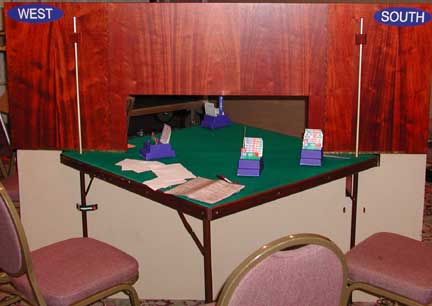
Like the article mentioned, this is how (some) bridge tournaments have been played for a long time for what its worth.

Not in separate rooms, but with a screen in the middle hiding your partner.

http://www.bridgehands.com/S/Screen_Bridge.jpg

Maybe its hard to get if you're not used to the game, but cheating like that is amazingly offensive.

Screens aren't used very often though - I wasnt a great player, but I played in the youth championships in Sweden a few times, and we didnt use screens, and I never once felt like it was needed - it's just not the done thing to cheat.

Post reply on HN