Live data from Hacker News

Marvin Minsky: What makes mathematics hard to learn? (2008)

web.media.mit.edu

131–140 of 175 posts

Re: Marvin Minsky: What makes mathematics hard to learn? (2008)

#131
post #123
post #88

Earlier quoted context omitted.

That's a pretty interesting way to put it. I feel that the math-related fields also have a long half-life: EE, ME, Statistics, Physics, etc.

The EE and ME stuff won't exactly be wrong , but could become out of date because of new device types and materials. Imagine studying EE before solid-state devices and ICs, for example. But it's still a pretty long half-life compared to biology!

Good point. Still, a drastic revolution in devices isn't something that happens often.
Re: Marvin Minsky: What makes mathematics hard to learn? (2008)

#132

> Anecdote: I asked a certain 6-year-old child “how much is 15 and 15”and she quickly answered, “I think it’s 30.” I asked how she figured that out so fast and she replied, “Well, everyone knows that 16 and 16 is 32, so then I subtracted the extra two 1’s.” Wait, is this girl some kind of base-2 native?

This is how i often work with things. I break them down into things that i know how to work with. I search my knowledge for elements that most closely represents the problems and then combine them. For example, rather than remembering 12 * 6 = 72, i recall that 10 * 6 = 60 and 2 * 6 = 12, hence 60 + 12 = 72. I don't need to remember as many things and for me i can do that much faster than trying to recall it. My memo…

Incidentally, this is now explicitly taught in elementary school math classes. They call it 'number bonds' and it often drives parents crazy because "OMG IT ISN'T HOW I LEARNED IT!", but it is clearly a better strategy than 'just memorize this multiplication table'

Re: Marvin Minsky: What makes mathematics hard to learn? (2008)

#133

Earlier quoted context omitted.

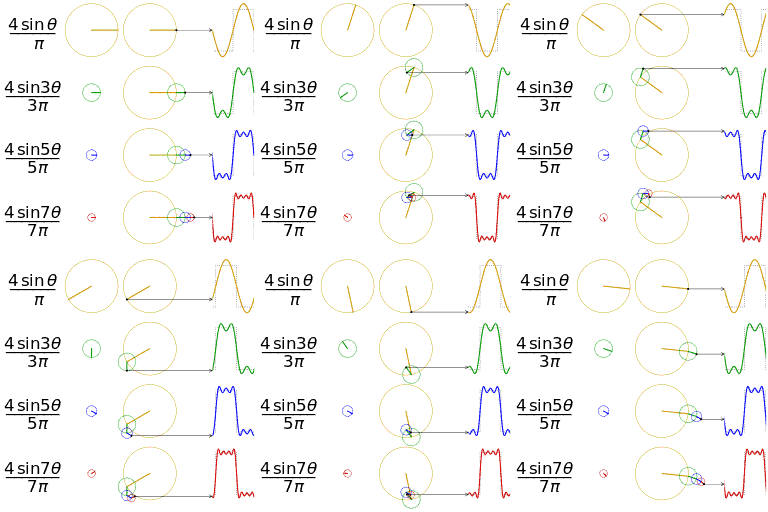
Far from impossible, it's even reasonably intutitive. Wikipedia has an excellent graphic https://en.wikipedia.org/wiki/File:Fourier_transform_time_an... . Then for people for which that's too abstract, I find this graphic helps a lot in explaining. http://static.nautil.us/1635_42a3964579017f3cb42b26605b9ae8e... You picked a really bad example for the unintutiveness of mathematics.

Speaking in my capacity as a person who doesn't understand Fourier transforms, I'm afraid I have to say that your "intuitive" graphics are anything but. I can't even make sense of your second graphic. Just a data point for you.

Fair enough, it works a lot better as a gif. Out of curiosity, does this clear things up, or just as confusing?

https://upload.wikimedia.org/wikipedia/commons/1/1a/Fourier_...

Re: Marvin Minsky: What makes mathematics hard to learn? (2008)

#134

Earlier quoted context omitted.

I'm not sure that is what he means with a "cognitive map". I believe, he means that children need a better understanding of what is possible to do with, and what the point is with math.

Agree. For me it was games. While other kids complained about algebra, I recognized it as exactly what I had been doing with my little Apple II games, basically fumbling on my own. Now each math lesson was a chance to make my games even more interesting. My first graphing calculator had a simple example of 3D point rotation. It was like learning a magical incantation! (This is pre-internet.) My friend and I were so e…

The other benefit is a lot of math intuitively makes sense in the context of using it for games. I started learning linear algebra when I was ~14 or so because I was trying to make a 3D game and had a specific idea of how the camera should operate—quaternions, once I got past the sci-fi name, just made sense in the context of rotating the camera around. That, in turn, made complex numbers a piece of cake when I got to them in school.

Re: Marvin Minsky: What makes mathematics hard to learn? (2008)

#135

He makes a really good point about traditional teaching methods. What's the point with the obsession over 'the correct method'? If the answer is correct, and the method in question can reliably reach the correct answer, in my opinion, the correct method is that one, and it differs from person to person.

It's not about solving that particular problem. They are teaching a method of problem solving. You're teaching a person to have different tools to solve problems instead of just relying on the methods they already know.

In an ideal world maybe the teacher could tweak the problem each time they see a person using a different method, to make the problem one that forces a person to use the method they are trying to teach. In the real world you usually can't give each student that kind of attention. You just have to say, "Look, I know you could solve it that way, but I need you to try to solve it this way so we can learn this method."

Re: Marvin Minsky: What makes mathematics hard to learn? (2008)

#136

Earlier quoted context omitted.

Speaking in my capacity as a person who doesn't understand Fourier transforms, I'm afraid I have to say that your "intuitive" graphics are anything but. I can't even make sense of your second graphic. Just a data point for you.

Fair enough, it works a lot better as a gif. Out of curiosity, does this clear things up, or just as confusing? https://upload.wikimedia.org/wikipedia/commons/1/1a/Fourier_...

Oooh. Yes, actually; I think I have an idea about what's going on (and why they're so damn useful) now.

Thank you!

Re: Marvin Minsky: What makes mathematics hard to learn? (2008)

#137
post #103

Earlier quoted context omitted.

Math notation is actually pretty great and is a result of multiple iterations. Earlier forms were much worse. S-Expressions by themselves are obviously not enough, you have to introduce at least first-order logic notation, set notation, etc. It's not obvious that the end result will be anywhere near as readable as the current notation.

Current math notation may be the result of multiple iterations, but they all took place before the widespread availability of computers. Current math notation is optimized for hand-writing and manual rather than automated proof checking. It may be great for paper and pencil, but times have changed. And BTW, the notation actually sucks for paper-and-pencil too because of its ambiguity. See: http://mitpress.mit.edu/sit…

When did Scheme get this "curried define": (define (((f x) y) z) blah)?

I'm sure that isn't in R5RS and I don't see it in R7RS. I found a description in the Racket manual.

In any case, I like how they are making the context explicit. In the regular math notation for the physics, you just say something like "the Lagrangian for the free particle" and then just spew out something with free variables sticking out of it, like velocity "v". The hacker in me of course asks, how the heck does that work if I have two particles? There is only one v? When we have two, we hand-wave in some subscripts: v1, v2, ... This system makes it explicit: it's the Lagrangian for a particle. So the particle appears as a parameter, and that parameter has accessors on it to retrieve its properties: velocity of the particle, etc.

Re: Marvin Minsky: What makes mathematics hard to learn? (2008)

#138
post #97

Earlier quoted context omitted.

I agree completely. But I also think it is helpful to understand how others who may have focused on this issue more than I have to date are approaching this. I see a fair amount of discussion regarding how we can do a better job of introducing math to children, but far less on what we should actually do. Should I just start playing around with LOGO or Scratch myself?

When my kids were younger, the curriculum that their school used was more about the aha!s and connections than about rote recipes. I volunteered in one's first grade math class where they spent 20 minutes of the 45 minute math period learning to draw puppies and kitties so they could answer the question, "Sue has 15 puppies and kitties. How many of each does she have?" The goal was to get the kids to come up with eve…

On the total flip side I remember when studying math in high school most of the other students HATED the math questions that required writing. It was like by that point they preferred the memorization. Maybe because that is what they were used to. Having to think about how to actually apply math was difficult for most of them.

Re: Marvin Minsky: What makes mathematics hard to learn? (2008)

#139

Earlier quoted context omitted.

This is super interesting. I tried to look for any reference of this, but found nothing. Do you happen to know if this thought of his is available somewhere, in a book, a paper, etc? Or is it a concept borrowed from someone else?

There is a wikipedia entry on the concept: https://en.wikipedia.org/wiki/Half-life_of_knowledge

Thanks. Useful.

Re: Marvin Minsky: What makes mathematics hard to learn? (2008)

#140
post #130
post #117

Earlier quoted context omitted.

Well, at least the languages you use stay pretty much the same? Javascript, HTML, and CSS are always going to be there. Although.. I suppose that could be considered both good and bad..

While that's half-true, compare ES3 to ES2015, or DHTML to HTML5.

This was a transition that took years though, plenty of time to learn the new technology.
Post reply on HN