Live data from Hacker News

Why Are Corporations Hoarding Trillions?

nytimes.com

291–300 of 412 posts

Re: Why Are Corporations Hoarding Trillions?

#291
post #217

Earlier quoted context omitted.

I'm coming around to the opinion that taxes on income are a bad idea. Income flows to people as they're trying to accumulate wealth, trying to climb from lower to middle to upper class. Higher taxes on income, especially highly progressive taxes, make it harder for people to move between social classes. The focus on income tax creates a situation where the person who makes $200k/yr but has a net worth of $0 gets taxe…

One big issue is feasibility: It's much easier to track, meter, and tax income as it changes hands than it is to track/meter/tax accumulated wealth.

Feasibility is a valid concern. Here's what I think.

Stocks are traded on public exchanges. Land and buildings stay in one place. Private jets need to land at airports and they each have a tail number. Most things to be sold efficiently are sold in public marketplaces. There are probably some assets that are hard to track, just like there is currently income that is hard to track. Some people are paid in cash and don't report it. A whole multi-billion-dollar black market of drugs, prostitution, etc. exists that is largely not income taxed. It happens. But in general income tax works, and a wealth tax would too.
Re: Why Are Corporations Hoarding Trillions?

#292
post #207

Earlier quoted context omitted.

That often cited minimum wage statistic also just so hapens to start at a time when minimum wage was near it's all time high on an inflation adjusted basis. Why do you suppose that is? A basic income is a far better solution than our current mess of bureaucratic welfare programs that are both inefficient and rife with harmful unintended consequences for those they intend to support. Milton Friedman's "negative income…

One thing I don't understand about basic income is how to deal with children. If the parents get the basic income of a child, then that will incentivize some people to have more kids simply to get more money. If you don't give basic income for kids, then people with a lot of kids won't be able to live. Of course, you can adjust the amount between the too extremes of full basic income and no basic income for kids, but…

There already are tax and welfare benefits to having children, and indeed it does incentivize having them when you really can't afford them. It doesn't seem sustainable long term, but we'll see. I don't think it's a problem with basic income any more than the current system. The bigger issue I find with basic income is that proposals typically don't include any mention of price control on the seller side and purchase control on the buyer side. Poor people are often trapped there because every local actor selling them stuff is trying to maximize rent extraction, and they continually buy things that are expensive and bad for them (case in point the recent cigarette article). Landlords get a lot of money from rent extraction, since they're paid in rent directly. It's even worse with universal, unconditional basic income. If as a landlord I hear everyone in my apartment complex is now getting an unconditional basic income of $20k/yr, guess what, next year rent prices are going up by around $20k, with lowered adjustments to account for other actors (like local food suppliers) also competing for this extra $20k/person/yr. This is basically the same thing that has happened to student loans. Without authoritarian measures to restrict economic freedom, which in addition to being authoritarian must also be good measures so as to not backfire as every other centrally planned economy has, basic income has no real chance at a large scale. In America in particular, authoritarian anything is a no-go.

Re: Why Are Corporations Hoarding Trillions?

#293
post #88

The US is out of demand. Workers are spent out. Thus, there's no need to increase output, because nobody has the money to buy it. The US has huge excess manufacturing capacity, thousands of malls which could handle more traffic ("there's always parking at Sears", a rather pathetic ad), and services which could handle more business. There's a glut of capital, plenty of available unemployed or underemployed workers, no…

Is this so bad? Falling into something of a European-type rut with permanent 8-12% unemployment and modest GDP gains? I remember the 90s. Everyone was buying shit non-stop. What kind of life is that? Sure it created jobs and growth but to the ludicrous end where we refused to accept the gravy train was ending. I remember Bush 43 pleading for Americans to "go back shopping" the black friday after 9/11 when the writing…

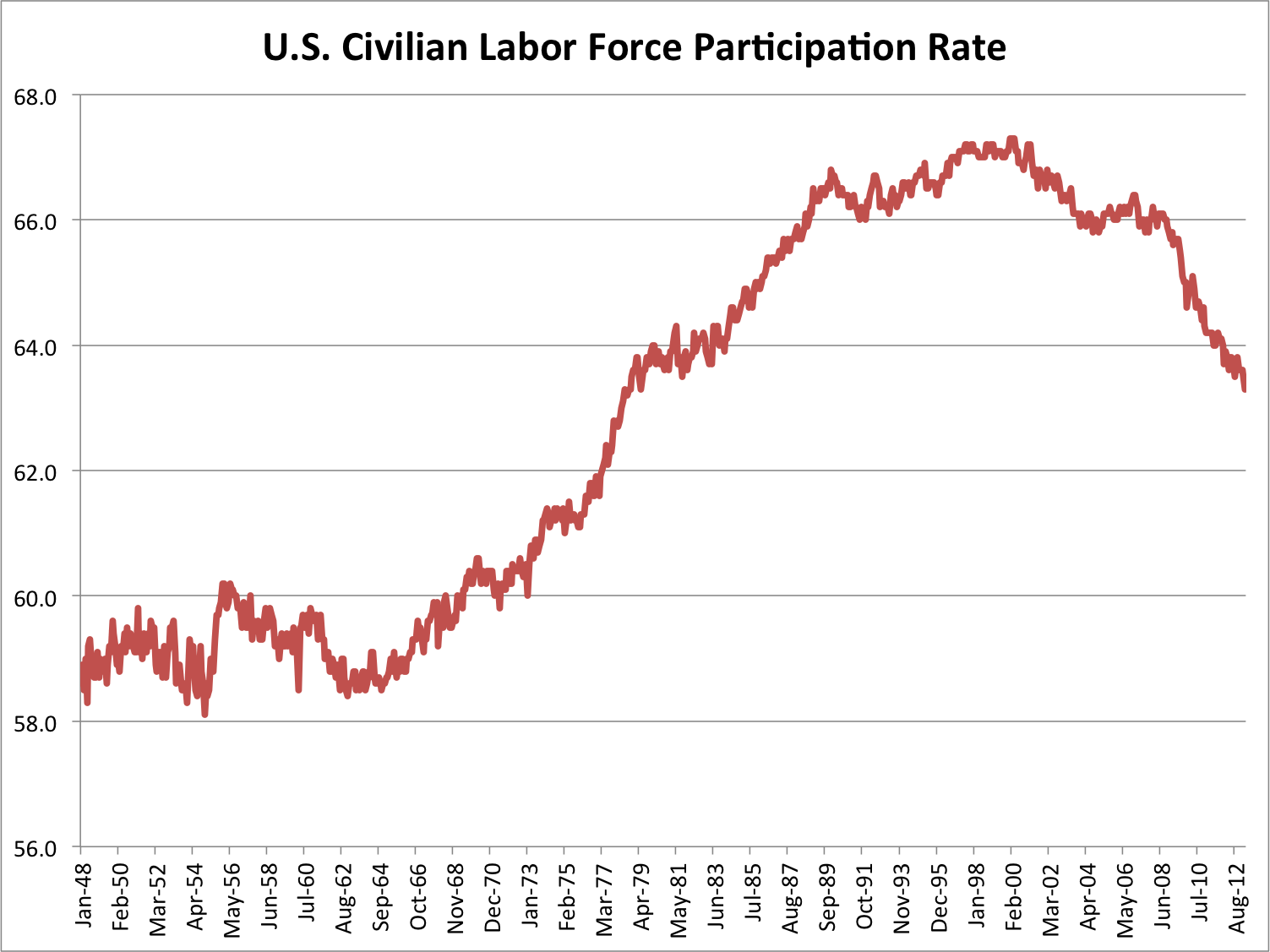
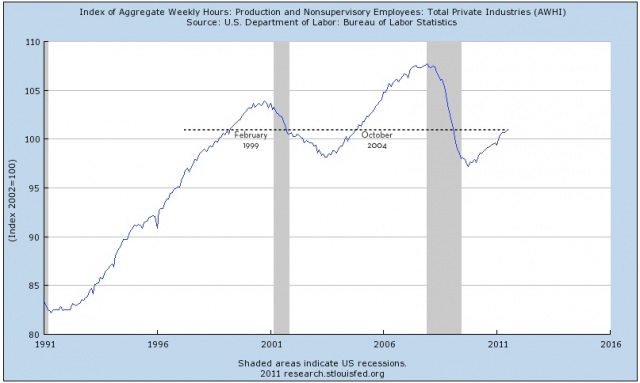
While statistics are tricky, I think there's a decent chance your entire premise - that we have all had a modest cut to our hours in exchange for less consumer goods - is untrue.

http://www.mybudget360.com/wp-content/uploads/2011/07/index_...

http://bigpicture.typepad.com/comments/images/wsj_prod_vs_ho...

https://qzprod.files.wordpress.com/2014/09/average-annual-ho...

especially for allegedly supervisory positions with job security & a salary, which no longer have to pay overtime; Hours worked per full-time employee has gone up, while part-time hourly positions have become much more common. Hourly jobs we now expect to work just enough that no benefits are offered (~39.9 hours), and double up to 78.8 hours over two jobs if we want to actually support a family... the better half of retail jobs will respect that sort of arrangement, while the worse half will require you to work 25-39 hours virtually "on-call", coming in whenever a gap presents itself, if you want to achieve that many hours.

The death of the labor movement has not helped the situation.

The best I could find to support your argument is

http://b-i.forbesimg.com/theapothecary/files/2013/07/PTEcono...

http://ibankcoin.com/news/files/2013/04/labor-force-particip...

Re: Why Are Corporations Hoarding Trillions?

#294

Earlier quoted context omitted.

I'm all for higher taxes on capital, maybe with some exceptions on the amount of capital gains tax to pay on your first €10m. But honestly, a wealth tax is just demotivating. Not every wealthy person invests their new found riches. It makes sense only to tax gains from investments, but only gains. Not making money on your capital? No problem, you don't pay. If you are, you do pay extra tax. I don't even think it's a…

> Second point against a pure wealth tax: some of that wealth might be tied up in very illiquid assets Isn't this an argument against real estate taxes in general, which are universally accepted? There are mechanisms to recover those taxes eventually.

Right. For example, if we don't like the idea of someone with wealth but no income needing to sell off part of their land or stocks every year, we could attach a debt to them that would be paid later when they eventually do sell some of their assets, or upon their death, etc. This could be arranged like a government loan with a low fixed interest rate, so if they wait 10 years to pay their taxes they'd owe their taxes plus some reasonable interest rate.

Re: Why Are Corporations Hoarding Trillions?

#295
post #235

Earlier quoted context omitted.

We have succeeded as a civilization: we are providing far more than we could ask for. Really? There is nothing you could improve in the human condition that would make life better?

Of course there is. The point is, we've reached the stage of our advancement when, on aggregate, we produce more than we actually need. Our current issues are with distribution of what is being produced.

The poor would love to have newer cars, consume more services, have nicer homes, etc. So then how are we producing more than we need?

Re: Why Are Corporations Hoarding Trillions?

#296
post #273

Earlier quoted context omitted.

Of course there is. The point is, we've reached the stage of our advancement when, on aggregate, we produce more than we actually need. Our current issues are with distribution of what is being produced.

Not sure that I would agree there. What if the "excess" production funds a cure for cancer? What if that cure requires additional resources? The world isn't static.

I'll try by best not to sound like a raging sociopath here.

In pure economic terms, curing cancer has little benefit to society. Cancer is not any one specific disease. It's a class of diseases, of which there are thousands (or more) of variants.

We may stumble on some amazingly technologically advanced cure to some forms of cancer but the more rare the form, the less likely there will ever be a treatment.

Most people get upset when you talk about humans as assets because we're indoctrinated at a very young age to value human life above all else.

If you can, in fact, speak about humans in economic terms of supply/demand. We have an overabundance of people, and nothing useful to give them jobs to do.

It's like the current oil market. Oil was highly valued due to the inelasticity of supply. Now that there is a glut of over supply and inelasticity greatly reduced, the value has dropped dramatically.

The supply of humans capable of doing useful work used to be somewhat constrained. Now, we have more people than can be reasonably assigned to do useful work without essentially paying them to warm a chair. Yet, like the oil market nothing is stopping people from having more kids and increasing the supply. The government even directly subsidizes people for the number of children they have due the persistent belief that GDP is directly dependent on population.

People can increase their value proposition by earning many degrees and racking up huge amounts of debt but, unless you're going to work in the industries that are thriving, it's a buyers market for employers.

Business owners have their choice pick of the herd. They can keep wages as low as possible and skim more cream off the top because there's a line out the door of people waiting the replace a worker who quits.

Who knows, maybe this is just the supply limit (ie in environmental science terms) as it applies to the human population. Poverty and misery is the expected result of making too many people before we can come up with enough useful reasons to sustain them.

Re: Why Are Corporations Hoarding Trillions?

#297
post #88

The US is out of demand. Workers are spent out. Thus, there's no need to increase output, because nobody has the money to buy it. The US has huge excess manufacturing capacity, thousands of malls which could handle more traffic ("there's always parking at Sears", a rather pathetic ad), and services which could handle more business. There's a glut of capital, plenty of available unemployed or underemployed workers, no…

> Sales decline each week after payday, then recover after payday.

This has always been true. My dad, a career Air Force officer, would shake his head at the servicemen who ate steak after payday, and were down to eating beans by the next.

Heck, I read Ambrose's book about the building of the intercontinental railroad in the 1860s, where he describes the profligate spending of the construction crews immediately after payday, and the Hell On Wheels camps that sprung up to take that money, providing hookers and blackjack.

Re: Why Are Corporations Hoarding Trillions?

#298
post #207

Earlier quoted context omitted.

That often cited minimum wage statistic also just so hapens to start at a time when minimum wage was near it's all time high on an inflation adjusted basis. Why do you suppose that is? A basic income is a far better solution than our current mess of bureaucratic welfare programs that are both inefficient and rife with harmful unintended consequences for those they intend to support. Milton Friedman's "negative income…

One thing I don't understand about basic income is how to deal with children. If the parents get the basic income of a child, then that will incentivize some people to have more kids simply to get more money. If you don't give basic income for kids, then people with a lot of kids won't be able to live. Of course, you can adjust the amount between the too extremes of full basic income and no basic income for kids, but…

Pay people to get IUDs or vascectomies. Some might argue that this is corrosive, but:

1) If a single mother/father only spent 1 hour a week taking care of their kid, they would surely be punished for neglect. So we are willing to literally coerce people who choose to be parents into working at least 52*18...938 hours. At a minimum wage of $5.35, that is at least $5,000 of coercion.

2) If we have a workable basic income, then someone shouldn't find themselves in the desperate position of having a medical procedure done to make ends meet unless we don't have universal healthcare.

Re: Why Are Corporations Hoarding Trillions?

#299

Earlier quoted context omitted.

In your example, aren't you implying that landlords and other wealthy individuals aren't simply not spending, but actually hoarding cash? Most wealthy individuals aren't holding cash, they put the money in a savings account or investment that has a return. This money appears to be held to most people, but even money in a savings account makes its way back into the economy by affecting the reserve requirements of bank…

In theory that money in a savings account or investment vehicle gets circulated back into the rest of the economy, but I think what we're seeing is that cash is tied up in some sort of buffer/holding effect in the financial sector, basically accumulating in ineffective places. The bulk of the money certainly doesn't seem to be circulating through the hands of individuals where it would likely spur more economic activ…

This is a really interesting observation. I've never heard someone mention a "buffer/holding effect" before, but that makes a lot of sense.

I wonder if it's something like... the average individual spends half of whatever cash they have available every year... but the average business that takes investment lets 6 to 12 months of it sit in accounts. I realize the bank would then loan against the money in those accounts, but is it "turtles all the way down"?

I'll have to refresh my understanding of fractional reserve banking, but I don't think a loan from Bank A being put into Bank B and so on can lead to infinite money supply. If I remember correctly it somehow leads to some multiple of the input money being generated. Here's a Wikipedia article about it:

https://en.wikipedia.org/wiki/Money_multiplier#Reserves_firs...

At some point all the institutions sitting on their money eventually does result in that money being sat on, and not being circulated through the economy.

Re: Why Are Corporations Hoarding Trillions?

#300

Earlier quoted context omitted.

The trick is, you don't invest during the downturn, hence all the cash hoarding. You invest after it bottoms out for a while. Macro economies do not recover like a rocket, the window to invest is very large, so large that if you only recognized the bottoming out a couple years later, you still haven't missed the opportunity.

That is a really interesting point. So I've never invested in stocks before (preferring to invest in my own business) but have decided to diversify and am only seeking returns in a 5-15 year bracket (but want to minimize 1-5 year downside so it could potentially work as an extra emergency fund too). I had assumed being 20%+ off of the highs, it'd be a good idea to start getting involved now, but.. maybe I should wait…

Don't try to time the market, it's a fool's game. Do regular purchases of a broad index ETF (exchange traded fund, low fees!), AKA dollar cost averaging as another child mentions. If you are worried about downswings, keep your portfolio balanced to roughly 50% equities and 50% bonds (there are broad bond index ETFs too).
Post reply on HN