What the CEO and upper management of these corporations say about this? Surely, they were asked about this by shareholders?
Why Are Corporations Hoarding Trillions?
11–20 of 412 posts
Re: Why Are Corporations Hoarding Trillions?
#12> Remarkably, the United States government was able to tax all that productive corporate behavior so much that it came close to paying off all its debts for the first time in 160 years.
The current US debt is over 18.900.000.000.000 $ (http://www.usdebtclock.org/#). Am I getting the author right that the US managed to put on 18 B $ in 20 years?!
Re: Why Are Corporations Hoarding Trillions?
#13It seems to me that holding large amounts of cash is only viable when inflation stays low. So a higher level of inflation might cause the release of some of these huge cash reserves in the form of real investment (real in terms of hands doing work instead of moving the cash to some other financial instrument)...
I mean, cash doesn't need to literally be a pile of money right? It could be in some kind of ultra short term instrument that has some kind of inflation protection. Normal people could buy t-bonds to exactly match inflation. Not sure what options are out there when you have 100 billion dollars - but something like interest rate futures could hedge you against inflation risk.
Re: Why Are Corporations Hoarding Trillions?
#14This article does a good job of explaining:
http://www.dailyfinance.com/on/corporations-cash-hoard-trill...
Some interesting excerpts:
"Four of the top five holders of cash are tech companies ...who together possess...about 23 percent of all cash owned by corporate America today. Overall, the tech sector controls more than half of such cash"
"about 60 percent of [non-financial corporate] cash piles are offshore and subject to as much as 35 percent tax if brought back to the U.S."
Re: Why Are Corporations Hoarding Trillions?
#15Earlier quoted context omitted.
Holding cash is essentially an investment in the sovereign government that controls that currency. Simply sitting on cash does not imply little or no risk.
It's not risk-less, but it's way less risky than every other alternative.
Possibly only if you are operating in a single market. If you have currency/soverign risk because you are selling in 100 countries, it's way more complex. I bet Apple doesn't consider all the rubles they have from their operations in Russia as less risky than parking it in US treasuries. The problem is getting it there...
Re: Why Are Corporations Hoarding Trillions?
#16> Remarkably, the United States government was able to tax all that productive corporate behavior so much that it came close to paying off all its debts for the first time in 160 years. The current US debt is over 18.900.000.000.000 $ ( http://www.usdebtclock.org/# ). Am I getting the author right that the US managed to put on 18 B $ in 20 years?!
Trillion.
Here's a chart of debt as a proportion of GDP:
http://dailyreckoning.com/dr-content/uploads/2015/06/Histori...
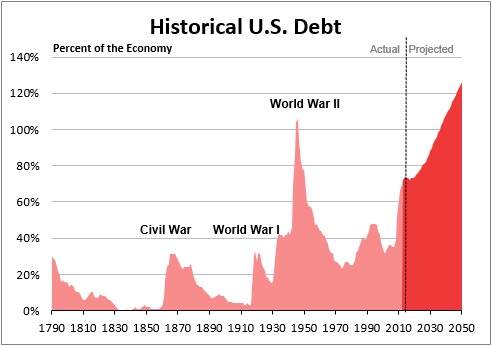
Re: Why Are Corporations Hoarding Trillions?
#17I think it's because the Fed's past easy-money policies (QE). The idea of QE is that the Fed puts a ton of cash into the market in order to encourage investment. However investment pushes asset valuations higher. Once asset valuations are high enough, people stop investing because the fundamentals don't support the valuations.
The money injected by the Fed will eventually be absorbed by inflation and the Fed reversing course and raising rates to suck money out of the market. But inflation's been low and the Fed's only done a single, very recent increase in interest rates, so "eventually" hasn't arrived yet.
I think the "big thing" they're waiting for is for the investment market to become less competitive. One way it becomes less competitive is with investors exiting the market (because they have things to spend their cash on, like bonds), another way it becomes less competitive is with more startups to invest in.
So by this analysis, the next couple years will be a great time to own equity/options in a startup -- those balance sheets are just waiting for the right opportunity to make an acquisition.
Re: Why Are Corporations Hoarding Trillions?
#18> Remarkably, the United States government was able to tax all that productive corporate behavior so much that it came close to paying off all its debts for the first time in 160 years. The current US debt is over 18.900.000.000.000 $ ( http://www.usdebtclock.org/# ). Am I getting the author right that the US managed to put on 18 B $ in 20 years?!
Yeah, I'm not sure what the author was trying to say there, because that's not even close to true. The US wasn't getting anywhere near to paying off the national debt in the 1990s.
https://en.wikipedia.org/wiki/National_debt_of_the_United_St...

Re: Why Are Corporations Hoarding Trillions?
#19Looks like the TL;DR of this article is: "Corporate leadership, being so much smarter than the rest of us dummies, sees something big on the horizon coming. They're saving all their cash so they can later invest because "the next transformative innovation could be just around the corner". Apparently they're smart enough to hoard all this cash, but not smart enough to know exactly what that transformative innovation is so they can get started on it right now.
Let me propose an alternate theory: They're no smarter than the rest of us, and NOBODY knows what to invest in anymore. Corporate leadership is uncreative and can't think of anything else to do with that money that will produce returns in excess of what they're already doing. Shareholders don't want the money back (they'll just turn around and invest it into another company that already has a pile of cash). And they sure as shit won't throw a bone to employees (whose wages have been stagnant for a decade). So, what are they going to do with it all? Who knows? Let it sit in a bank account!
Re: Why Are Corporations Hoarding Trillions?
#20It's the same reason I save my money: for opportunities when prices are low. This is especially relevant now that the stock market is tanking. Most people with any kind of money think this way.
>It's the same reason I save my money: for opportunities when prices are low.
So then you buy low, and no longer have money saved for even lower opportunities. The logic of this plan doesn't make sense. You can't both be saving for and spending on opportunities, and you have no way of knowing when or what opportunities might arise.
>Most people with any kind of money think this way.
According to...?