So, about a week ago, I wrote a piece that I feel has a solid point and I posted it on Hacker News. It hit 39 karma and had 54 comments. Not impressive for Hacker News overall, but, hey, decent for my own personal blog's track record. The top voted comment on it is incredibly dismissive, completely dismissing my 6-ish years of college, more than 5 years working in insurance, etc. over one detail that wasn't thoroughl…
The internet has made defensive writers of us all
131–140 of 186 posts
Re: The internet has made defensive writers of us all
#132As engineers, we are hardwired to nitpick. Coming up with counter-examples is the default response. Instead, I try to say a supporting example first. This helps me learn from other people's point of view. Edit: Though I admit I don't do the best job on HN. :/
I agree. Programming is an applied form of constructive logic. A program that works is an example (existence proof) that its specification (a theorem) can be fulfilled (proven). When we review code, we’re generally trying to disprove—looking for ways in which the program doesn’t fulfill the specification.
Re: The internet has made defensive writers of us all
#133I am fairly new to Y-Combinators Hacker News. Unfortunately, I've run head-long into this very issue on this forum. It ruins the experience. There is value in communicating figuratively and/or with metaphors. When creatively solving problems, looking for trends or drawing a hypothesis out of the ether, it is often desirable to avoid specifics. In my opinion, one's inability to comprehend and respond to any given stat…
I think that HN is one of the rare forums where this article doesn't apply. Usually the top comment in a particular thread contains the least hedges and most enthusiastically espouses a particular opinion. The comment is not usually overly bombastic (though it sometimes is). The comment almost always adopts the majority opinion on HN. Posting a comment not aligned with the majority opinion carries a risk of at most -…
There is a major psychological effect from getting attacked for stating an opinion you might hold to heart. As an avid reddit/hn commenter, I feel it often.
I don't really care if someone disagrees with me on something minor, but if it's something I truly believe is important and I see people disagreeing with it left and right and downvoting anything in line with that opinion, it makes me feel weakness and despair.
Weakness: I am overwhelmed by the people disagreeing with me. I can't answer everybody. Not because I don't have the arguments but because it's pointless, won't lead anywhere and will achieve nothing but make me look insane. The "hivemind" effects makes widely-held opinions even stronger and minority opinions even weaker. Alone, I am powerless to counter that.
Despair: Let's say someone thinks gays/black/women/whatever shouldn't [have some human right]. You truly believe that's wrong. If someone says to me "I think women shouldn't have the right to vote" and is impossible to convince, I feel pretty awful about it. I feel like that person is contributing in making the world worse, and I live in that world.
Now what if that's not about some minority-held opinion, but about something far more widespear? What if it's, for example, similarly insensitive and disgusting comments about islam/muslims? I don't just feel awful being around that person, I feel crushed by the amount of people who would agree with it. I'm quite afraid of what happens when such opinion is widely held. I feel like I'm looking at a lifetime of awful and I feel crushed by it.
My fiancée is a muslim. This is empathy kicking in. Not everything affects me that way, but I'm far less likely to comment on something I don't hold to heart.
But yes, I do enjoy HN because the hivemind effect is far more limited. The hidden downvotes and sorting algorithms are a million times better than Reddit's. It's not ideal, but it's still an excellent place to have discussion and a "good enough" place to have debates.
Re: The internet has made defensive writers of us all
#134So, about a week ago, I wrote a piece that I feel has a solid point and I posted it on Hacker News. It hit 39 karma and had 54 comments. Not impressive for Hacker News overall, but, hey, decent for my own personal blog's track record. The top voted comment on it is incredibly dismissive, completely dismissing my 6-ish years of college, more than 5 years working in insurance, etc. over one detail that wasn't thoroughl…
Is there a way to use comments as an editorial device? A wiki-like solution, combined with a MS-Word Track-changes features, where you can make changes, and leave comments and it all shows up on the same page? Like with the health care article example, the first 90% of that seems like pure fluff (when it isn't making a false or misleading or questionable statements), essentially padding added to a high-school report…
Why do you think 90% seems like fluff? Based on comments on Metafilter where all I did was talk about DPC, I felt the background info was necessary.
But I do hope to write a more professional version and I am in talks with a publication that may take it. So I am keenly interested in feedback.
Thanks!
Re: The internet has made defensive writers of us all
#135I feel compelled to write about race issues because I am a person of color. The issues directly impact my life. But I'm afraid because readers might be pissed off enough to get me fired. :/
I also feel compelled to write about race issues. I don't write about them, though-- the issue is too poisoned to even approach if you aren't the correct race. I churn quietly instead.
If you don't want to take the time to do that, that's fine. But don't churn. And don't blame other people.
I'm a white male and I feel totally confident expressing my opinions on race and gender, including opinions that go contrary to mainstream feminist and anti-racist positions. You might be surprised to learn that women and people of color are not unified in their beliefs about race and sex.
But that's only because I've taken the time to listen very carefully to criticism, to listen particularly carefully and gently when someone is telling me something that seems wrong, and do my own research. It's not just a matter of watching the world go by and having an opinion.
Re: The internet has made defensive writers of us all
#136I'm seeing way, way, waaaaaay too many commenters here who apparently came away from this thinking that "defensive writing", as described by the author, has anything to do with not offending people. That's totally orthogonal to what the author is talking about. He's talking about the tendency some people have to take everything as literally as possible, finding some logical hole in an argument based on a very literal…
> ...this method is justified, because we know the earth is flat.
This is one of the core techniques in esoteric writing. What the great error does is intentionally push the dynamic of the conversation away from agreeability on the surface towards "picking apart and puzzling". People who aren't inclined to think about things will miss the great error entirely and go on without feeling the need to remark(since the essay's surface will usually be framed towards an audience's status quo), but once the error is discovered, the rest suddenly falls into doubt, and then literal thinkers are suddenly confronted with an essay that is far more challenging, because your error was not just an error, but a trap to force them to think about the other statements carefully in order to "prove you more wrong". It is their thinking, and not yours, that becomes warped. To pull this off the essay has to hold a tension between truth and falsity where some statements hold true even under inspection, while others don't.
This also makes the resulting comment threads much more lively since they will consist of smart people falling over themselves to show how wrong and stupid you are, only to find their minds are changed by the end.
Re: The internet has made defensive writers of us all
#137Earlier quoted context omitted.
It's one of the surprising side-effects of the Internet that anything whatsoever you might say in a public forum can potentially offend someone, somewhere, somehow.
You can look at this positively and that if someone gets offended then at least people are reading your work. It is very disheartening when you take the time to write something thoughtful and you get no response at all.
> It is very disheartening when you take the time to write something thoughtful and you get no response at all.
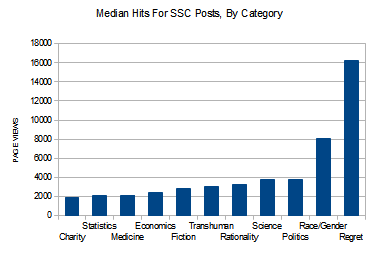
Scott Alexander explored this topic in [0]. He also laments the fact that the posts he considers most valuable are read the least, while his most controversial ones are also the most popular. He even has a nice graph of it[1].
[0] - http://slatestarcodex.com/2014/12/17/the-toxoplasma-of-rage/
Re: The internet has made defensive writers of us all
#138Earlier quoted context omitted.
Which is great for code reviews, but terrible for sensitive topics like diversity, etc.
Are you sure? I think there are a lot of good, but fragile ideas, even in software. And culturally, the tech world tends to destroy them.
Re: The internet has made defensive writers of us all
#139A great quote from the article: "The defensive writing style also encourages another sort of ugliness, which is that “avoiding saying something wrong” becomes a primary focus of the writing, rather than communicating or exploring ideas which the author might himself be unsure of." One thing that's great about Gwern Branwen's writing is that Gwern's essays are accompanied by a "belief tag". That tag gives the ability…
This sort of matches the way I personally thing about information and my own opinions. Back in my head I always have this feeling of "degree of confidence", of how sure I am about what I'm saying, and it's often hard to express it in the speech itself. It fits perfectly as meta-data / qualification. Saying once, "this is a thought I'm playing with, I'm not sure either way" beats having to qualify every sentence with "maybe".
Also, I have most fun reading arguments that sound totally convincing to me but are tagged by author as something he doesn't have high confidence in. I end up having to figure out how this smart guy just convinced me of something he himself isn't sure about.
Re: The internet has made defensive writers of us all
#140Earlier quoted context omitted.
For which the Principle Of Charity was created: https://en.wikipedia.org/wiki/Principle_of_charity
It would be brave person indeed who put their faith in this on the public internet.