Live data from Hacker News

My simplified response to Paul Graham's simplified essay

blog.rongarret.info

131–140 of 211 posts

Re: My simplified response to Paul Graham's simplified essay

#131
post #82

Earlier quoted context omitted.

This wealth is based on social cohesion, which can fall apart in a generation or two. Genghis conquered half of Asia and built an empire of great wealth and high culture, but lack of cohesion tore it apart not long after.

I think there is a better (though still rather disanalogous) comparison between the US with the decline of the Roman Republic into the Principate. Some of the same arguments apply to the EU. In both cases a large (and roughly similar) number of people with different cultural splits (Red & Blue/North & South European) are increasingly feeling like their governmental structures are failing to represent them. Perhaps X0…

> Perhaps X00 million people is simply too many for our existing legislative structures to accommodate at this point in history.

It's interesting. The US, and I assume the EU, has a mechanism for solving this. Simply devolve authority from the federal level to the state level. The states can, theoretically, better tailor solutions to their individual populace than the federal level can to the entire country.

However, things only seem to ever go the other direction. Maybe I just don't see the things that are devolved? Or does it genuinely just not really happen?

I suppose one could make an argument that marijuana legalization is an example of states taking back power from the federal government. They pass the laws regardless of the fact that it is still federally illegal and nothing is technically stopping the DEA from busting every single seller in, say, Denver for distribution.
Re: My simplified response to Paul Graham's simplified essay

#132
post #10

PG's simplified essay seems like attack on a strawman; he's mainly arguing that inequality is good, but then mostly everybody agrees with that. The issue people see (and PG conveniently ignores) is increasing inequality - not locally increasing (i.e. an enterpreneur becoming rich because of a successful business idea), but globally increasing inequality, which happens because of rent-seeking, tax avoidance, buying po…

> mostly everybody agrees with that What??? /me suddenly understands what's meant by "privilege"

Hm... can you find anyone who honestly disagrees with "inequality is good", and therefore claims that "inequality is bad" and so "equality is good" (and also proposes a reasonable and practical implemntation)? Even communists only preached, not practiced, this.

Re: My simplified response to Paul Graham's simplified essay

#133
post #119

Earlier quoted context omitted.

Meadian doesn't make sense when talking about inequality. 3 people having $1, $2 and $3 have the same "median inequality" as 3 people having $1, $2 and $300000000000. You need either mean, range or quantiles.

> Meadian doesn't make sense when talking about inequality. You need either mean, range or quantiles. Uh... what? The median is the 2-quantile.

Sorry, I meant "interquantile range" (e.g. 25-75th quantile).

Re: My simplified response to Paul Graham's simplified essay

#134
PG's simplified essay and a lot of its proponents seem like people, in the middle of a drought, start warning about the potential for flooding.

Yes, inequality is inevitable. Yes, the poor you will always have with you. Yes, central planning has been tried and found wanting. But that doesn't mean that the state of things is good, nor does it mean we need further deregulation, less taxes on the wealthy, and so forth. It's really weird to see threads where people argue against that the very existence of progressive taxation is some sort of statist plot.

We need less philosophizing, and more evaluation of the current state of affairs and discuss what pragmatic steps need to be taken to alleviate the situation.

Re: My simplified response to Paul Graham's simplified essay

#135
Globalization/free trade has caused wage stagnation in developed countries by allowing capital to more easily move jobs to the developing world. This system has created way bigger profits for capital, increased wages for millions in the developing world, and more wealth overall.

All this has been enabled by the great triumph of "free trade" treaties that are the first way that humans have figured out how to create enforceable laws across countries. For example, the US recently repealed meat labeling laws due to a WTO ruling. This mechanism has allowed capital to bypass democratic forces that tend towards protectionism.

But the free trade treaties arere heavily rigged towards manufacturer's interests with intellectual property industries now trying to influence them more. If labor had a seat at the negotiation table for creating cross-country enforceable rules the outcome for workers could be better. Some ideas I can imagine off the top of my head,

- free movement of labor, not just capital

- environmental rules that prevent capital from shopping for the jurisdiction where they can pollute the most

- prohibitions on child labor, slave labor, trafficking, etc

- all countries provide free education through teenage years

- global tax shelter rules to prevent capital from hiding its profits

Re: My simplified response to Paul Graham's simplified essay

#136

Great reply, although I disagree with the typical simplified assertions that the Soviet System didn't work. Without doubt the system had major flaws. But it is perhaps much more shocking that the system worked as well as it did given so many obvious problems with it. Taking a primitive peasant society and turning it into a space traveling civilisation was quite astonishing. One has to also keep in mind that for decad…

To extend on this with an anecdote; A buddy of mine lived and worked in Cuba for many years, and has very positive things to say about life there. He lives in Canada, and enjoys life in Cuba as much as he does in Canada, which I think says a lot.

Every single person has healthcare, food and shelter. Every single person has a job, and their kids go to a good school. Because everyone is paid the same, work is not the focus of life, social interactions are (which echos my experience during 2 years in Latin America) There is no point working harder or longer, it doesn't get you anything, so you go home to your family.

When you see a friend or distant acquaintance on the street, you stop and talk for 20 minutes. You prioritize family and spending time with them, rather than prioritizing work.

Obviously it's not perfect, but it's very far from the disaster it's made out to be.

Re: My simplified response to Paul Graham's simplified essay

#137

More simplified summary of the debate : PG: "Startups create economic inequality. But it looks like they drive the economy and create value. I'll defend Startups so let's say that economic inequality is not a core problem" Crowd 1: - "OMG ECONOMIC INEQUALITY IS BAD !" - "OMG you defend concentration of power in rich people !" - "OMG your pinterest wall is more important that educating you children, that's what you ca…

Yes. It's bizarre to see everyone responding to something that wasn't actually said.

Re: My simplified response to Paul Graham's simplified essay

#138
post #10

PG's simplified essay seems like attack on a strawman; he's mainly arguing that inequality is good, but then mostly everybody agrees with that. The issue people see (and PG conveniently ignores) is increasing inequality - not locally increasing (i.e. an enterpreneur becoming rich because of a successful business idea), but globally increasing inequality, which happens because of rent-seeking, tax avoidance, buying po…

Exactly. the issue is that economic growth over the last 20-30 years appears to be accruing at vastly different rates to different income brackets ( even if you remove top 1% out of the analysis ), not the starting level of inequality. Since it's the case even for say top 60% bracket vs 20% bottom bracket, having taken out the top 40%, it has little or nothing to do with startups.

Re: My simplified response to Paul Graham's simplified essay

#139
> Today, the top 1% control fully half of the planet's wealth.

I've seen that statement debated, so I was curious if it was actually true. I had to follow quite a few links before I hit bedrock. Garret links to an NPR piece[1], which links to an Oxfam "study"[2], which references a Credit Suisse report[3], which is 64 pages long and covers way more than global wealth inequality. I finally found the relevant bit on page 10, in a section named, "Distribution of wealth across individuals":

> Our estimates for mid-2013 indicate that once debts have been subtracted, an adult requires just USD 4,000 in assets to be in the wealthiest half of world citizens. However, a person needs at least USD 75,000 to be a member of the top 10% of global wealth holders, and USD 753,000 to belong to the top 1%. Taken together, the bottom half of the global population own less than 1% of total wealth. In sharp contrast, the richest 10% hold 86% of the world’s wealth, and the top 1% alone account for 46% of global assets.

Finally! Can the author please link to that instead? It would have saved me so much time. So the statement is mostly true, except note that debt is counted. That means a significant fraction of people have negative net worth. Those trading against future earnings (using student loans, car loans, mortgages, etc) will be at the bottom of the wealth distribution.

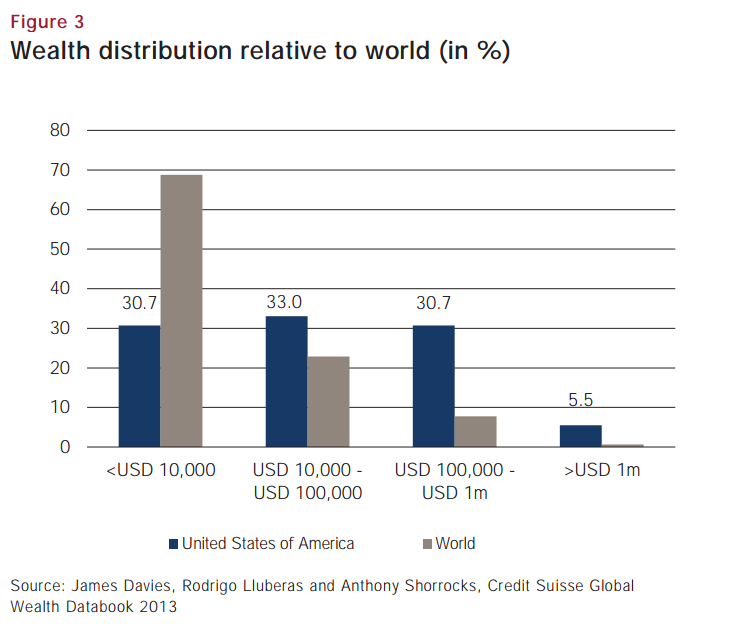
Remember, this is world wealth inequality, not US wealth inequality. What does US wealth look like? According to page 46 of the Credit Suisse report, 40% of US adults are in the top decile of wealth distribution. Heck, 7.5% of US adults are in the top 1% of wealth owners worldwide. There's a graph of US wealth distribution compared to the world.[4] It shows the US as a much more balanced place.

More than anything else, "The top 1% control half the world's wealth." is a statement about the inequality of nations, not people. Unless one is advocating wealth taxes to finance foreign aid, it's disingenuous to further a domestic agenda by citing the impoverished masses in developing countries.

I think if Garret took the time to be more rigorous, he could build a very good critical companion to PG's essay. But in its current state, it's not something I can really engage with.

1. http://www.npr.org/sections/thetwo-way/2014/01/20/264241052/...

2. It's just a short overview of others' research: https://www.oxfam.org/sites/www.oxfam.org/files/bp-working-f...

3. https://publications.credit-suisse.com/tasks/render/file/?fi...

4. http://geoff.greer.fm/photos/screenshots/Screen%20Shot%20201...

Re: My simplified response to Paul Graham's simplified essay

#140

Earlier quoted context omitted.

This is the way unemployment is calculated all over the world, so it does not affect the parent's point, which is comparative.

Country A has 5% "official" unemployment. But 20% of the population has simply given up seeking employment, lives at home with their parents, and plays video games all day. Another 30% of the population is employed part-time and barely covers their bills, even though they would like full-time work. Country B has 5% "official" unemployment. Everyone who would like to work is either employed or seeking employment. And…

The numbers are equatable, even if they don't measure what you would prefer they measure. But if you'd like to supply alternate unemployment data, I'm sure many readers would appreciate it. As it is, your post is hypothetical.

And anyway, unemployment has been measured the same way for decades. If the question is whether we stand on a societal precipice right now, then criticizing how unemployment is measured is not relevant. Of course it has shortcomings. But it has had the same shortcomings for a long time, so the shortcomings themselves are not proof that we stand on a precipice now.

Post reply on HN