Live data from Hacker News

Is there any point to the 12 times table?

blog.wolfram.com

21–30 of 198 posts

Re: Is there any point to the 12 times table?

#21
Only in non-metric countries.

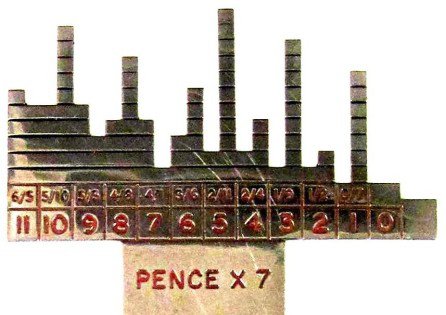
Back in the British era of pounds, shillings, and pence, hardware had to be built to do arithmetic in that system. This resulted in one of the strangest, and most complex, purely mechanical computing devices ever built - the McClure Multiplying Punch [1], from Powers-Samas. This device came out in 1938. The comparable IBM machine was the IBM 602 Multiplying Punch, but IBM only did decimal multiplies. The McClure machine had a mechanical multiplier for pounds, shillings, and pence. It contained a physical multiplication table, made out of brass plates, and the machinery to use them for multiplication by table lookup. There's a picture of the "Pence x 7" plate.[2] That's one row of a multiplication table, and it's 12 wide, from 0 to 11. Sixpence x 7 = 3 shillings 6 pence. The brass column heights reflect that.

[1] http://www.computerconservationsociety.org/resurrection/res5... [2] http://www.computerconservationsociety.org/resurrection/imag...
Re: Is there any point to the 12 times table?

#22
post #3

I recently worked with a person who had to do her three times table using her hands, starting from 3. She would still struggle at about 6 or 7 times. We worked behind the counter in a builder's merchant. She is no longer working for us.

Why not?

Re: Is there any point to the 12 times table?

#23

Forget the stats and calculus. Think carpentry, measuring and cutting wood products. If you are building things in the US/UK/Canada then you are using feet and inches. 12 inches to a foot. It's a tiny thing to learn and will serve kids well in any number of professions. Now 11, that's a total mystery. Other than it being between 10 and 12, I see no reason to memorize 11s.

> in the US/UK/Canada

And the other 94% of the world population…?

Re: Is there any point to the 12 times table?

#24
post #7

Earlier quoted context omitted.

11s are practically free, though, in base 10. The algorithm "repeat the non 11 number twice" works up till 10 x 11, where the "add a 0" algorithm for 10 kicks in. So you're just really memorizing 11 x 11 = 121 and 11 x 12 = 132.

A simple trick: For 11 x a 2-digit number you can simply take the first digit of the 2-digit number then the 2 digits of the number added together then the last digit of the 2-digit number. Ex: 11 * 12 = 132 or 1, 1+2, 2. 11 * 45 = 495 or 4, 4+5, 5. For numbers which sum to more than 10 add the carry to the first number ex: 11 * 59 = 649 or 5, 5+9 = 14 so add 1 to the initial 5 and keep the 4, 9.

I'm 29 and never heard this before. Neat!

Re: Is there any point to the 12 times table?

#26
post #3

I recently worked with a person who had to do her three times table using her hands, starting from 3. She would still struggle at about 6 or 7 times. We worked behind the counter in a builder's merchant. She is no longer working for us.

Why not?

Presumably the inability to do basic math quickly.

Re: Is there any point to the 12 times table?

#27
post #11

Twelve has more divisors than ten (1, 2, 3, 4, 6 & 12 vs 1, 2, 5 & 10). If we were really smart, we'd switch from base 10 to base 12: many more 'decimals' (really duodecimals) would be non-repeating. One can very quickly count by twelves on the joints of one's fingers, using the thumb as an index (0-143 is a much larger range than 0-10, and it's easier to hold one's hands in the shape necessary). If we were really sm…

divisors are bad. Here's why: If you have a prime (or p^n) base, you can assess how much computation you have to do based on the non-zero digits on the left.

say in hex you have a number 0x56aF900000, you know that your divisors can have no more than 5 non-zero (hex) digits. This is not so for decimal numbers; 32 * 125 = 4000

Re: Is there any point to the 12 times table?

#28
post #11

Twelve has more divisors than ten (1, 2, 3, 4, 6 & 12 vs 1, 2, 5 & 10). If we were really smart, we'd switch from base 10 to base 12: many more 'decimals' (really duodecimals) would be non-repeating. One can very quickly count by twelves on the joints of one's fingers, using the thumb as an index (0-143 is a much larger range than 0-10, and it's easier to hold one's hands in the shape necessary). If we were really sm…

Easy divisibility is the reason why when we switched to metric, the one thing that didn't switch is time. Which means that, for example, converting from m/s to km/h is a mess. (You have to multiply by 3.6, can you easily do that in your head?)

With a base 12 version of everything you would have 1/12 of a day being 2 hours, 1/144 of a day is 10 minutes, and 1/1728 of a day is 50 seconds. These units would give us both easy divisibility and are close enough to existing time units to make sense.

This change would mean we have to memorize a 12 times table rather than a 10 times table. But in base 10 a 10 times table has easy patterns for 1, 2, 5, 9 and 10. A 12 times table has repeating patterns for 1, 2, 3, 4, 6, 8, 9, 11 and 12. The result is that a 12 times table in base 12 is actually less work to memorize than a 10 times table in base 10.

In the long run this transition would be a clear win. But it isn't enough of one compared to the transition to ever make sense to initiate.

Re: Is there any point to the 12 times table?

#29
post #28
post #11

Twelve has more divisors than ten (1, 2, 3, 4, 6 & 12 vs 1, 2, 5 & 10). If we were really smart, we'd switch from base 10 to base 12: many more 'decimals' (really duodecimals) would be non-repeating. One can very quickly count by twelves on the joints of one's fingers, using the thumb as an index (0-143 is a much larger range than 0-10, and it's easier to hold one's hands in the shape necessary). If we were really sm…

Easy divisibility is the reason why when we switched to metric, the one thing that didn't switch is time. Which means that, for example, converting from m/s to km/h is a mess. (You have to multiply by 3.6, can you easily do that in your head?) With a base 12 version of everything you would have 1/12 of a day being 2 hours, 1/144 of a day is 10 minutes, and 1/1728 of a day is 50 seconds. These units would give us both…

decimals cause huge problems for computers. How do you represent 0.6 as a floating point? In the long run, the correct solution is for everything to be binary.

Re: Is there any point to the 12 times table?

#30
post #10

Forget the stats and calculus. Think carpentry, measuring and cutting wood products. If you are building things in the US/UK/Canada then you are using feet and inches. 12 inches to a foot. It's a tiny thing to learn and will serve kids well in any number of professions. Now 11, that's a total mystery. Other than it being between 10 and 12, I see no reason to memorize 11s.

That is only yet another reason in literally infinite ones why the US needs to actually push metric units. We bleed our stupidity into the UK and Canada while the rest of the world makes sense.

No, the US is not exporting its stupidity to the UK in this case. There's a reason those units are called "imperial."
Post reply on HN