Live data from Hacker News

A Response to Paul Graham’s Article on Income Inequality

cryoshon.co

91–100 of 249 posts

Re: A Response to Paul Graham’s Article on Income Inequality

#91
post #56

Earlier quoted context omitted.

> The nominal wage has increased since the early 70s, but the purchasing power of that nominal wage has gone down faster than the increase. This is policy, not capitalism. Which option would you prefer? (1) You have a 70s real wage, but can only purchase goods and services that were available in the 70s, or (2) You have a 2016 real wage and you can purchase all goods and services available today. Keep in mind that re…

You're presenting a false choice. You could have a 1970 real wage and buy the stuff of today? My point is exactly the fact that we don't have that is a result of inflation. Please explain, mechanistically, why you believe that there are only two options here.

I'm simply presenting a thought experiment, not an actual choice. The thought experiment demonstrates that purchasing power has increased from 1970 to 2016 (at least, if you prefer 2016 wages and products to 1970 wages and products).

If you'd like to argue that "purchasing power should have increased more if it wasn't for XYZ..." then that's fine, but it's separate from the point that I was debunking:

> but the purchasing power of that nominal wage has gone down faster than the increase

If one prefers 2016 products at 2016 wages, then purchasing power has increased. Since real wages have stayed constant, we're basically just talking about 1970 products vs. 2016 (and 2016 products are much better, cheaper, etc)
Re: A Response to Paul Graham’s Article on Income Inequality

#92
post #9

PGs articles aren't wrong - but they are second order, when we need a first order response to a current evil [ before it leads to bloody revolution ] If you look at income distribution its a hockey stick - you really have to slap yourself on the face and realise there is no middle class - what you thought of as professional-middle-class-contributor is actually college-debt-burdened-lower-class - no matter how many ye…

> So, just as "All Lives Matter" is not a good response to the "Black Lives Matter" movement, It's tangential, but can you please explain this part? It seems to me that "All Lives Matter" really is the more apt phrase, because it shifts the focus from an us-versus-them conflict to actual justice. Edit: Got it. I'll stop being part of the problem. The only remaining question is this: What's the most effective way to b…

It goes a little further than what the other people are saying. It's not just that the reply "All Lives Matter" is ignoring the issue of police violence against African Americans. It's being used as a defense of the police officers who did the killings, an apologistic post-hoc rationalization that the cop was defending himself. When a person uses "All Lives Matter", what they really mean is "cop's lives matter more".

The easiest thing you can do is donate to the ACLU. You could probably also find part-time volunteer work at any of the many institutions trying to end or mitigate poverty.

Re: A Response to Paul Graham’s Article on Income Inequality

#93
post #36
post #9

PGs articles aren't wrong - but they are second order, when we need a first order response to a current evil [ before it leads to bloody revolution ] If you look at income distribution its a hockey stick - you really have to slap yourself on the face and realise there is no middle class - what you thought of as professional-middle-class-contributor is actually college-debt-burdened-lower-class - no matter how many ye…

> People aren't asking for "income equality" they are asking for some level of humanity and democracy to be restored to our version of Capitalism, to strengthen that capitalism. That phrase could mean anything in practice that anyone wants it to mean. If we're going to discuss these things, we should be specific. What specific policy is desired, and how is it going to help? "Humanity" and "democracy" are not economic…

According to two different 'Outlook of M&A' panels I attended in the past two months, corporations have more uninvested cash on their balance sheets than is typical. I mention that because even the money invested by the wealthy into corporations does not necessarily get spent by corporations. This is part of the reason why the argument for 'tax cuts for the wealthy' doesn't hold up under current conditions.

Thinking about it in terms of supply and demand of goods, increasing wealth of the middle class increases overall demand, and increasing wealth of the wealthy increases supply, but only to the extent that demand will support.

Source from 2013 but still applicable: https://www.stlouisfed.org/Publications/Regional-Economist/J...

Re: A Response to Paul Graham’s Article on Income Inequality

#94
post #77
post #56

Earlier quoted context omitted.

> The nominal wage has increased since the early 70s, but the purchasing power of that nominal wage has gone down faster than the increase. This is policy, not capitalism. Which option would you prefer? (1) You have a 70s real wage, but can only purchase goods and services that were available in the 70s, or (2) You have a 2016 real wage and you can purchase all goods and services available today. Keep in mind that re…

I'd take options 1 in a heartbeat, my student debt would vanish and my rent in NYC would be almost nothing.

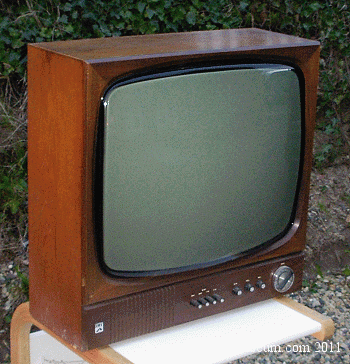
Are you sure? You wouldn't have a personal computer, a cell phone, or the Internet. You'd have a rotary telephone in your house only. You'd have a TV that looks something like this: http://www.rewindmuseum.com/images3/hmv2647side.gif

On that TV you can watch 1970s programming only. A 25" TV in 1970 cost $850 dollars ('77 Sylvania), which is equivalent to $5200 dollars today. I can hardly even find a TV that costs $5k today! For $4000 I can buy an 80-inch absolutely amazing Visio M80: http://www.amazon.com/dp/B00VQO5HSE - and they don't even sell TVs as small as 25" any more.

Your stove and refrigerator look like this, and work about as well as they look: http://airconvintage.com/antique/images/101_8149.JPG You also have access only to 1970s automobiles, which are nowhere near as comfortable, quiet, and maintenance-free as today.

If you're making this (hypothetical) tradeoff, then you're also limited to 1970s medicine and dentistry as well. Would you really choose 1970s medicine over today, too?

There are some people who would make this tradeoff, and I can respect that choice if you are one, but most people would not. Most people would prefer to live in 2016 with the products and services available today.

Re: A Response to Paul Graham’s Article on Income Inequality

#95

Earlier quoted context omitted.

> I don't mean hardcore enforced-total-equality Socialism, I mean nice Socialism like the kind Bernie Sanders has been raving about. It's taboo to point this out, especially on HN, but I'm feeling bold today: You can't discuss the socialist policies of Western European countries without addressing their wealth. And you can't discuss the current wealth of Western European countries without acknowledging the process by…

Many countries in Western Europe have been destroyed and rebuilt multiple times since the 19th century when slavery was practiced.

> Many countries in Western Europe have been destroyed and rebuilt multiple times

This doesn't change the fact that the current economic status of Denmark and Sweden today is directly linked to their status as colonial powers and slaveholders from the 17th-20th century.

> since the 19th century when slavery was practiced.

This entire subthread began with the claim that being "low-class" in the US is tantamount to slavery. If that's the case, there should be no problem with accepting colonialism, as it was practiced by Sweden into the late 19th century and Demark into the early 20th century, as a form of slavery, since it resembles slavery far more closely than being a member of the working poor in the US.

Re: A Response to Paul Graham’s Article on Income Inequality

#96
post #51

Earlier quoted context omitted.

"Those who are in control of the system" in this case are simply your fellow users. The community is often in disagreement about what should be on the front page. To the extent that we intervene as moderators, it's often to try to balance the competing concerns. Unfortunately it seems to be impossible to do that perfectly.

I'm fully aware of that. However, partly since it's impossible to quantify the number of users who wish to avoid so-called duplicate posts, it's easy to interpret efforts at moderation as disagreement with an opinion. At the end of the day, if Paul Graham's opinion gets a chance at prime blog real estate, shouldn't people who disagree with him get the same chance?

> it's easy to interpret efforts at moderation as disagreement with an opinion

It certainly is easy, but it's an uncharitable interpretation. We're moderating this thread less, not more, than we normally would.

One asymmetry here is that you're upset about a specific case, but we have to moderate HN in general. If you can come up with a viable set of general principles that would make HN significantly better, I'd like to know what they are. I personally have found it to be a hard problem.

A second asymmetry is that the cases where you dislike HN moderation stand out far more than the cases you agree with. (I mean "you" the reader, not you personally.) The latter simply blend into the status quo. Such perceptions are prone to bias, which is one reason it's easy to be uncharitable.

Re: A Response to Paul Graham’s Article on Income Inequality

#97

I think it's useful to draw a bright line around the 'value creation' that PG is referring to, also. It's not just creating chairs, it's aggregating great wealth by 'disrupting' traditional industries. Those traditional industries have workers and shareholders who lose out. What makes successful startups so profitable is they displace a large and less-efficient system with a small, efficient one. Efficient in terms o…

> Piketty's suggested policy response is simple: high taxes on aggregated wealth. You need to go one step further and outline where and how the federal government should put this new tax revenue to work. How much should we raise taxes? Which brackets? What form of wealth do we tax? Why taxation rather than issuing bonds? What percent of gov revenue should we allocate to the DoD? How much to Social Security and Medica…

It's easy to say "raise taxes". It's hard to say where the new revenue should be invested, by whom, and how.

It's also easy, when someone proposes solving one problem, to say "well, you're not allowed to solve that one until you've solved every other problem in the world first". It's hard to say "OK, you seem to be prioritizing this problem, let's both make our arguments and because we live in a democracy whoever sways the most people to their side will win".

Re: A Response to Paul Graham’s Article on Income Inequality

#98

> Now: none of the above, and families often consist of two breadwinners (& no children) with a hearty amount of debt, nothing owned, and few savings. All of this is by choice on the part of the families. People choose to seek employment. People choose to go into debt. People choose to spend rather than save. > The family unit itself may even be weaker because of less shared ownership. "The death of the family is the…

Which "State" are you referring to? I'm not aware of an organization by that name.

> Imagine perfectly egalitarian society, in terms of wealth.

The "perfect egalitarianism" strawman is, at this point, barely recognizable as either man or straw for all the beatings it's suffered. It is as useless a hypothetical in discussing the appropriate distribution of resources as would be "imagine the entire universe was owned by a single person".

The vast majority of people support the use of some degree of compulsion to obtain a more stable or fair distribution of resources than would be obtained in a state of nature. "Stable" tends to be the goal of the right, while "fair" tends to be the goal of the left. From there, everything is a subject of debate -- how much intervention is too much? what is the preferred distribution? can we reach the preferred distribution with a permissible level of intervention?

Re: A Response to Paul Graham’s Article on Income Inequality

#99
post #9

PGs articles aren't wrong - but they are second order, when we need a first order response to a current evil [ before it leads to bloody revolution ] If you look at income distribution its a hockey stick - you really have to slap yourself on the face and realise there is no middle class - what you thought of as professional-middle-class-contributor is actually college-debt-burdened-lower-class - no matter how many ye…

> I really think we are headed for bloody revolution, because most of the populace are angry, and its a rational anger because their survival needs are barely being met, in many cases. From someone who grew up poor and identifies strongly with outlaws, I concur. But unlike OP I think it needs to happen.

Surely a cool, calculated, orderly effort to solve the problems described by the GP would be better than bloody revolution, which is a mere outpouring of anger that might not even solve the problems and would probably create entirely new ones. Do you think that no other option is possible at this point?

Edit: Talk of revolution makes me think of the song "Won't Get Fooled Again" by the Who, particularly the closing lines, "Meet the new boss. Same as the old boss."

Re: A Response to Paul Graham’s Article on Income Inequality

#100

Earlier quoted context omitted.

"lower class are basically slaves" You're going to compare working graveyards at 7-Eleven to slavery ? You should read a little bit about slavery and human trafficking. https://en.wikipedia.org/wiki/Slavery I suspect most slaves would not agree with you.

Masters actually bought slaves. They weren't cheap. So they had to, you know, feed them and care for them somewhat. Now when you aren't needed at the 7/11 you can almost just go die in a fire: have you seen was homelessness is like in the US? I have.

Slaves weren't cheap, but the income and wealth inequality of those times was incredibly larger than today. In many jurisdictions slaves actually were just property, not people. Wealthy slaves owners still could kill slaves just for fun, without feeling much financial loss. Like today someone could buy a Tesla and then decide to burn it.

(Though we should recall that the rights of slaves and whether slave-owner could be prosecuted for manslaughter obviously depended on era and jurisdiction).

I find it astonishing that people compare modern-day income equality and the position of the poor in our time, in the Western world, to that of historical slavery (slavery in United States, or slavery in other slave-based economies in the New World prior to 19th century, not to mention slavery in the Old World which continued officially well into later half of 20th century).

In the West, no one is legally killing, whipping or dismembering the poor workers for not being obedient. Even the poor are still free to leave a place if they find life there unsustainable. Modern-day comparisons to "slavery" typically involve something along the lines "you are expected to do something in exchange for money that is given to you and you feel unpleasant about it".

It just doesn't compare with the actual, terrible injustice of real slavery.

Post reply on HN