Live data from Hacker News

Economic Inequality

paulgraham.com

101–110 of 580 posts

Re: Economic Inequality

#101
post #13

Earlier quoted context omitted.

Exactly. There would still be sufficient economic motivations for startups and startup founders in a world where startup founders were taxed at a 75% rate.

I hear this from liberals all the time, often in more extreme form of "even if only a cent of a million is left there will be motivation to make that million!". But wtf are you so sure? I for one am not looking for a smaller bump in salary at 50% tax already as I don't see how additional effort would pay for itself. I imagine a lot of people don't consider an effort to found startups at this rate too.

Because the self-made rich don't stop working. Because hugely productive people work on open source. Because hugely productive people work at non-profits. Because hugely productive, active, socially beneficial people spend their lives in poverty working for the benefit of others.

It's a bizarre mind that can simultaneously believe that you need huge rewards to motivate people AND know that 95% of startups fail.

Startup founders I know well (n=20) are intrinsically motivated and only superficially extrinsically motivated. They don't stop once they get "f-u" money. They do the same thing over again, with a nicer car.

Re: Economic Inequality

#102

Graham is arguing against an enormous straw man. Nobody is suggesting that we “prevent people from getting rich” or “end all economic inequality”. The most extreme proposals I’ve seen in America are ones like, “institute an unconditional basic income as an alternative to means-tested welfare programs,” or “allow every citizen/resident into a single-payer healthcare system,” or “go back to the tax structure of the 195…

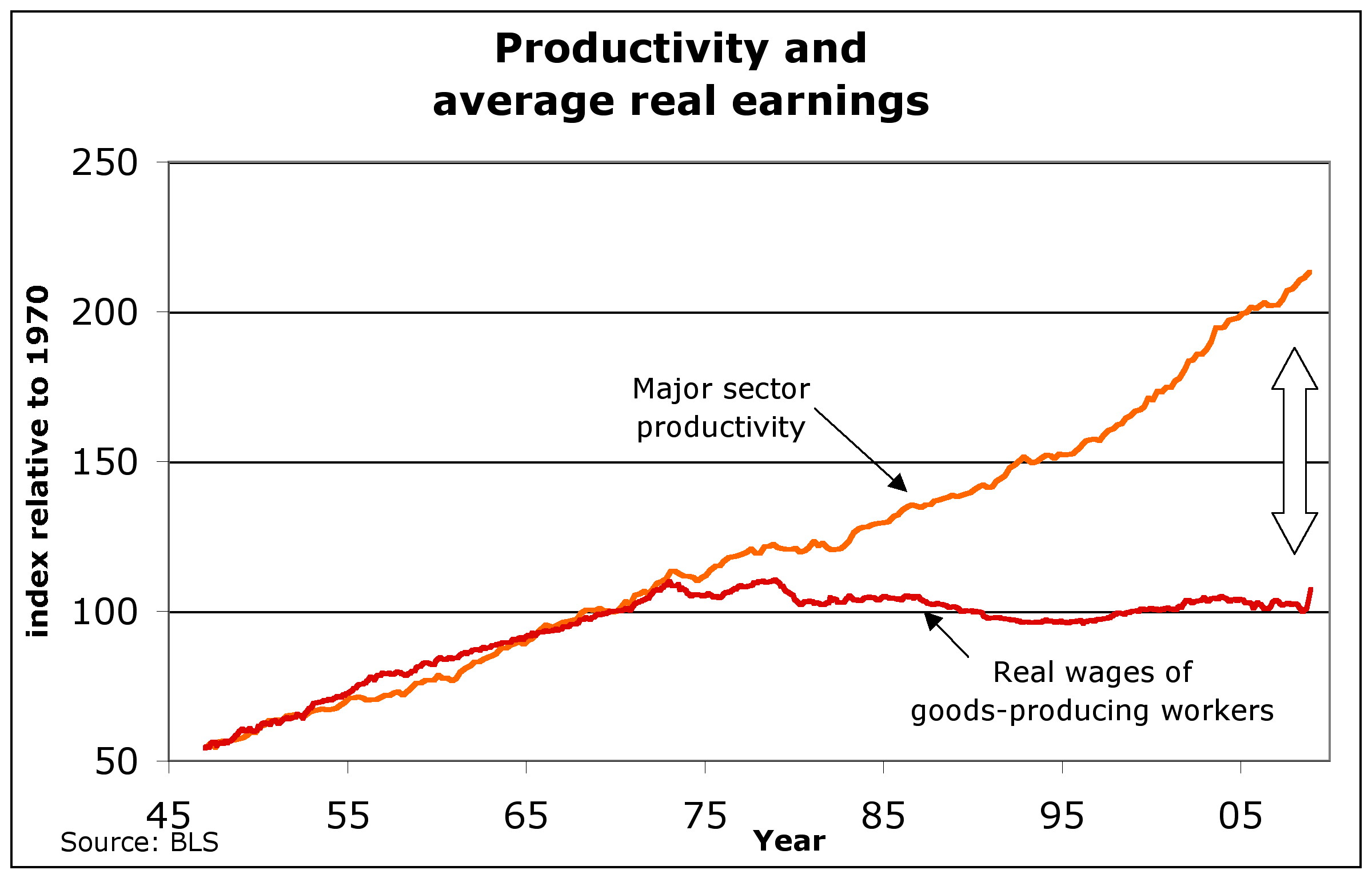
There's nothing wrong with someone getting rich provided they contribute a proportional amount of value to society. Problem is that since the post-WII period (also called the Golden Age of Capitalism) such rewards have been happening less and less [1,2]. In fact, I think reducing inequality is essential for promoting productivity.

[1] https://en.wikipedia.org/wiki/Post%E2%80%93World_War_II_econ...

[2] https://upload.wikimedia.org/wikipedia/commons/7/73/US_produ...

Re: Economic Inequality

#103

I don’t think “income inequality” has much to do with the rich getting richer, especially startups. I think the concern has to do with whether those same startups make the poor, poorer. Some do, some don’t. I believe that Github, for example, makes it easier for the world’s poor to become richer. Amazon or Walmart, on the other hand... Some of these disruptive industries make a lot of people poorer by driving busines…

> Amazon or Walmart, on the other hand... Some of these disruptive industries make a lot of people poorer by driving businesses into bankruptcy.

Amazon and Walmart make the poor richer, because they need spend a smaller proportion of their incomes on food & goods. That's why Amazon & Walmart out-competed the mom-and-pops of a generation ago.

This was bad for the owners of the mom-and-pop stores, but it was good for the poor: in fact, the only way it could happen is because the poor voted with their dollars.

Re: Economic Inequality

#104
post #80

Graham is arguing against an enormous straw man. Nobody is suggesting that we “prevent people from getting rich” or “end all economic inequality”. The most extreme proposals I’ve seen in America are ones like, “institute an unconditional basic income as an alternative to means-tested welfare programs,” or “allow every citizen/resident into a single-payer healthcare system,” or “go back to the tax structure of the 195…

He is defending what he is doing and what Y-combinator has been doing. One of the most important roles of a leader is to create vision -- build a story that explains and interprets reality based on it. In general, startup world lives on hopes and ideals. More so than other industries. Founders have to have a "burning desire to change the world". It could be building a better future, moving the technology forward, mak…

> He is defending what he is doing and what Y-combinator has been doing.

But that is the straw man. Those of us who think extreme economic inequality is a bad thing do not think that YC is a bad thing, notwithstanding that it does contribute to economic inequality.

The problem is not YC, the problem is that extremely rich people use their money to buy political power, which they then use to create laws that allow them to extract rents (by, for example, paying lower marginal tax rates than less wealthy people). It's the positive-feedback effect that this creates (more money -> more political power -> still more money) that is the problem, not YC, nor (obviously) the creation of wealth.

Re: Economic Inequality

#105

People still got rich when the top tax percentage was 90%. I personally don't care what people make, but I care when they use their massive wealth to influence policies which affect me. If you have more access to my representative than I do and you don't even live in my congressional district, then I want that to stop, one way or another.

> People still got rich when the top tax percentage was 90%.

Yes; in a world of blind people, the one-eyed will be king. But the poor were much poorer then than now.

Re: Economic Inequality

#106
post #84

Earlier quoted context omitted.

I like the term social mobility. A person's station in life should not be tied to their parents' income level.

I don't see why low social mobility would necessarily be a consequence of high income inequality.

It's not. At least not directly. PG touches on this at the bottom of his essay.

High income equality indirectly erodes social mobility because the ruling class rigs the rules to benefit their children. For example, in the 60s Ivies added ridiculous criteria such as "manliness" and height to discriminate against Jewish applicants. Today, schools reduce the weight of grades and tests to discriminate against Asian applicants.

Re: Economic Inequality

#107
post #80

Graham is arguing against an enormous straw man. Nobody is suggesting that we “prevent people from getting rich” or “end all economic inequality”. The most extreme proposals I’ve seen in America are ones like, “institute an unconditional basic income as an alternative to means-tested welfare programs,” or “allow every citizen/resident into a single-payer healthcare system,” or “go back to the tax structure of the 195…

He is defending what he is doing and what Y-combinator has been doing. One of the most important roles of a leader is to create vision -- build a story that explains and interprets reality based on it. In general, startup world lives on hopes and ideals. More so than other industries. Founders have to have a "burning desire to change the world". It could be building a better future, moving the technology forward, mak…

But he's defending against a strawman. Almost no one is arguing for flat payment where everyone makes the same amount of money. What most want is equality for opportunity (something that YC and other VCs might give).

In many ways, startups and access to capital could be a great equalizer for opportunity equality. It allows individuals to control so much of their destiny. The alternative is to pass through a gatekeeper at some large company, spend years working up the ladder (if any progress is made at all) or even worse to not even be able to make it into that large company.

The problem is when wealth in one generation guarantees wealth in the next generation, and where upward mobility is nearly impossible. Opportunity equality is what almost everyone is pushing for, when they talk about economic equality. It's now possible to teach oneself to program and then make a six figure a year salary. It's now possible to start your own company and get funding in a way that just was never possible before. The problem is that opportunity equality right now is only limited to tech. In almost every other area the opportunity just isn't there.

Re: Economic Inequality

#108
post #65

Earlier quoted context omitted.

I like the term social mobility. A person's station in life should not be tied to their parents' income level.

> A person's station in life should not be tied to their parents' income level. Why not? One's genes are rather intimately tied to one's parents' genes, and those genes completely determine one's physical self. One's upbringing is the direct result of one's parents' choices (and one's own reaction to them, which is itself a product of genes and upbringing). It seems patently obvious that one's parents' lot in life (i…

The entire point of capitalism is to exploit individual's self interests for the betterment of society.

> those genes completely determine one's physical self

They also have an impact outside of one's physical self.

Re: Economic Inequality

#109

Earlier quoted context omitted.

On that note: the most offensive economic inequality isn't the 1% vs. the 99%, which successful startup founders would find themselves on the wrong side of. It's more about the 80 individuals with more wealth than half the world's population [1] – which, yes, does include "startup founders" such as Gates, Ellison, Bezos, Zuckerberg, Page & Brin, etc. But the vast majority of successful startup founders aren't in this…

Why is that more offensive? What if they were all startup founders or created companies that made profound and positive change? At what point is the cross-over between being reasonably and unreasonably wealthy? If they have too much money and give most of it away, is that better than continuing to create new ventures that could make a difference? This economic inequality feels similar to racism. Why should a very wea…

These sorts of discussions always go downhill because they very quickly turn into defending (and attacking) people as if their identity is inextricably linked to their wealth, which means that policy discussions are read (and sometimes written) as personal attacks. Can we do better than that, please?

I don't see a claim that any of these folks are bad people for their money. Gates, for instance, is doing extraordinary good in the form of philanthropy; it's a stretch to imagine that the "offensive economic inequality" is a judgment of his character (although you may be correct that parent's choice of word "offensive" was risky). There are grounds to criticize his richness based on the anti-competitive actions of Microsoft in the '90s, but his richness per se isn't valid grounds to condemn him.

What is to blame, what is "offensive," is a society that allows people to become fantastically wealthy like this. What would the harm for society be if, through whatever means, it was much more difficult to become this wealthy? Maybe it is high taxes on the ultra-rich, maybe it is an unwillingness to allow high CEO salaries, maybe it is a serious estate tax, etc. Is it really true that Gates, Zuckerberg, Page, Brin, etc. were motivated primarily by money to found Microsoft, Facebook, Google, etc.? If they had a 99% marginal tax rate once they have assets of $500M (on any form of gaining wealth), would we have a weaker Microsoft or Facebook or Google doing less good for the world because they wouldn't be working as hard? Would the good done to people on the lower end of the scale not outweigh any possible harm here? That seems hard to imagine.

And it is precisely because these people could be less rich that the comparison to racism feels ill-placed. A society biased against people of a particular race cannot make existing people cease being of that race, and preventing new people of that race would be grossly immoral. A society biased against billionaires can in good conscience make fewer people billionaires, and it can even prevent hereditary billionaires without any particular immorality (although I think most of the people on that list are self-made).
Re: Economic Inequality

#110
post #30
post #19

[deleted]

Exactly. As someone working in Spain, I can live a comfortable life on my salary, but I don't feel rich. I would certainly struggle to give up working for a year and try and bootstrap a startup from what I can save (it's possible but it would be tough).

> I would certainly struggle to give up working for a year and try and bootstrap a startup from what I can save (it's possible but it would be tough).

Any risk is tough, otherwise it wouldn't be a risk.

And would Spain permit you to keep enough of the potential rewards to make it worth your while?

(as an aside, if you have enough saved that you could bootstrap a company, then you are rich in comparison to the vast majority of mankind throughout history and today)

Post reply on HN