I've always been strangely fascinated by this project. I don't understand it. I appreciate the technical skill involved, and the amount of effort expended. But, I can't imagine working on it. From my perspective, Windows is an inferior system to any UNIX-based system on almost every front. It has a very strong application ecosystem, but technically it's unpleasant to work on (for me). So, given that, if there's somet…
IMHO the nixes have a far superior CLI, but Windows' GUI is (at least pre-Metro, i.e. Win32 desktop) superior to the many disjoint alternatives that the Linux/BSD/OS X/Solaris/etc. world has. Instead of Qt, Gtk, and all the others, Windows just has Win32 and all apps have basically identical look-and-feel (except for those that go out of their way to reinvent the standard GUI elements, but in my experience this is mu…
ReactOS, a 17-year quest for an open-source Windows, has a new release candidate
121–130 of 178 posts
Re: ReactOS, a 17-year quest for an open-source Windows, has a new release candidate
#122A serious question: When will we see a truly new OS built from the ground up? If there is a space where there seems to be little innovation it is in the space of new OS paradigms. Flavors of Windows or Linux - are there really any commercially ready alternatives today or in the very near future?
Re: ReactOS, a 17-year quest for an open-source Windows, has a new release candidate
#123Earlier quoted context omitted.
> if there's something I want an OS to do that Linux can't do, I would be motivated to work on making Linux able to do that thing so I could do that thing on an Open Source OS I enjoy using, rather than work on replicating Windows so I could do that thing on an open source OS I don't enjoy using. That's a great ethos, but it's not that Windows can do something Linux can't. If you want to play a game/use a CAD made on…
If you want to run Windows applications on an Open Source OS, the Wine approach is much more realistic. It's also nicer because for everything that Linux can already do, you don't have to mimic Windows. Anyway, desktop applications are not that relevant today, and most of those that are (like web browsers, developer tools) are cross-platform anyway.
Even if you're never going to use ReactOS, it still helps make wine better.
Re: ReactOS, a 17-year quest for an open-source Windows, has a new release candidate
#124Earlier quoted context omitted.
- Written for thread based applications, not processes - Asynchronous IO architecture only matched by Solaris - Object based architecture - OO ABI (more so with WinRT), besides the C one - Allows C++ in kernel space - Components as interoperability between applications - User space driver model, specially nice for graphics drivers - Pursues the mainframe ideas of safer languages for system and application's programmi…
> Powershell is closer to Xerox PARC REPLs than any UNIX shell, except for Mac OS X. Which shell do you mean on OS X? I thought they just shipped with zsh or bash?
Re: ReactOS, a 17-year quest for an open-source Windows, has a new release candidate
#125Earlier quoted context omitted.
My situation is almost identical to recursive. I upgraded to Windows 8, right when it came out. Hated the jarring dual interface. But the only thing I had to do was install Classic Shell[0]. And I was back to the familiar Windows. Practically nothing else changed from the UI perspective. The same with Windows 10 as well. I'm addicted to the Win32 based Start menu and the ability to right click files and folders from…
Thanks. Does it totally kill metro? Everytime I work on a Win8 computer, I manage to do something that brings metro up (e.g, press the network icon in the notification area on the right, or press the "Windows" key on the keyboard), and start cursing ....
The only time I had to go to the Metro Start Menu was to find the Universal Apps like Mail and Edge browser. These don't show up on the Classic Shell results for some reason. Once I pinned them to the taskbar however, I haven't needed that Metro screen again.
Re: ReactOS, a 17-year quest for an open-source Windows, has a new release candidate
#126This is one OS I've kept my eye on forever, though it feels as though Microsoft will go open source before ReactOS can catch up if anything. I wouldn't mind if certain parts of Windows were open sourced, or replaced by open sourced alternatives at least, not all of Windows. We saw this happen to the Open Live Writer.
Microsoft already kinda went open source, unintentionally :) http://www.opennt.net/ interesting thread documenting start of OpenNT project http://www.betaarchive.com/forum/viewtopic.php?f=61&t=33250 from broken code base that would not compile to booting ~Windows 2003 compiled from source.
Re: ReactOS, a 17-year quest for an open-source Windows, has a new release candidate
#127This is one OS I've kept my eye on forever, though it feels as though Microsoft will go open source before ReactOS can catch up if anything. I wouldn't mind if certain parts of Windows were open sourced, or replaced by open sourced alternatives at least, not all of Windows. We saw this happen to the Open Live Writer.
Microsoft already kinda went open source, unintentionally :) http://www.opennt.net/ interesting thread documenting start of OpenNT project http://www.betaarchive.com/forum/viewtopic.php?f=61&t=33250 from broken code base that would not compile to booting ~Windows 2003 compiled from source.
Re: ReactOS, a 17-year quest for an open-source Windows, has a new release candidate
#128I've always been strangely fascinated by this project. I don't understand it. I appreciate the technical skill involved, and the amount of effort expended. But, I can't imagine working on it. From my perspective, Windows is an inferior system to any UNIX-based system on almost every front. It has a very strong application ecosystem, but technically it's unpleasant to work on (for me). So, given that, if there's somet…
IMHO the nixes have a far superior CLI, but Windows' GUI is (at least pre-Metro, i.e. Win32 desktop) superior to the many disjoint alternatives that the Linux/BSD/OS X/Solaris/etc. world has. Instead of Qt, Gtk, and all the others, Windows just has Win32 and all apps have basically identical look-and-feel (except for those that go out of their way to reinvent the standard GUI elements, but in my experience this is mu…
Re: ReactOS, a 17-year quest for an open-source Windows, has a new release candidate
#129Earlier quoted context omitted.
It's been about 5 years since I was a regular Windows user, but I can't think of a single Qt app I used on a regular basis. Care to name some examples?
I am a regular Windows user (split between OSX and Windows, actually, but Windows gets used on a daily basis) and I can't think of a single Qt app I use on a regular basis now. Actually, with my current workflow, I can't think of a Qt or GTK app that I use on a regular basis on either platform. I guess Wireshark's Qt and it gets used occasionally. But most of the cross-platform Qt and GTK stuff I used to install (Pid…
I'd also argue that Qt applications are still "native" in that they run as a native EXE (or ELF on nix). Granted they don't use Win32 APIs, but then calling them non-native because of that is a little like calling Windows OpenGL games non-native because they don't use Direct3D. But that's an aside point.
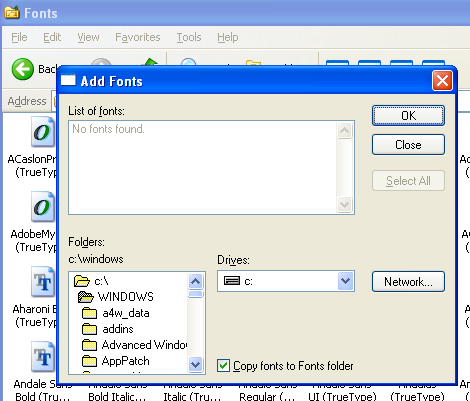
On the whole, I don't think it makes sense to categorise Windows desktop applications by what toolkit they use. MS Office 2003 didn't use Win32 toolbars. Office 2007 then introduced the ribbon bar, which changed in appearance in every subsequent release of MS Office. And even within MS Office, Microsoft doesn't always follow the same design patterns (Office 2007 used ribbon in Word and Excel but not in Outlook). Even outside of MS Office, some Windows applications in WinXP used different menu bars to the ones provided by the Win32 APIs (you can see by looking at whether menu items go 3D or just highlight when you hover over them). One example was the difference between Windows Explorer and Notepad. Plus often older Windows utilities go completely unaltered for years, eg the add font dialog box in XP was still using Windows 3.1 APIs: http://apagreekkeys.org/images/addFont1.jpg ....and this is all without discussing the disruption Metro has caused.
I will grant you that in spite of these criticisms, Windows still fairs better than Linux in terms of uniformity. But it's certainly not consistent enough to define anything that doesn't use Win32 widgets as non-native.
Re: ReactOS, a 17-year quest for an open-source Windows, has a new release candidate
#130I've always been strangely fascinated by this project. I don't understand it. I appreciate the technical skill involved, and the amount of effort expended. But, I can't imagine working on it. From my perspective, Windows is an inferior system to any UNIX-based system on almost every front. It has a very strong application ecosystem, but technically it's unpleasant to work on (for me). So, given that, if there's somet…
Windows can run an executable with a GUI interface compiled for 32-bit Windows over 20 years ago... Though it's far from perfect, Windows has a better binary compatibility record than ANY other OS for far longer periods of time. There is something to be said for that. It's only recently (for 64-bit windows) that DOS support (ntvdm) has been unavailable.
However, as a sibling comment notes, Linux has also preserved binary compatibility (at the kernel level) for a similar amount of time (of course as long as neither of them break compatibility then Windows will have the numerical edge as it's slightly older).
So the question becomes, why is compatibility so apparently good on Windows and so apparently bad on Linux? I feel it's to do with a culture of dynamic linking and compiling your own software. A statically linked X11 application from 15 years ago will, as far as I can tell, run fine on Linux - it's just that such things are rare. You're far more likely to come across either a dynamically linked binary, or a source tree. This seems to be reflected in source code compatibility, which is better in Linux.