Live data from Hacker News

How to build a better PhD

nature.com

11–18 of 18 posts

Re: How to build a better PhD

#11
The problem is simple, and easily solved: fund science at greater levels.

I trust everyone knows this story - the funding rate has dropped dramatically in the last 15 years, and as a result the average age for an RO1 has gone up steadily (see [here](http://nexus.od.nih.gov/all/wp-content/uploads/2012/02/age-o...).
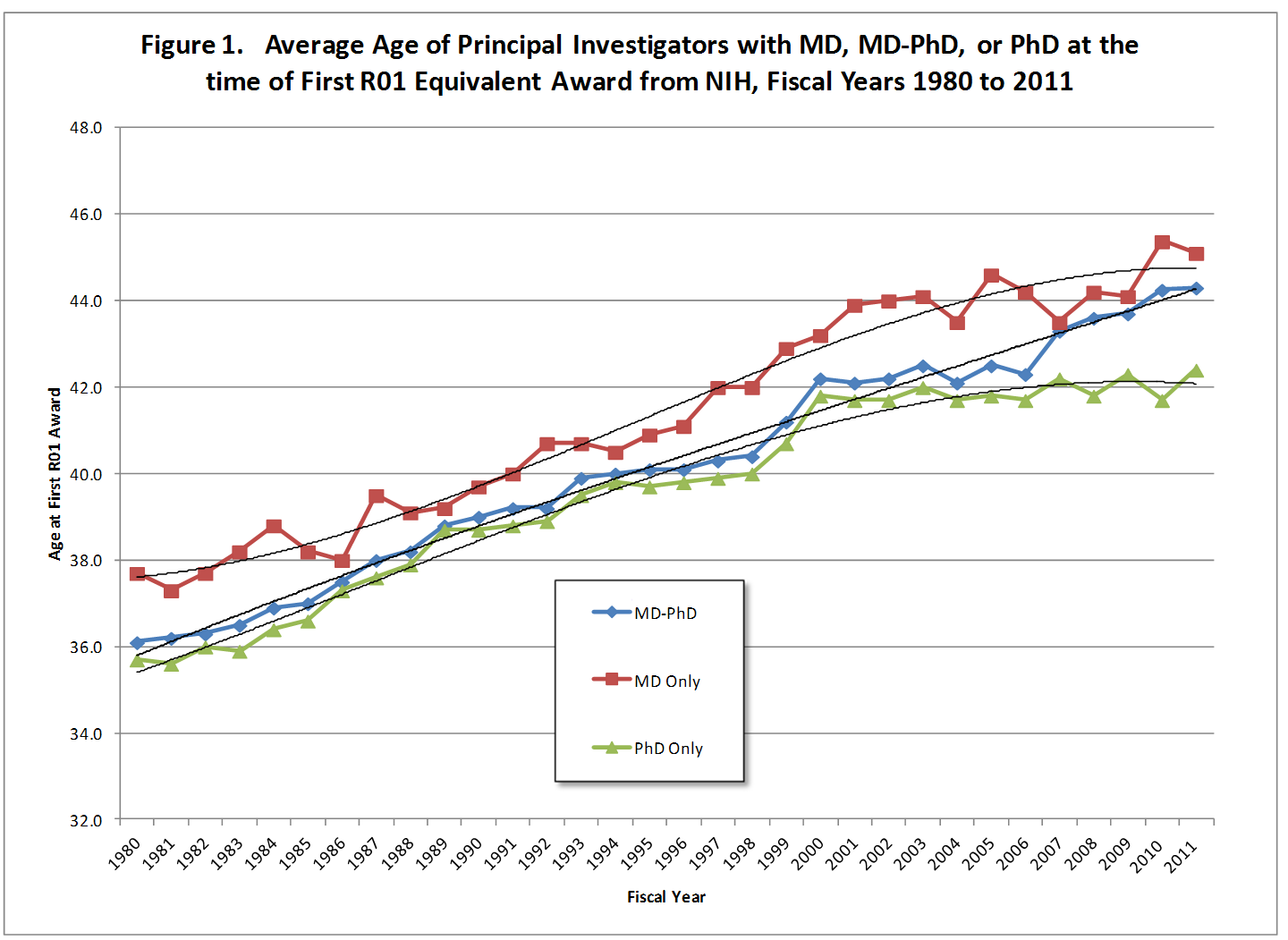
Just give scientists more money, and a lot of these problems will vanish. There will be more academic positions; there will be less competition for grants.

This is entirely a problem of money. I have a PhD and have somehow managed to shoehorn myself into academia without pursuing a tenure track. There is a tremendous scope for people like me. I could hire three people today and put them to serious full-time work on difficult projects that would make a substantial impact in my field (cancer research) - if I had the resources.

It's easy to fit people into non-tenure track positions in academia, there is no structural issue. The reason people go to industry is only because there is no room made for them on the public dole. If the public steps up and funds more science, this problem will abate.

Re: How to build a better PhD

#12
As the article notes in its introduction, too many PhD students misunderstand where their PhD will lead. That's a clear problem, and robs many of our brighter kids of years spent in prep for jobs that don't exist. Doing that deliberately is malignant and should end.

How to correct the problem? Start by requiring universities to inform incoming students AT ALL LEVELS of two things:

1) Given the forthcoming degree, what jobs await them? Report job trends for their graduates in the past 20 years, including what job titles they take at what employers.

2) What will this education cost them? Report the range of student debt for students over that same 20 years, including repayment horizons.

Much needs to change in academia, and it starts with a full accounting of the cost and market value of a degree, especially when a significant market value is expected.

(It's worth noting that nowhere would the benefit of doing this be greater than countering the for-profit degree mills that abound in recent years. But in the end, the damage done by teaching useless skills at a good university is little different than failing to teach useful ones at a bad university.)

Re: How to build a better PhD

#13
>“And a master's is not considered a failure for those who can't make it to a PhD.”

I was in a physics PhD program straight out of undergraduate school. In that program, at least, the culture very much was that the master's degree was the "failure option".

I ended up leaving after one year for personal reasons, and I felt like even more of a failure because I couldn't even get to the "failure option" point. Five years later and even though I'm relatively successful working as a programmer it still bothers me.

Re: How to build a better PhD

#14

The problem is simple, and easily solved: fund science at greater levels. I trust everyone knows this story - the funding rate has dropped dramatically in the last 15 years, and as a result the average age for an RO1 has gone up steadily (see [here]( http://nexus.od.nih.gov/all/wp-content/uploads/2012/02/age-o... ). Just give scientists more money, and a lot of these problems will vanish. There will be more academic…

This is a completely layman's analysis, but I think that science funding has gone down because we are less and less able to understand what it is that is being studied and how it can benefit humanity. Go back 40 or 50 years and the things scientists were discovering were tangible and real. They produced things that people could touch, consume, and understand.

The biggest science project we have going, the LHC, is impossible for the lay man to understand. "A big circle which smashes tiny things together? You're just watching it? I don't get it!". Compare that to the discovery of penicillin; "You're growing fungus under your fridge and it's going to cure my sick child? Take all my money!".

Re: How to build a better PhD

#15

The problem is simple, and easily solved: fund science at greater levels. I trust everyone knows this story - the funding rate has dropped dramatically in the last 15 years, and as a result the average age for an RO1 has gone up steadily (see [here]( http://nexus.od.nih.gov/all/wp-content/uploads/2012/02/age-o... ). Just give scientists more money, and a lot of these problems will vanish. There will be more academic…

This is a completely layman's analysis, but I think that science funding has gone down because we are less and less able to understand what it is that is being studied and how it can benefit humanity. Go back 40 or 50 years and the things scientists were discovering were tangible and real. They produced things that people could touch, consume, and understand. The biggest science project we have going, the LHC, is imp…

That is because this generation has lot of diversions. Focus is the key for research.

Re: How to build a better PhD

#16

Earlier quoted context omitted.

This is a completely layman's analysis, but I think that science funding has gone down because we are less and less able to understand what it is that is being studied and how it can benefit humanity. Go back 40 or 50 years and the things scientists were discovering were tangible and real. They produced things that people could touch, consume, and understand. The biggest science project we have going, the LHC, is imp…

That is because this generation has lot of diversions. Focus is the key for research.

Focus is easy when there's a strong value proposition. We got nuclear done very quickly because the value was near infinity. The science being done today seems to have weak value.

Re: How to build a better PhD

#17

The problem is simple, and easily solved: fund science at greater levels. I trust everyone knows this story - the funding rate has dropped dramatically in the last 15 years, and as a result the average age for an RO1 has gone up steadily (see [here]( http://nexus.od.nih.gov/all/wp-content/uploads/2012/02/age-o... ). Just give scientists more money, and a lot of these problems will vanish. There will be more academic…

This is a completely layman's analysis, but I think that science funding has gone down because we are less and less able to understand what it is that is being studied and how it can benefit humanity. Go back 40 or 50 years and the things scientists were discovering were tangible and real. They produced things that people could touch, consume, and understand. The biggest science project we have going, the LHC, is imp…

I agree.

I work at a large national research institute, 50 % of our budget is financed through grants. Just last week we were told by my institute's director (and I'm rephrasing only slightly): "If you really want to help our finances, do something that makes it into the evening news. Then it's easy for politicians to send money our way, they love to finance things that appear on the evening news. Because that is their currency for the next election. But if we don't succeed at it, it will be even harder in the future."

Re: How to build a better PhD

#18
post #8

Earlier quoted context omitted.

Industry researchers don't do things in public and don't publish? Lame purposes and helps no one? Again I just can't relate any of that to what I know at all! When I finished my PhD I moved into industry and basically kept working on the same project. I work for a megacorp, and almost everything I do is developed fully in the open (public GitHub repo, not a mirror), we publish several times a year at the same venues…

There are a few industry options for the sciences but less so for the humanities, where tenure is intended to protect scholars who investigate and question things that the wealthy and powerful might find dangerous to their interests (e.g. Marxism).

Also, it sounds like you are talking about (software) engineering, rather than basic science (e.g., astronomy). There are plenty of questions humanity would like for science to answer for which there is no financial incentive to a corporation.
Post reply on HN