Live data from Hacker News

Why it’s so hard to innovate in the e-mail space (2014)

medium.com

61–68 of 68 posts

Re: Why it’s so hard to innovate in the e-mail space (2014)

#61

Earlier quoted context omitted.

Actually I didn't know; thank you for telling me! (That also makes me realize that I could likely do it in a much easier way than I currently am...) What are the email clients that allow that kind of behavior?

Well, essentially, all of the traditional text-only clients do (such as Mutt, which is what I use), I think Thunderbird does as well, beyond that, no clue, but there probably are others. Traditionally, if you chose to reply to an email, the mail client would put the mail you were responding to into your editor, with > marks in front of every line. The only socially acceptable way[1] to write your answer was to insert…
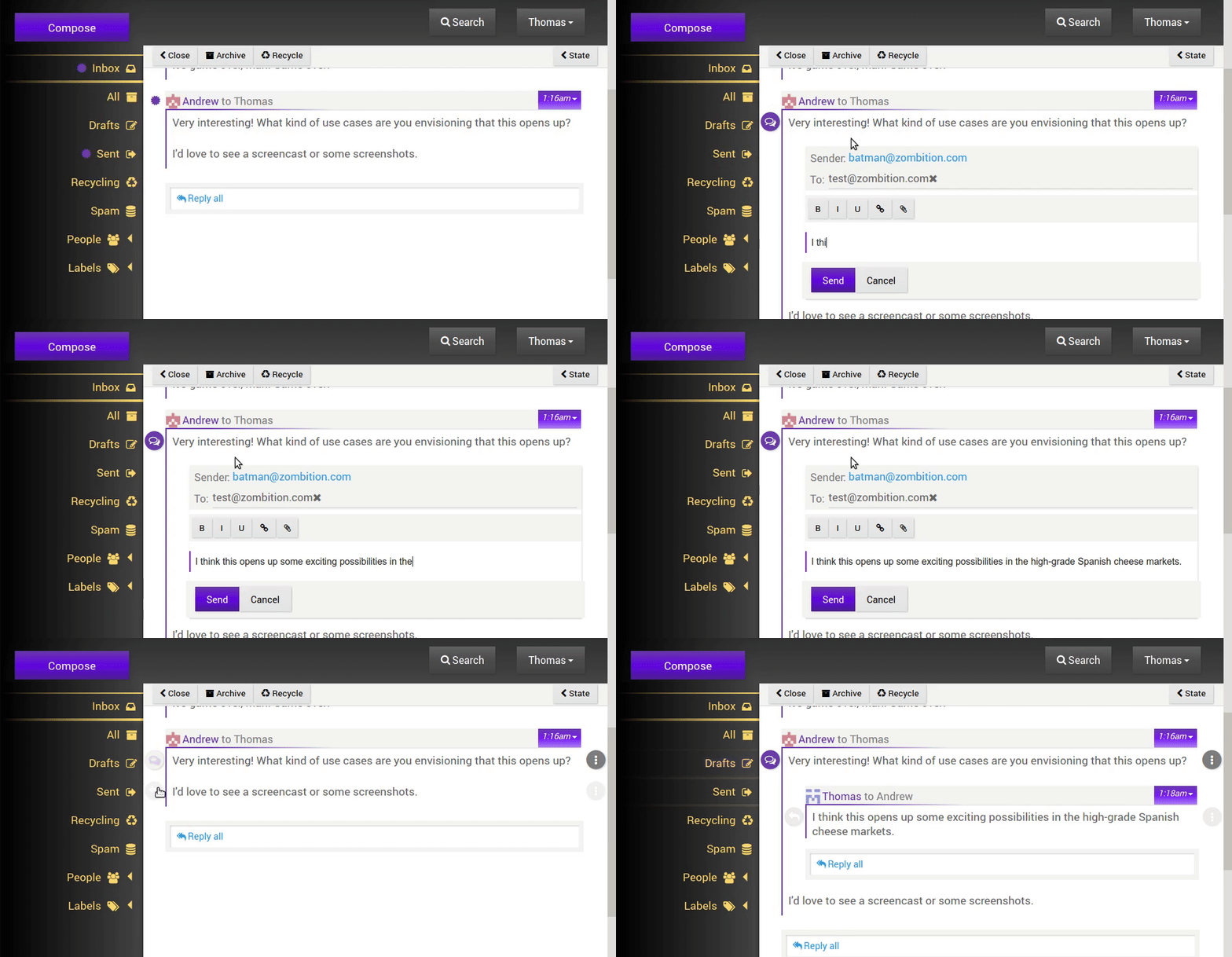
Ah right. I was meaning something more like this so that you can skip the quoting business entirely and have the visual hierarchy match the conceptual hierarchy: https://s3-us-west-2.amazonaws.com/zombition-static/20151208...

> Clueless developers and users around the turn of the millenium then somehow didn't understand the purpose of providing you with a quoted version of the email you replied to, and started putting the reply above the quoted mail, thus ending up sending a copy of the mail they just received back to the person they received it from ... and nobody seemed to notice how idiotic an idea that actually is, and so it became sortof the new norm in large parts of the internet to attach large blobs of completely useless and often close to unreadable text to every mail, up to the point where some people even invented justifications for the behaviour that mostly tend to describe how this "feature" allows them to work around the lack of proper thread handling in their mail clients.

Yes, I think the rationale must run something like "What if user A deletes the entire conversation they were having with user B, and user B replies to the deleted conversation, but user A doesn't know what the reply is about because they deleted the entire conversation, have a terrible memory, and are too embarrassed to ask user B to explain what's going on? Let's just send the entire conversation as quoted text every time."

Re: Why it’s so hard to innovate in the e-mail space (2014)

#62
post #5

Earlier quoted context omitted.

If I ever get a chance to revamp an email system I will probably use rspamd instead. Those "add-ons" are painful. https://rspamd.com https://rspamd.com/rspamd-slides.pdf

Check out Haraka, built by an old SpamAssassin developer (ie me). It's all that and has custom anti-spam features like the Karma plugin too. It's in place at some large installs (eg craigslist, who went from 20 postfix servers to just 7 Haraka servers).

I'll look into it, thanks!

Re: Why it’s so hard to innovate in the e-mail space (2014)

#63
post #54
post #29

Earlier quoted context omitted.

> New internet users are no longer even setting up email accounts. What percentage of new internet users do not have any email accounts? I haven't been able to find any reliable data.

Seems like a strange claim, considering many sites that new internet users use will not let you sign up without an email account

I agree. I'm skeptical and would like to see what data might support that claim. I've not been able to find any myself.

Re: Why it’s so hard to innovate in the e-mail space (2014)

#64
post #63
post #54

Earlier quoted context omitted.

Seems like a strange claim, considering many sites that new internet users use will not let you sign up without an email account

I agree. I'm skeptical and would like to see what data might support that claim. I've not been able to find any myself.

1.2 Billion Whatsapp users with phone number only

800 Million Messengers users as phone number only

20+ Apps with 100m + users as phone number only.

Together these PN based winners outstrip the combined usage of almost all web apps. I mean you are all downvoting me -- but its kind of funny how out of the loop the thinking is here.

Re: Why it’s so hard to innovate in the e-mail space (2014)

#65
post #59

Because. It. Doesn't. Need. It. Email isn't broken.

Not necessarily broken, but certainly outdated. What do you think about spam, encryption, attachment sizes? Imagine being able to publish your email address online without worrying about spam; even in your profile you've been forced to obfuscate your own a little. Or to know that every message you send can only be read by the recipient and nobody in-between - without having to explain PGP to non-techs. Or being able…

You make a good point. Why would I obfuscate like that? My email is out there in git logs, mailing list logs, lists stolen from other websites, lists bought from other websites.

I can't see that encryption will ever work end-to-end as we want. People are too stupid to learn most things. Technical solutions rely on big corporations that we trust to do the Right Thing(TM). The Right Thing(TM) is impossible from US companies and probably impossible from European companies.

Attachments. I don't remember the last time I sent a large one. As far as I know most of the size limitations are artificially implemented by companies that don't want to spend that much on storage. Other limitations such as Gmail's block on executables is because people are stupid and will run everything they get sent.

People will never not be stupid so we can never have nice things.

Re: Why it’s so hard to innovate in the e-mail space (2014)

#66
post #43

At a very high level, email is primarily used for discussions. With this view, successful innovation in the e-mail space requires innovation in the nature of discussions themselves. Tinkering around with better usability or feature improvements will not be sufficient to overcome the massive inertia of 'traditional e-mail'. We are a startup that just launched ( https://tmail21.com ) that aims to rethink the discussion…

Pretty good endeavor that you essentially created a BPM application, that is only as if email used as a BPM platform which is seen prevailing in corporate than other enterprise tools (SAP, Oracle etc.)

I actually propose instead of re-inventing email, create addons to extend what email message can be used/read/interacted with. For example, high school teaching today has been reliant on gmail for offline homework assignment and discuss between teacher and kids. There are some tools in that space aggressively exploited by schools to conduct their "innovative" teaching efforts.

Gmail, or microsoft outlook would be the best go-to destination for the majority of who can afford an in-house IT team, or shadow IT in large enterprise who's tired of the lack of evolution from SAP, IBM etc.

Still, Gmail and outlook are slow in adopting or providing email as an open extendable platform for BPM application purpose.

Then there are everyday use of email other than BPM, notification, online purchase receipt, offline discussion, even transmitting files, photo etc. via email are somewhat common with email client.

The longevity of email is exactly the lack of rigor of the intended use of it, BPM or not, email is flexible to conduct any discussion to an open goal, or without a goal.

To understand email better, one has to compare email to SMS, and social media along with how mass used these tools.

Re: Why it’s so hard to innovate in the e-mail space (2014)

#67

Earlier quoted context omitted.

Well, essentially, all of the traditional text-only clients do (such as Mutt, which is what I use), I think Thunderbird does as well, beyond that, no clue, but there probably are others. Traditionally, if you chose to reply to an email, the mail client would put the mail you were responding to into your editor, with > marks in front of every line. The only socially acceptable way[1] to write your answer was to insert…

Ah right. I was meaning something more like this so that you can skip the quoting business entirely and have the visual hierarchy match the conceptual hierarchy: https://s3-us-west-2.amazonaws.com/zombition-static/20151208... > Clueless developers and users around the turn of the millenium then somehow didn't understand the purpose of providing you with a quoted version of the email you replied to, and started puttin…

> Ah right. I was meaning something more like this so that you can skip the quoting business entirely and have the visual hierarchy match the conceptual hierarchy:

Well, if it's supposed to be compatible with all the HTML crap out there, and even most MUAs' broken encoding of plain text email, it might be hard, but in principle, I'd think this should actually be rather simple:

Simply specify an algorithm that defines how to segment a text/plain body into paragraphs and how to thus generate MIME object-scope IDs per paragraph (by simply numbering them) and use that same structure to provide UI elements per paragraph. Then, if the user writes a per-paragraph reply, generate a multipart/alternative body, with one text/plain part in traditional quoting style, optionally with format=flowed, and one alternative application/fancy-paragraph-foo part which contains in some sort of serialization format references to the message+paragraph IDs, that paragraph's text, and the corresponding reply text. This way, a receiving MUA that doesn't support application/fancy-paragraph-foo will display an ordinary quoted plaintext body, and also, if a communication partner uses different MUAs, you can still reply to an email sent using an MUA without application/fancy-paragraph-foo support and still have the feature work if the reply is then read in an MUA that does understand it. Also, including the text of the original paragraph makes sure you can still display a message sensibly when the displaying MUA doesn't have the mail it's in reply to - you'd just have to be careful to not misrepresent the authorship information as reliable.

> What if user A deletes the entire conversation they were having with user B, and user B replies to the deleted conversation [...]

* g * (is there any way to escape asterisks to their literal meaning?!)

Well, the rationale I've heard is that it's easier to make sure new participants in a conversation can read up on what has happened so far ... which obviously would be solved far better by attaching a thread of message/rfc822 attachments when adding a new participant that the recipient could navigate using their MUA's usual UI instead of having to read a close to unreadable unstructured mess of emails.

Re: Why it’s so hard to innovate in the e-mail space (2014)

#68
post #43

At a very high level, email is primarily used for discussions. With this view, successful innovation in the e-mail space requires innovation in the nature of discussions themselves. Tinkering around with better usability or feature improvements will not be sufficient to overcome the massive inertia of 'traditional e-mail'. We are a startup that just launched ( https://tmail21.com ) that aims to rethink the discussion…

Pretty good endeavor that you essentially created a BPM application, that is only as if email used as a BPM platform which is seen prevailing in corporate than other enterprise tools (SAP, Oracle etc.) I actually propose instead of re-inventing email, create addons to extend what email message can be used/read/interacted with. For example, high school teaching today has been reliant on gmail for offline homework assi…

Thanks for your insights bitcuration. I agree that email is flexible enough to do things like goal oriented discussions, but it is just so painful. The best one can do is fling attachments around and hope to get all the versioning right and avoid inadvertent branching.

TMail21 does other email-like things like transmitting files, notifications, full search etc.

It also does interesting things like giving every thread a unique tracking number, which allows it to be tied into the broader enterprise ecosystem. The idea is that just like the URL transformed the Internet (i.e. the web), Tracking numbers can transform 'email'. Now, TMails can be referred to from Chat, Voice, IM, Apps, Spreadsheets etc.

Another thing we do that is very hard to do in email is things like Certified Mail, Certified Forwards, Transactional Guarantees, Certified Diffs, Non-repudiable audit trails etc.

All of these capabilities are however means to an end to make TMail21 the first true BPM tool for regular business users (rather than for coders and 'process analysts)

Post reply on HN