Most Americans don't even know what the word equality means, and wouldn't be able to explain how equal differs from equitable.
People Want Fairness, Not Economic Equality
11–20 of 147 posts
Re: People Want Fairness, Not Economic Equality
#12Re: People Want Fairness, Not Economic Equality
#13Even "Fairness" isn't quite as useful a metric - where do you draw the line between things that should be eliminated as being unfair and things that are valuable culture and individuality? Parental intelligence is strongly causally coupled with their children's future intelligence simply through their working vocabulary and talkativeness, which is clearly unfair from the perspective of the newborn child; how do you f…
Ah, the hypothetical "entire new pie". Just produce it, bro; then there will be no more arguments about inequality.
Re: People Want Fairness, Not Economic Equality
#14Don't we all want to be super rich?
If we aren't rich, fairness is the next best thing.
Re: People Want Fairness, Not Economic Equality
#15Earlier quoted context omitted.
Not fair in what context to whom?
You really need me to tell you this? should we allocate votes on that basis? Hint think how single people will see this.
You see fairness and equality arrive at different conclusions, so my point is fairness can seem unfair, depending how we slice fair. Still, one can argue pay based on need is quite fair, if not fairer than simple equality.
Re: People Want Fairness, Not Economic Equality
#16Even "Fairness" isn't quite as useful a metric - where do you draw the line between things that should be eliminated as being unfair and things that are valuable culture and individuality? Parental intelligence is strongly causally coupled with their children's future intelligence simply through their working vocabulary and talkativeness, which is clearly unfair from the perspective of the newborn child; how do you f…
Parental intelligence is strongly causally coupled with their children's future intelligence simply through their working vocabulary and talkativeness
Your statement is correct, but your assumed cause is not. It's 60-80% genes: https://jaymans.files.wordpress.com/2014/04/iq-heritability-...
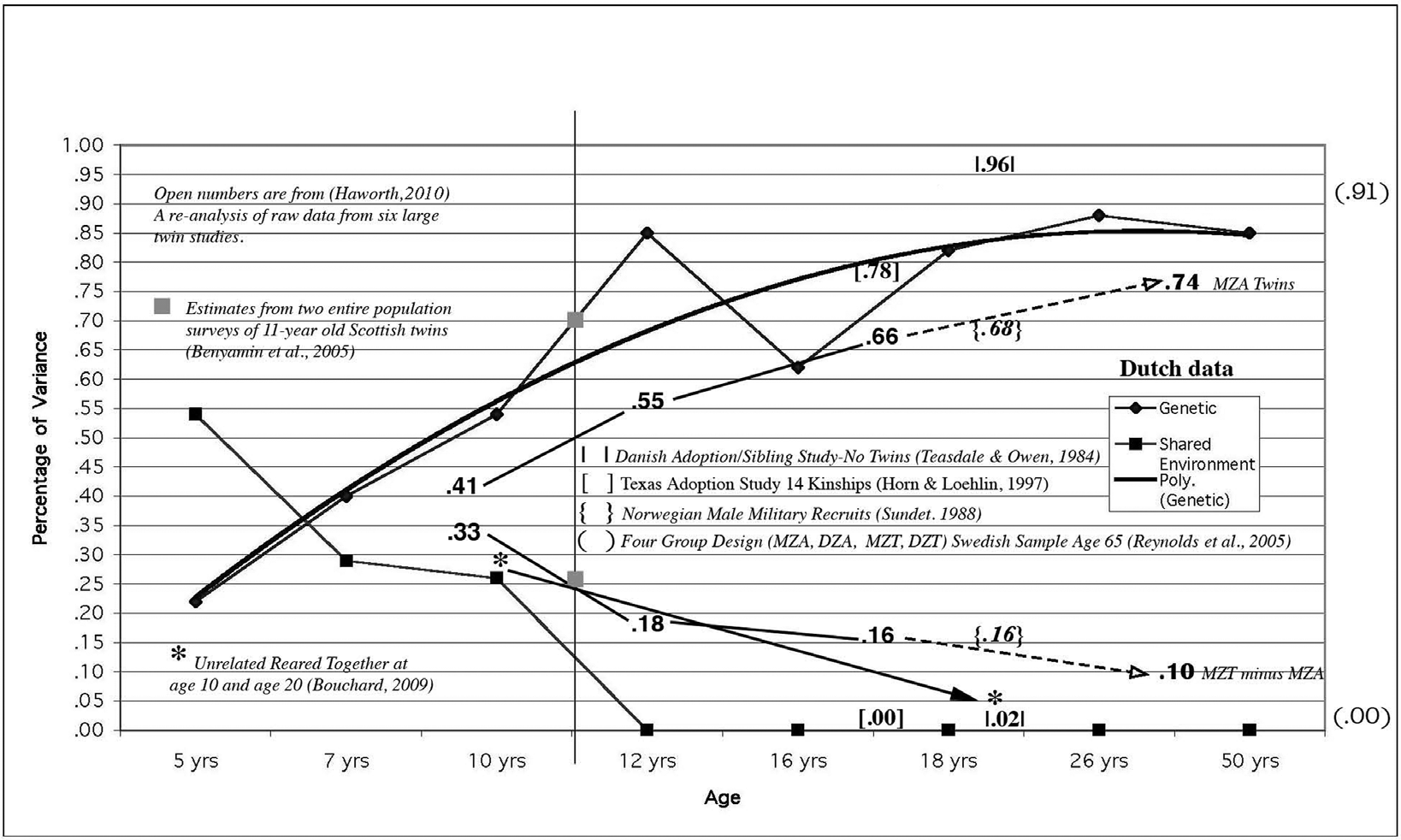
Re: People Want Fairness, Not Economic Equality
#17This makes sense. It's not that we should all be uniform but rather we all have access to being uniform if we so choose. Even if we attempted equality, time would introduce inequality due to the risks people take. One invests wisely, the other gambles away. Do we compensate the gambler to reestablish equilibrium? Should a soon to be retiree have the same wealth or earning power as a new graduate of X degree, or even…
Maybe we should compensate workers based on responsibilities (ie dependents
I was following you up until this notion. Compensation has nothing to do with a worker's responsibilities. Compensation is based on how much the job is worth to the person or company paying. That's why a brain-surgeon with no dependents is paid more than a ditch-digger with a house full of kids.
Re: People Want Fairness, Not Economic Equality
#18This makes sense. It's not that we should all be uniform but rather we all have access to being uniform if we so choose. Even if we attempted equality, time would introduce inequality due to the risks people take. One invests wisely, the other gambles away. Do we compensate the gambler to reestablish equilibrium? Should a soon to be retiree have the same wealth or earning power as a new graduate of X degree, or even…
> Even if we attempted equality, time would introduce inequality due to the risks people take. One invests wisely, the other gambles away. Do we compensate the gambler to reestablish equilibrium?
You just assumed the gambler ended up worse off. What if he won? Do we compensate the investor for his sub-risky-gambling return?
Re: People Want Fairness, Not Economic Equality
#19Even "Fairness" isn't quite as useful a metric - where do you draw the line between things that should be eliminated as being unfair and things that are valuable culture and individuality? Parental intelligence is strongly causally coupled with their children's future intelligence simply through their working vocabulary and talkativeness, which is clearly unfair from the perspective of the newborn child; how do you f…
[deleted]
Re: People Want Fairness, Not Economic Equality
#20Even "Fairness" isn't quite as useful a metric - where do you draw the line between things that should be eliminated as being unfair and things that are valuable culture and individuality? Parental intelligence is strongly causally coupled with their children's future intelligence simply through their working vocabulary and talkativeness, which is clearly unfair from the perspective of the newborn child; how do you f…
When the civilization is confined to one small planet while hitting the physical limits to growth, the fixed pie is a good analogy.
There is fixed and diminishing amount of arable land to grow the wheat and apples. You can make only so many pies.