Live data from Hacker News

Western Digital agrees to buy SanDisk for about $19B

bloomberg.com

21–30 of 50 posts

Re: Western Digital agrees to buy SanDisk for about $19B

#21
post #4

I always have thought that companies were bought for a price of it's market value (stock price * number of stocks), or if someone did not wanted pay all in cash they would've tried to compensate in other ways until market value is reached. But here WD bought SD for ~85-86$ per share, when it was worth ~75$ per share. It's at least 13% more. Does it simply mean that WD hopes that SD will rise in value rapidly? Or I im…

If you really want to understand how buyout happen, "Barbarians at the Gate: The Fall of RJR Nabisco" is a really good book.

http://www.amazon.com/Barbarians-Gate-The-Fall-Nabisco-ebook...

Re: Western Digital agrees to buy SanDisk for about $19B

#22
post #19

Earlier quoted context omitted.

Really? Before the flood, I seem to remember you could get a 1TB Samsung F1 7200rpm drive for £30. Now, an equivalent drive will set you back around £35, and it's taken a long time to reach that level...

Physical disks are not going down in price because their market volume is shrinking, their technology is just not evolving. On consumer machines, the 5400rpm drives are being replaced by other 5400 or by SSDs, not by 7200rpm. So the 5400 disks don't go down in price, whereas SSDs do (albeit slowly, due to technological constraints).

I'd say SSDs are going down in price pretty dang fast. The technology is advancing far more rapidly than HDDs could ever dream of. The Samsung 850 EVO 500GB is already ~25% cheaper than the equivalent 840 was a year ago, with better performance. Not to mention the high performance NVMe drives we're starting to see, where the price:performance is even better.

Re: Western Digital agrees to buy SanDisk for about $19B

#23
post #11
post #4

I always have thought that companies were bought for a price of it's market value (stock price * number of stocks), or if someone did not wanted pay all in cash they would've tried to compensate in other ways until market value is reached. But here WD bought SD for ~85-86$ per share, when it was worth ~75$ per share. It's at least 13% more. Does it simply mean that WD hopes that SD will rise in value rapidly? Or I im…

A couple things: If WD were to start buying sandisk share-by-share, then the price would go up. By the time they owned 50+% their average share price would be a lot more than $86. Owning 100% of sandisk is more than 100 times as valuable as owning 1%. With 100%, WD can tell sandisk what to do, has access to their IP, can merge steps in the production process, etc.

You can still do that with majority ownership (e.g. 51% of shares). The difference with owning 100% is that you have to share dividends with the other 49%, which makes it difficult to move money out of a company.

Re: Western Digital agrees to buy SanDisk for about $19B

#24
post #14

Earlier quoted context omitted.

Hmmm, when did the price decreases stop? I last bought some high capacity drives in 2011 just before the floods in Thailand zapped the industry, and I now note I can buy twice the capacity, 2TB -> 4TB, for $35 less. There could be demand issues, as companies like Amazon, Google, Backblaze, etc. etc. buy them in mass quantities to offer redundant cloud storage. At the other end, SSDs have got to be eating the lunch of…

Really? Before the flood, I seem to remember you could get a 1TB Samsung F1 7200rpm drive for £30. Now, an equivalent drive will set you back around £35, and it's taken a long time to reach that level...

Really. Seagate enterprise highest duty cycle "nearline" drives, 5 year warranty (which I not long ago had to use for one of the 2 I bought back then).

A SAS interface adds $20 currently; models and Newegg prices:

  Constellation ES   ST32000444SS 2TB $265  7/15/11 SAS
  Constellation ES.3 ST4000NM0023 4TB $230 10/21/15 SAS
  Constellation ES.3 ST4000NM0033 4TB $210 10/21/15 SATA
ADDED: Samsung magnetic hard drives are going to be bad for historic price comparisons, for Seagate bought their unit in 2011 (http://www.seagate.com/about-seagate/news/seagate-completes-...). Per that press release, "To ease the transition of products and technologies, Seagate will retain certain Samsung HDD products under the Samsung brand name for 12 months";

Your old price might be lower than normal due to that sale, and/or whatever prompted Samsung to get out of the business; the current price is close out inventory of older generation technology.

Re: Western Digital agrees to buy SanDisk for about $19B

#25

This sucks for consumers. Prices are already way to high for HDs and don't seem to come down anymore. It is as if there is some sort of price fixing going on.

Yeah seriously, SanDisk own patents to flash IIRC, their stuff is always less than their competitors. I hope WD isn't going to jack up prices.

Micron seems to be the cheapest in my experience, aside from TLC crap from Samsung.

Re: Western Digital agrees to buy SanDisk for about $19B

#26
The consolidation in the semiconductors/chip IP industry, thus far in 2015:

1. Intel-Altera: http://www.bloomberg.com/news/articles/2015-06-01/intel-buys...

2. Avago-Broadcom (and earlier, Avago + LSI): http://www.bloomberg.com/news/articles/2015-05-27/avago-said...

3. Silicon Imaging-Lattice: http://www.wsj.com/articles/lattice-to-buy-silicon-image-for...

4. NXP-Freescale: http://www.eetimes.com/document.asp?doc_id=1327236

5. (2014) Cirrus-Wolfson: http://www.eetimes.com/document.asp?doc_id=1322171

6. Avago is further looking at Xilinx, Maxim, and Renesas: http://www.reuters.com/article/2015/05/14/us-chipmakers-m-a-...

This is one industry that is in flux ATM.

Edit: Further afield, though tightly coupled with this industry, on the manufacturing equipment side, Lam Research announced acquisition of KLA-Tencor today http://www.wsj.com/articles/semiconductor-firm-lam-research-...

Re: Western Digital agrees to buy SanDisk for about $19B

#27
post #8
post #6

Earlier quoted context omitted.

When buying a healthy company there's generally a premium required, which is booked as "good will" https://en.wikipedia.org/wiki/Goodwill_(accounting) And all too often written off after the acquisition doesn't pan out.

>> after the acquisition doesn't pan out. Considering that this is common , one wonders - wouldn't it be better investing the $19 billion in innovation, even if in non-related fields ?

To make some sort of (of course flawed) comparison:

You want a nice house.

You can drive around the neighborhood, look at what houses exist and inspect the house you are interested in from roof to cellar bevor making an offer. You adjust your price for the parts you think need renovating, market conditions etc. Banks will gladly finance the deal, you don't need to have very much money of your own.

Or you buy an empty plot, buy a lot of materials, hire people to turn the materials into a house of your specifications. In many established neighborhoods it's very hard to even get an empty plot. Maybe you don't find the materials or people in the quantity or quality you want. Maybe your plans are not that good. Maybe the weather is bad and you take much longer than you planned, and you can't stop at half a house when you run out of money. If everything goes well you can get a better house for less money, but you have to be able to afford the risk.

Re: Western Digital agrees to buy SanDisk for about $19B

#28
post #14

Earlier quoted context omitted.

Hmmm, when did the price decreases stop? I last bought some high capacity drives in 2011 just before the floods in Thailand zapped the industry, and I now note I can buy twice the capacity, 2TB -> 4TB, for $35 less. There could be demand issues, as companies like Amazon, Google, Backblaze, etc. etc. buy them in mass quantities to offer redundant cloud storage. At the other end, SSDs have got to be eating the lunch of…

Really? Before the flood, I seem to remember you could get a 1TB Samsung F1 7200rpm drive for £30. Now, an equivalent drive will set you back around £35, and it's taken a long time to reach that level...

This is all anecdotal but...

I bought...

1TB WD Green EARS HDDs in 2010 for $70. 2TB WD Red HDDs in spring 2014 for $89. 1TB WD Black HDDs in fall 2014 for $90.

Just spot checked the same drives...

1TB WD Green EARS HDDs go for $57. 2TB WD Red HDDs go for $89. 1TB WD Black HDDs go for $71.

So prices are slowly falling but I don't think that we're going to see the rapid falls we were accustom to in the last decade due either to technological constrains or consumer demand, likely both.

From 2000-2005 we went from 20GB to 500GB drives, a 25x growth in 5 years but in 2010 we only had 2TB drives which is just a 4x growth. It's 2015 the largest consumer HDDs you can get from WD, Seagate, and HGST are 6TB, 8TB, and 10GB respectively. That's 3-5x growth for the 5 year period. Why has growth slowed? Is it a technological constraint or a lack of investment?

In the early 2000s you could only play music and movies you possessed so there was a big demand for storage space for all your ripped CDs and DVDs. In 2007 Netflix introduced online streaming and today we have thousands of choices for streaming video or music on demand which combined with cloud storage options negated our need for high capacity drives. I think the fact that people are opting for 120GB SSDs over 4TB HDDs demonstrates that the consumer need for extremely large hard drives is in decline.

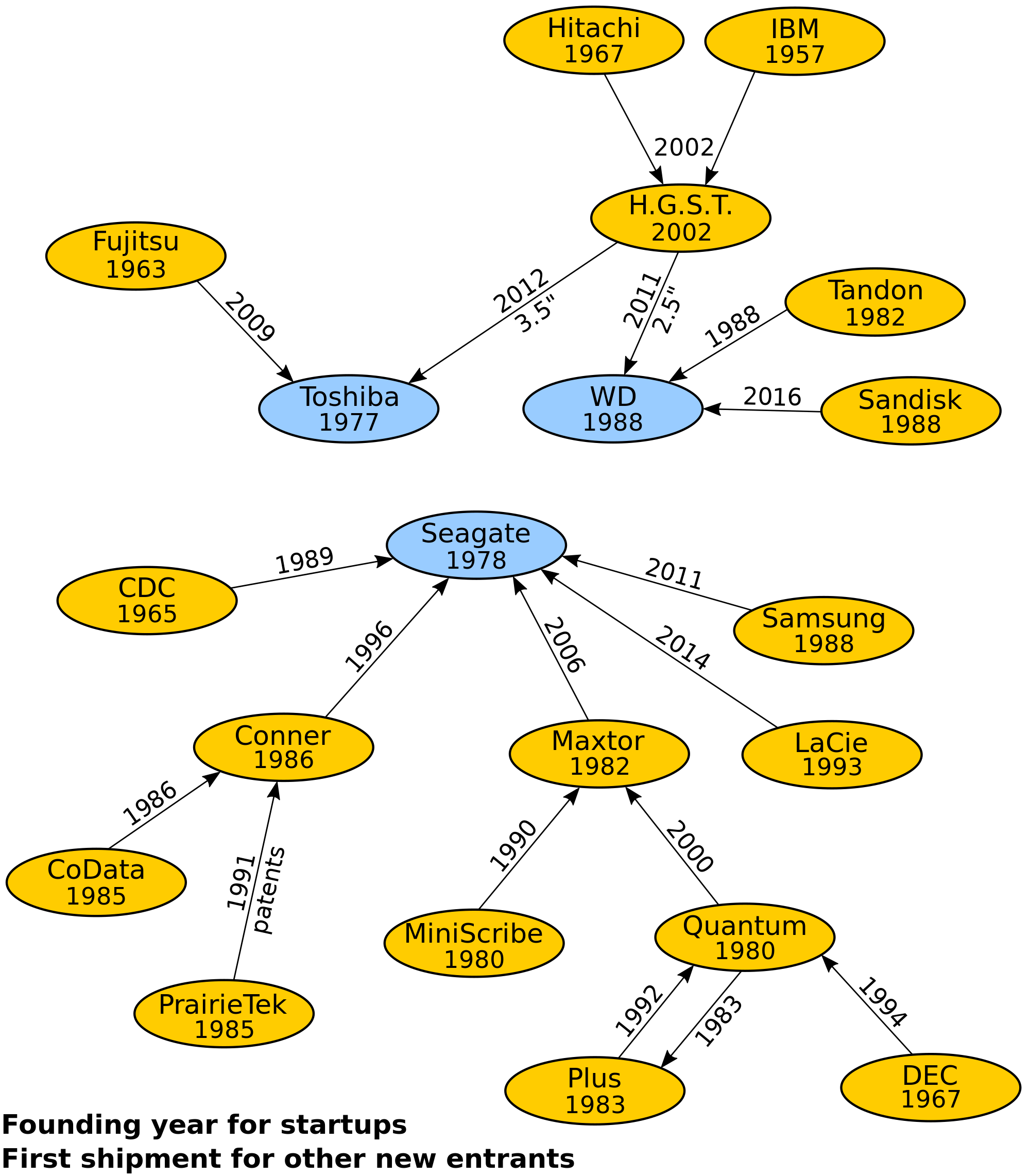
In the past the HDD makers were very competitive but if you look at WD, Seagate and HGST today you can see they're no longer competing on drive capacities. HGST is the only one that even bothers to sell a consumer grade 10TB HDD. Western Digital has been diversifying for years; first it was portable backup solutions, then NAS drives, NAS solutions, Surveillance and Data Center drives, and just today they announced they're buying Sandisk, a major SSD player.

I think the industry as a whole is moving away from HDDs and for that reason they nolonger need to compete so ferociously on price points.
Re: Western Digital agrees to buy SanDisk for about $19B

#30
post #20
post #8

Earlier quoted context omitted.

>> after the acquisition doesn't pan out. Considering that this is common , one wonders - wouldn't it be better investing the $19 billion in innovation, even if in non-related fields ?

This is a common misconception by non financial people (no offense). You have to look at this from a finance and risk perspective. 1. Cash lying around in your bank account is usually a poor use of working capital (you are effectively "losing" money by it sitting in the form of cash) 2. Investing in "innovation" is always risky. Look at how many internal Google apps get scrapped a year or two into launch. They effect…

Bit first, this is not cash lying around, this is new debt. Second ,Even if you take all of Google's investments into innovation and and look at them combined ,they would probably offer a decent return on investment. Similarly if you look at intel capital's investments , you'll probably get a nice financial story + a decent strategic lever.

Also from a pure financial perspective - sandisk has a profit of $1.22 Billion.That would take 15 years to repay. Isn't risky to make such long term investments in i a single investment , in tech , which is a dynamic field usually ?

Post reply on HN