Live data from Hacker News

The Most Important Thing: Decline in poverty, illiteracy and disease

nytimes.com

131–140 of 218 posts

Re: The Most Important Thing: Decline in poverty, illiteracy and disease

#131
post #57

Earlier quoted context omitted.

American progressives can be just as guilty, if less organized. They tend to view big business with suspicion and incorrectly think that the American government is hopelessly corrupt and in the pocket of "Big Business and/or Wall Street".

No, I don't think I ever hear American progressives assert that they want less government. Less corrupt government? Absolutely, but the idea that government is "too big" seems entirely in province of the contemporary right (and you can partition that up into the industrialists who want to abolish the EPA, the code-worded-racists who want to end welfare, the bootstrappers who want to privatize everything, etc).

As a progressive, I would support a plan of re distributive basic income. The plan I would support would involve shrinking existing government.

As a progressive, I support removing the costs of worker healthcare from labor costs to industry.

As a progressive, I support reducing the over-all social cost to higher education by eliminating the federal grant and loan processes, and simply block allocating per-student rates for state schools.

As a progressive, I would love to see Corporations dehumanized; Speech equal speech; and commercial activity limited to the interaction of autonomous entities.

As a progressive, I would support returning the sovereign responsibilities of application of force to the government, and in doing so reduce the actual per-body cost of warfare and law-enforcement. (Ending cost-plus contracting) (Returning prisoners to the states from private enterprises)

If given free reign, every industry would cloud it's cost externalities, such as the environmental repercussions, or the needs of the dependents that work those convenient company towns. Quarterly balance reports rarely see the value in education, healthcare, or decent food in those locked-in labor units.

Re: The Most Important Thing: Decline in poverty, illiteracy and disease

#132

Earlier quoted context omitted.

Can putting those numbers side-by-side in such a way mislead people on the social impact of those events? Murder is rare, but it has a very high impact on society and the surrounding people. It creates an environment of stress and fear. Car accidents do the same to a much lesser extent. Smoking related diseases are somewhat more expected, they aren't so sudden. People have time to adjust, receive medical attention, a…

> Murder is rare, but it has a very high impact on society and the surrounding people. How do you know? What metrics are you using to form this opinion? Or are you using the same gut impression that the article alludes to and the GP specifically states? By my math each murder could affect 10 people as to leave them in a state equivalent to death and still not come anywhere close to the impact as smoking. Let me put i…

I'm just using my gut impression. Sorry for not being more clear.

My main point was that seeing the raw numbers may also present a skewed perception of the how impactful those deaths were on society. Especially when you see them side by side, and one looks so much more "important" than the others by virtue of being an order of magnitude larger.

You might be right that a death from smoking related disease is more impactful on society than a murder, I have no idea about that and my speaking about it probably confused the point.

Re: The Most Important Thing: Decline in poverty, illiteracy and disease

#133
post #35

"We cover planes that crash, not planes that take off." It always fascinates me how much my world view and the world view of those around me is based on the exceptional and not the mundane. The news outlets report the news assuming that the audience knows what's normal. When the news is used to become informed about the world many people come away with a skewed impression of reality. I am of the opinion that people w…

Can putting those numbers side-by-side in such a way mislead people on the social impact of those events? Murder is rare, but it has a very high impact on society and the surrounding people. It creates an environment of stress and fear. Car accidents do the same to a much lesser extent. Smoking related diseases are somewhat more expected, they aren't so sudden. People have time to adjust, receive medical attention, a…

You absolutely should ignore mass shootings. Paranoia about terrorism has created the NSA and TSA, and all sorts of other nonsense. People watching airplane crashes on the news think that airplanes are incredibly dangerous and drive instead.

The raw numbers are important. People are actually surprised when you give them statistics like how rare murders actually are, or how rare shark attacks are, etc. That wouldn't be surprising if people already had an accurate model of the world. We should strive to inform people, not misinform them further. Knowing about the risk of auto accidents is far more important to the average person than knowing about the details of mass shootings.

The news actively misinforms people about risks. It creates irrational fears and behaviors. The "social impact" you are talking about exists because of the news misinforming people. It's an effect, not a cause. If the news reported on every traffic crash instead, mass shootings wouldn't have any impact on our society or people's behavior.

Maybe people living in such a society would be more likely to buckle their seatbelts, and less likely to own guns.

Our goal should absolutely be to minimize death and suffering. Everything else is secondary and subjective. We should strive to be more rational and consistent, not embrace our irrational fears of rare things.

Re: The Most Important Thing: Decline in poverty, illiteracy and disease

#134

Earlier quoted context omitted.

Can putting those numbers side-by-side in such a way mislead people on the social impact of those events? Murder is rare, but it has a very high impact on society and the surrounding people. It creates an environment of stress and fear. Car accidents do the same to a much lesser extent. Smoking related diseases are somewhat more expected, they aren't so sudden. People have time to adjust, receive medical attention, a…

The negative effects of mass shootings are largely because people don't understand the risks. So I think they'd go away if we realized they didn't matter. You're right though that smoking shouldn't be top. Everbody dies of something but we can't save all old people from old age diseases forever.

> You're right though that smoking shouldn't be top. Everbody dies of something but we can't save all old people from old age diseases forever.

The CDC disagrees. If you click through the last link in the post above they list in great big bold letters "Smoking is the leading cause of preventable death." The key word being "preventable". You're right in that there is little value in worrying about unpreventable causes of death but, please, don't make the mistake of thinking smoking is by any means unpreventable. Also, it's worth pointing out that smoking including second hand smoking kills people of all ages

Re: The Most Important Thing: Decline in poverty, illiteracy and disease

#135
post #125

Another big secret, is that the source of a lot of poverty being lifted is because of China. That's right, that terribly communist government suppressing its people and free speech, is actually responsible for lifting 500 million people out of poverty over the last 30 years. That is definitely a big secret of american media, and something that it neglects to report on, in favor of free speech violations, naval exerci…

Great, so instead of starving to death they can live long boring lives full of grueling work enriching assholes who don't even let them have internet access or freedom of mobility within their own country. There's a good reason the vast majority of rich Chinese people move to the West. It's an awful place to live if you have a choice.

Haha have you been to China? It's really not as bad as you are imagining. The controls on internet access is not as extreme as portrayed in western media. I'm not sure where this mobility issue is coming from. If you're talking about poor factory workers being constrained, well poor people everywhere have a hard time being mobile. Although at least in China's case, they have some of the world's most developed high speed rails to get between places. Chinese New Year is the world's largest annual migration.

Although many are, the "vast majority" of rich Chinese people are not moving to the West, that's extreme hyperbole. China is full of terrible things: massive income inequality, pollution and smog, corruption, scams, copycat, scandals and more. But there are also amazing things: innovation, one of the world's richest histories, strong families, and a hunger for progress. Life has been improving there for the past 30+ years, not steadily improving, but improving at an explosive pace of progress. It's not "an awful place to live" (at least I hope not for the 1.3 billion people there), and there is far worse you could do on Earth right now.

Re: The Most Important Thing: Decline in poverty, illiteracy and disease

#136

Earlier quoted context omitted.

> Murder is rare, but it has a very high impact on society and the surrounding people. How do you know? What metrics are you using to form this opinion? Or are you using the same gut impression that the article alludes to and the GP specifically states? By my math each murder could affect 10 people as to leave them in a state equivalent to death and still not come anywhere close to the impact as smoking. Let me put i…

I'm just using my gut impression. Sorry for not being more clear. My main point was that seeing the raw numbers may also present a skewed perception of the how impactful those deaths were on society. Especially when you see them side by side, and one looks so much more "important" than the others by virtue of being an order of magnitude larger. You might be right that a death from smoking related disease is more impa…

I respect the general thrust of your position in that we as a society must evaluate things like death on all axes including social impact. But until thing like social impact become less nebulous and more quantifiable I will continue to base my opinions on the the "raw" numbers because at least I can compare apples to apples.

Re: The Most Important Thing: Decline in poverty, illiteracy and disease

#137

Earlier quoted context omitted.

I'm just using my gut impression. Sorry for not being more clear. My main point was that seeing the raw numbers may also present a skewed perception of the how impactful those deaths were on society. Especially when you see them side by side, and one looks so much more "important" than the others by virtue of being an order of magnitude larger. You might be right that a death from smoking related disease is more impa…

I respect the general thrust of your position in that we as a society must evaluate things like death on all axes including social impact. But until thing like social impact become less nebulous and more quantifiable I will continue to base my opinions on the the "raw" numbers because at least I can compare apples to apples.

I'm not suggesting we ignore "raw" numbers. Just that we should realise they are not directly comparable, as they are not all measuring sudden or violent terminations of life.

Re: The Most Important Thing: Decline in poverty, illiteracy and disease

#138
post #107

I think the average American is going to be shocked in the next couple of years when the rest of the world passes us by. The technological capability of developing nations has increased rapidly. Our rate of technological progress is slowing down. For example, Intel is having difficulty scaling down process technology past 14nm while the fabs in China are catching up at 28nm.

> For example, Intel is having difficulty scaling down process technology past 14nm while the fabs in China are catching up at 28nm. It's much, much easier to "catch up" than to actually innovate. With the education system and culture in China and India there's no way they're going to pass us by. Those are countries where having an original thought and arguing with your teacher gets you kicked out of school. Hell, in…

China has plenty of "original thought[s]". I bet India does too. I always find it amazing that in the U.S. we tend to judge other countries as being "unoriginal" or "lacking creativity", simply because we are better right now. We forget to factor in that we are the wealthiest country in the world, have been for hundreds of years. We have the best resources, and that create a compounding effect for our accomplishments. Not to mention that a lot of our original ideas likely come from specifically China and India.

Re: The Most Important Thing: Decline in poverty, illiteracy and disease

#139
This article is deceptive because it speaks of raw numbers rather than percentages. While the number of people living on less than a dollar a day went up throughout the 20th century, this was because populations were exploding over the same period. At the same time, the fraction of people living on less than a dollar a day plunged dramatically. In fact, this trend slowed after 1990 - since then this rate has declined less quickly than it did during the seventies, when it fell from almost 30% to less than 10% in 1985. See https://orderorder.files.wordpress.com/2015/04/capitalism.jp... e.g.

Re: The Most Important Thing: Decline in poverty, illiteracy and disease

#140

This article is deceptive because it speaks of raw numbers rather than percentages. While the number of people living on less than a dollar a day went up throughout the 20th century, this was because populations were exploding over the same period. At the same time, the fraction of people living on less than a dollar a day plunged dramatically. In fact, this trend slowed after 1990 - since then this rate has declined…

That particular chart seems to show significantly lower numbers than most I've seen. Sub 10% since 1985.

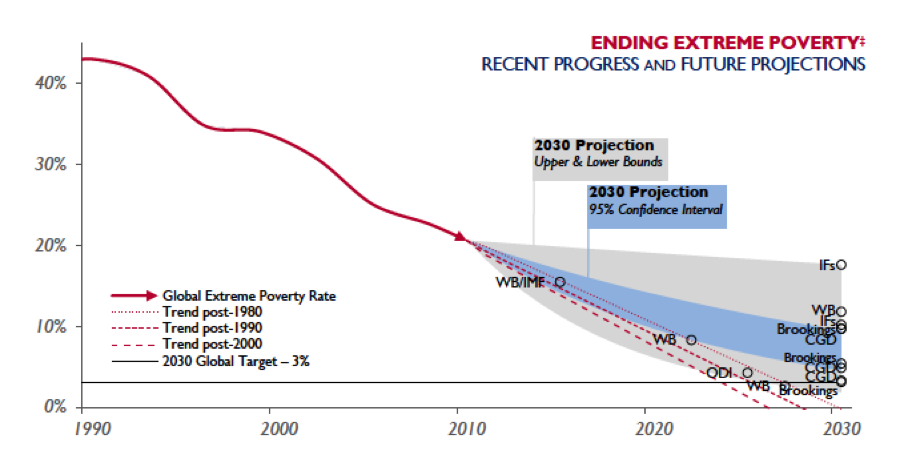
This one shows 20% as of 2010. And over 40% in 1990. https://upload.wikimedia.org/wikipedia/commons/e/e1/USAID_Pr... https://en.wikipedia.org/wiki/Extreme_poverty

Also from that article. "n 1990, the percentage of the global population living in extreme poverty was 43.1%, but in 2010, that percentage had dropped down to 20.6%." That doesn't line up AT ALL with your image which says 10% in 1985.

So I'm not sure what's going on here exactly. But I don't think it's as simple as absolute vs percentage deception.

Post reply on HN