Isn't gerrymandering a much more complex problem than that makes it out to be? I've always thought the problem was that it's actually difficult to even come up with a definition of what fair is. For instance, do you want each district to be as representative of the population as possible? Or do you want the house of representatives to be as representative of the population as possible? I suspect that you can't have b…
Gerrymandering is simply incumbency protection. Fairness is simply maximal competitiveness.
Gerrymandering and a cure for it – the shortest splitline algorithm
21–30 of 178 posts
Re: Gerrymandering and a cure for it – the shortest splitline algorithm
#22Because gerrymandering increases homogeneity. A gerrymandered district is more homogeneous--the voters are more alike than they were before. In general.
Homogeneity in general increases unity. A more homogeneous district means the voters in general share more common interests. If the voters share more common interests then it is easier for them to elect and hold accountable a politician who can represent their common interests.
Of course if you want the corporations to have more control over the government, and you want the people to have less control, then gerrymandering is indeed bad.
Re: Gerrymandering and a cure for it – the shortest splitline algorithm
#23Isn't gerrymandering a much more complex problem than that makes it out to be? I've always thought the problem was that it's actually difficult to even come up with a definition of what fair is. For instance, do you want each district to be as representative of the population as possible? Or do you want the house of representatives to be as representative of the population as possible? I suspect that you can't have b…
> Isn't gerrymandering a much more complex problem than that makes it out to be? No, its vastly simpler: the problem with gerrymandering is that there is no good way to draw single-member winner-take-all districts, and the solution is just don't do that . Multimember districts with a system that provides proportional representation within each district (e.g., five-member districts with STV) solve the problem pretty m…
Re: Gerrymandering and a cure for it – the shortest splitline algorithm
#24Re: Gerrymandering and a cure for it – the shortest splitline algorithm
#25gerrymandering is good--for the electorate. why? Because gerrymandering increases homogeneity. A gerrymandered district is more homogeneous--the voters are more alike than they were before. In general. Homogeneity in general increases unity. A more homogeneous district means the voters in general share more common interests. If the voters share more common interests then it is easier for them to elect and hold accoun…
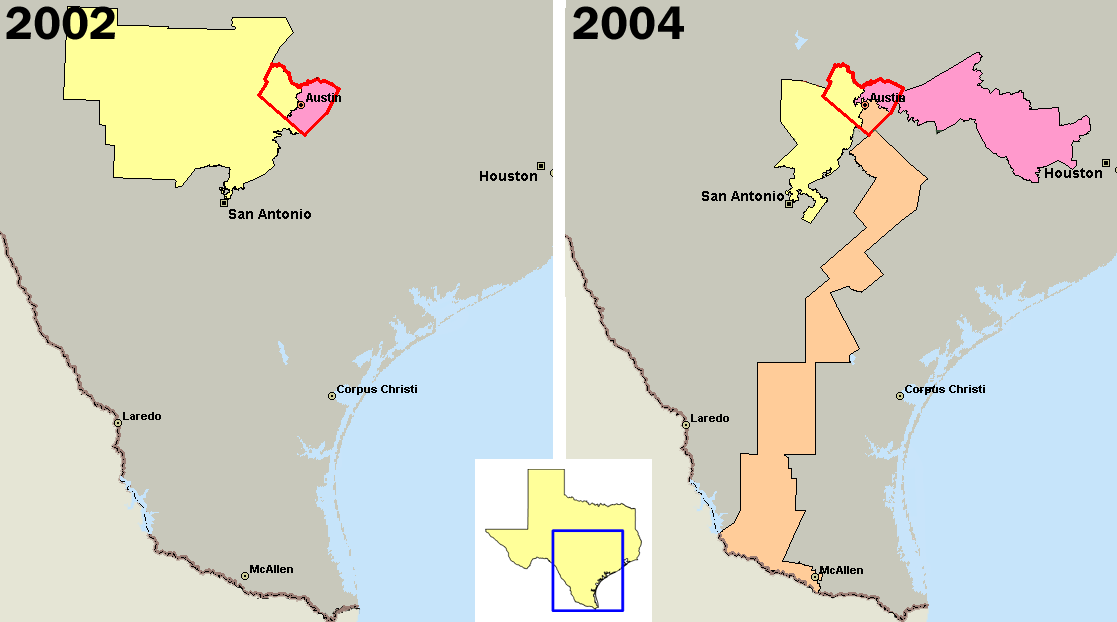
https://upload.wikimedia.org/wikipedia/commons/2/24/TravisCo...
Regardless of desirability, gerrymandering does not by definition increase homogeneity. It's a tool that is used for political gain, whatever that may be.
Re: Gerrymandering and a cure for it – the shortest splitline algorithm
#26Re: Gerrymandering and a cure for it – the shortest splitline algorithm
#27Earlier quoted context omitted.
Gerrymandering is simply incumbency protection. Fairness is simply maximal competitiveness.
Define "maximal competitiveness" in a 60-40 state with ten districts. Ten 60-40 districts? Eight 51-49 districts, and two 96-4 districts? Either could be argued as incumbency protection.
Duverger's Law suggests that a two party system is the logical result of winner takes all elections, because aspirant will attempt to win with the smallest coalition.
In other words, fair redistricting will reduce polarization.
Re: Gerrymandering and a cure for it – the shortest splitline algorithm
#28Earlier quoted context omitted.
> Isn't gerrymandering a much more complex problem than that makes it out to be? No, its vastly simpler: the problem with gerrymandering is that there is no good way to draw single-member winner-take-all districts, and the solution is just don't do that . Multimember districts with a system that provides proportional representation within each district (e.g., five-member districts with STV) solve the problem pretty m…
Agreed. But even when the USA sees the light on proportional representation, there will continue to be winner takes all elections. Executive positions (president, governor, mayor), senators, judges, ballot issues, etc. In those cases, approval voting is the correct answer. Easy to explain, easy to tabulate, most mathematically fair, hardest to game. Per Duvenger's Law, approval voting would probably also help replace…
"Sees the light"? Proportional representation is far from a panacea. It tends to lead to a fragmented government (which is usually bad). It also privileges party over individual candidates (which can be good or bad, but those who dislike partisanship would certainly disapprove). There are other factors at play as well.
Most (in)famously, the Weimar Republic used PR. That didn't end well.
Re: Gerrymandering and a cure for it – the shortest splitline algorithm
#29Isn't gerrymandering a much more complex problem than that makes it out to be? I've always thought the problem was that it's actually difficult to even come up with a definition of what fair is. For instance, do you want each district to be as representative of the population as possible? Or do you want the house of representatives to be as representative of the population as possible? I suspect that you can't have b…
I do think the algorithm presented here is too simplistic. It's likely to create situations where people have to travel long distances to their polling places and, if anything, we should be optimizing for voter turn out. It could, perhaps, work if cities were never split between districts, but even then people who live just over the border may have to travel quite a ways to vote.
I wonder whether we're arguing over the best bad idea rather than something simpler which would yield a better result. Is there really a benefit to geographically grouping voters? I'd argue that you're likely to get better representation from grouping voters by age range rather than locality. We've consistently seen policies that benefit older demographics over younger demographics...perhaps if there was a candidate elected only by 20-somethings, that demographic would actually be represented for once.
Re: Gerrymandering and a cure for it – the shortest splitline algorithm
#30Earlier quoted context omitted.
Agreed. But even when the USA sees the light on proportional representation, there will continue to be winner takes all elections. Executive positions (president, governor, mayor), senators, judges, ballot issues, etc. In those cases, approval voting is the correct answer. Easy to explain, easy to tabulate, most mathematically fair, hardest to game. Per Duvenger's Law, approval voting would probably also help replace…
"But even when the USA sees the light on proportional representation" "Sees the light"? Proportional representation is far from a panacea. It tends to lead to a fragmented government (which is usually bad). It also privileges party over individual candidates (which can be good or bad, but those who dislike partisanship would certainly disapprove). There are other factors at play as well. Most (in)famously, the Weimar…
Already the case.
It also privileges party over individual candidates
Distinction without a difference. Even if the focus is on the candidates, they're all firmly partisan with little variation.
Most (in)famously, the Weimar Republic used PR. That didn't end well.