Live data from Hacker News

The toxic side of free – how I lost the love for my side project (part 4)

remysharp.com

21–30 of 185 posts

Re: The toxic side of free – how I lost the love for my side project (part 4)

#21
post #13

The credit card problem is quite easy to solve: allow a few months of free "pro" functionality upon signup, and then allow users to upgrade. During that period of time, you can also track whether they actually used the service at all.

But then you'll have people creating new accounts every time the trial ends, instead of paying! The sweet spot is probably 24 hours. Too long for a fraudster to wait around, and too short for people to bother making an account every day for pro fuctionality.

> But then you'll have people creating new accounts every time the trial ends, instead of paying!

These would be malicious users. Both words are significant here. People using the service just to check credit cards are malicious, but not users. Free users are users but not malicious.

I think for most services, the set of actual malicious users—people who do want to use the service for its intended purpose, but don't want to support it—is fairly small.
Re: The toxic side of free – how I lost the love for my side project (part 4)

#22

Please, please, anyone, if you are getting started in online payment processing, don't do it yourself. Use a service that already handles the VAT and fraud detection issues. Then, when you've proven your product, and got substantial sales, you can write your own. Maybe. The author of the article spent weeks and thousands of euros to implement a payment system. And yet he had only a handful of customers.

Well, he used Stripe, so he didn't write his own. Personally I wasn't aware that there was such a high fee for a chargeback. Is that because Stripe doesn't handle fraud well?

Seems like most of his time was spent dealing with tax issues, which you'd have to do regardless of how money is actually transferred.

Re: The toxic side of free – how I lost the love for my side project (part 4)

#23

Please, please, anyone, if you are getting started in online payment processing, don't do it yourself. Use a service that already handles the VAT and fraud detection issues. Then, when you've proven your product, and got substantial sales, you can write your own. Maybe. The author of the article spent weeks and thousands of euros to implement a payment system. And yet he had only a handful of customers.

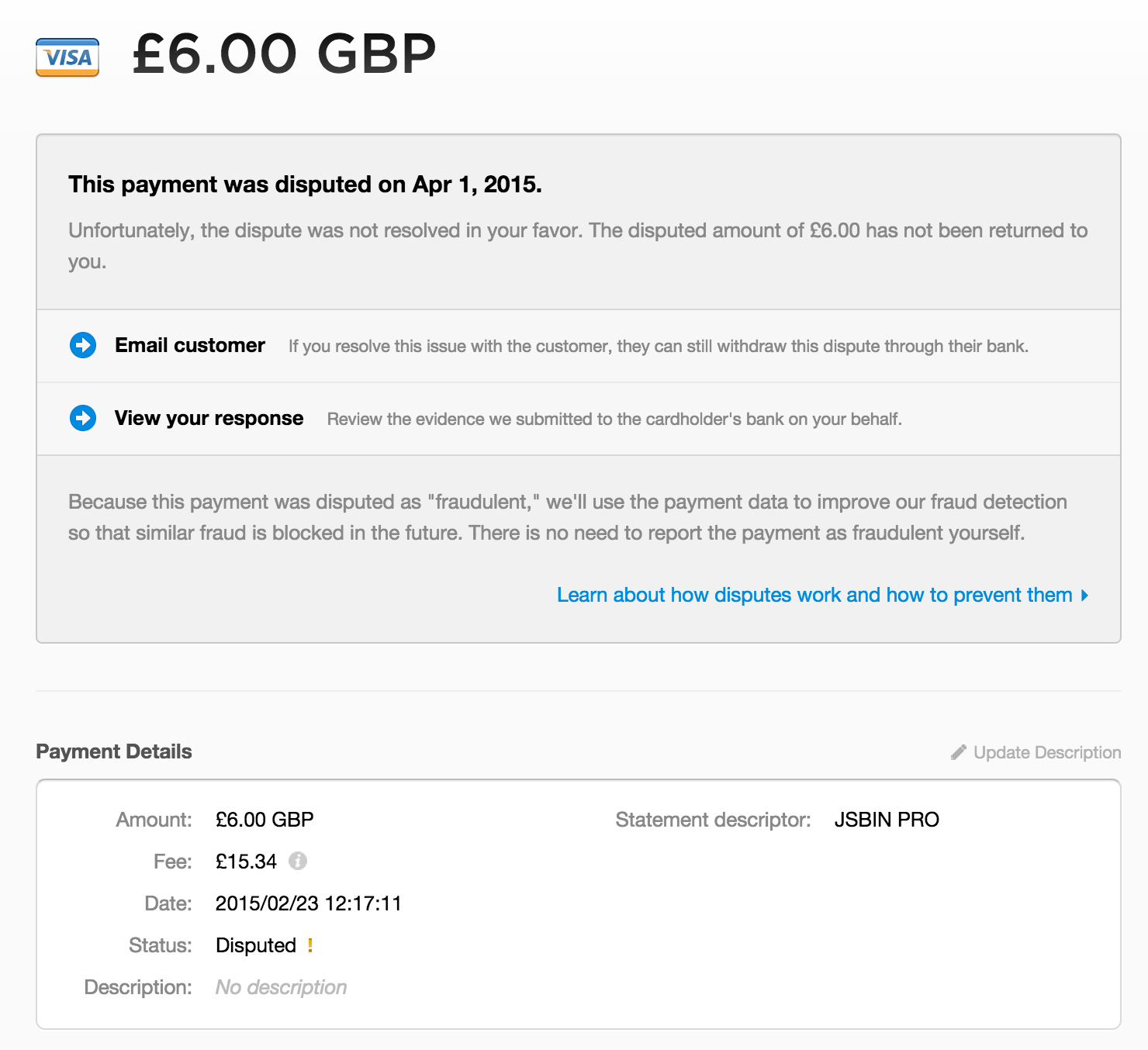
He did (stripe): https://remysharp.com/images/jsbin-stripe-fraud.png

Re: The toxic side of free – how I lost the love for my side project (part 4)

#25

Please, please, anyone, if you are getting started in online payment processing, don't do it yourself. Use a service that already handles the VAT and fraud detection issues. Then, when you've proven your product, and got substantial sales, you can write your own. Maybe. The author of the article spent weeks and thousands of euros to implement a payment system. And yet he had only a handful of customers.

Well, he used Stripe, so he didn't write his own. Personally I wasn't aware that there was such a high fee for a chargeback. Is that because Stripe doesn't handle fraud well? Seems like most of his time was spent dealing with tax issues, which you'd have to do regardless of how money is actually transferred.

Good point. I consider using Stripe a "do-it-yourself" solution, which requires manual coding. As far as handling EU VAT, Stripe offers nothing, and you need to manually implement this.

I meant that you should use a service last FastSpring or Avangate initially, which require no coding, and completely take care of VAT.

Re: The toxic side of free – how I lost the love for my side project (part 4)

#26
post #11

Okay, say you're a US citizen building some digi service like JS Bin, and VATMOSS starts fling threats at you, for how long can you go about ignoring them? I mean 3.5k GBP and however many weekdays it took isn't exactly affordable for every small business, and if you don't even have many Euro pro-users, I don't see the cost-benefit justification of giving VATMOSS priority unless they can reach across the Atlantic.

Depending on the kind of service, a good solution is to use a third party provider that handles VAT payments for you; FastSpring, for example: http://www.fastspring.com/vat

(disclaimer, I am a happy FastSpring customer in the US, but have no other relationship with them)

Re: The toxic side of free – how I lost the love for my side project (part 4)

#27
post #20
post #11

Okay, say you're a US citizen building some digi service like JS Bin, and VATMOSS starts fling threats at you, for how long can you go about ignoring them? I mean 3.5k GBP and however many weekdays it took isn't exactly affordable for every small business, and if you don't even have many Euro pro-users, I don't see the cost-benefit justification of giving VATMOSS priority unless they can reach across the Atlantic.

I think the obligation to pay customers' VAT goes back way before VATMOSS. That said, I think you've answered your own question. Unless you're at a size that would be drawing attention, it would be logical to ignore this if you're not in the EU.

> I think the obligation to pay customers' VAT goes back way before VATMOSS.

Yep, VOES was put in place in 2003 and that was a simplification, before that businesses were supposed to register themselves with each country's tax office and fill VAT everywhere. For non-EU businesses VATMOSS mostly updates the scheme: register yourself in any member state and use their MOSS portal as a non-EU business, the tax office is supposed to redistribute VAT based on your fillings.

The business also has the option to forego MOSS/VOES and register itself in each country of course.

Re: The toxic side of free – how I lost the love for my side project (part 4)

#28
post #8
post #5

> it's cost me, £21.54 to allow some shithead to use JS Bin as a stolen card testing facility. Not sure if it's standard practice, but in our case we let the users use the "free tier" service first , and we offer the paid plans only once we can validate they have a genuine interest in the product . It works well for us to avoid these cases.

That's an interesting approach, but if the "pro" features are something the user really needs, then don't you risk losing a sub if the feature is withheld until you "get to know each other?"

You could give them 15 days free use, and only charge it after that... there is a risk that the charge doesn't go through (in which case you've given a couple weeks free service - big deal), but otherwise, you've just made it much less useful for card testing (to the point that they certainly won't use your site).

Re: The toxic side of free – how I lost the love for my side project (part 4)

#29
post #11

Okay, say you're a US citizen building some digi service like JS Bin, and VATMOSS starts fling threats at you, for how long can you go about ignoring them? I mean 3.5k GBP and however many weekdays it took isn't exactly affordable for every small business, and if you don't even have many Euro pro-users, I don't see the cost-benefit justification of giving VATMOSS priority unless they can reach across the Atlantic.

Depending on the kind of service, a good solution is to use a third party provider that handles VAT payments for you; FastSpring, for example: http://www.fastspring.com/vat (disclaimer, I am a happy FastSpring customer in the US, but have no other relationship with them)

I should also add a point relevant to this article; that outsourcing to a provider like FastSpring can also give you the benefit of real-time fraud detection/risk analysis. https://support.fastspring.com/entries/64433830-Understandin...

I've had maybe one or two chargebacks that made it past their filter in the ~three years I've been with them, and I don't remember having to pay any extra fees for it.

It sounds like a part of OPs issue was not the "cost" so much as trying to do to much himself, which ended up being costly.

Re: The toxic side of free – how I lost the love for my side project (part 4)

#30

This is why if any of my personal projects go anywhere they'll remain free while they are in my hands. They can act as a portfolio ("look what I've done, aren't I clever") for when job hunting but I'll not even try make money directly from them even to cover costs. If they become worth charging for then someone can buy the rights from me and run it. Yeah they'll take the lion's share, but also all that hassle and I c…

This is why Amazon DevPay(?) exists. You ship software, and Amazon directly bills your customers for the AWS usage. you don't have to get into the AWS-reselling business just because you wrote cloud software.
Post reply on HN