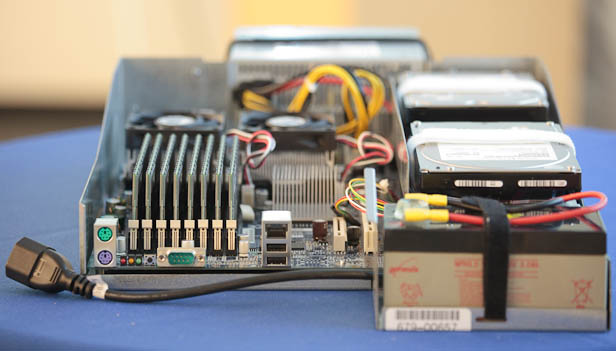
Beyond security, this highlights one of the main issues with the cloud. Was there no backup? Of course once you get beyond the headline, I think most people are much worse with protecting themselves from rare outages than Google.
This was closer to a colocated server than a cloud service. GCE gives you a VM that you install your favorite OS on. Google keeps the VM running, but the rest (such as whether the server backs itself up) is up to you.
As mentioned in the article, it only affected recently written data of 'Google Compute Engine' services. GCE allows user to launch VMs and generate arbitrary data on the server. Normally, Google redundantly distributes out data to at least 3 different geographically distinct locations. Check out the 'BigTable' white paper [0] for more info. For 99% of cases (and pretty well all user cases), this would not cause data…
Nowadays they use Reed–Solomon coding to effectively distribute their data without copying it to 3 places.
Do you have a source for that? Why would they start using it now?
Beyond security, this highlights one of the main issues with the cloud. Was there no backup? Of course once you get beyond the headline, I think most people are much worse with protecting themselves from rare outages than Google.
If you were running the data center instead of Google, it'd suddenly stop being cloud. How would that change lightning and power loss?
Google Compute Engine offers customers the option to make snapshots for backup, or use a true "cloud" storage engine. If anyone lost data here it was customers explicitly not doing backups and only using a single zone. I don't know why anyone would expect different. GCE easily allows you to network machines in multiple data centers, but close geographically. So you'd only need to handle region-wide disasters.
Relevant amusing bit from the Amazon FAQ: "S3 is designed to provide 99.999999999% durability of objects over a given year. This durability level corresponds to an average annual expected loss of 0.000000001% of objects. For example, if you store 10,000 objects with Amazon S3, you can on average expect to incur a loss of a single object once every 10,000,000 years." I think my favorite part of that is "on average", a…
"just 0.000001% of disk space was permanently affected." So Google just exhausted their 11 9's for centuries to come.
Which would be embarrassing if this had happened to a product offering such an SLA. Instead, this is just zone-local HDD storage. It will only affect customers that decided to run a system in a single site, making no snapshots or using cross-region replication, etc. Which may be quite a few seeing as there seems to be this misunderstanding that VMs "in the cloud" have physics-defying redundancy attributes. (Not saying you have this idea, just that multiple clients have expressed surprise when their single-VM setup goes down because "isn't this what the cloud is for?".)
This is how, for example, you can know whether a wildfire was started by lightning - once a point of origin is determined, simply check the data for strikes.
Relevant amusing bit from the Amazon FAQ: "S3 is designed to provide 99.999999999% durability of objects over a given year. This durability level corresponds to an average annual expected loss of 0.000000001% of objects. For example, if you store 10,000 objects with Amazon S3, you can on average expect to incur a loss of a single object once every 10,000,000 years." I think my favorite part of that is "on average", a…
Many people have far more than 10k objects though. Based on that math, if you stored 10 billion objects in S3 (certainly well within the realm of possibility), you'd lose an object on average every 10 years, which is a length of time one can think about.
Your main point (that making high reliability systems more conventionally reliable is building your high wall yet higher still) is definitely valid. But the lossage rate is actually a meaningful number given the extremely large number of objects stored in S3.
Relevant amusing bit from the Amazon FAQ: "S3 is designed to provide 99.999999999% durability of objects over a given year. This durability level corresponds to an average annual expected loss of 0.000000001% of objects. For example, if you store 10,000 objects with Amazon S3, you can on average expect to incur a loss of a single object once every 10,000,000 years." I think my favorite part of that is "on average", a…
This is S3 which isn't comparable to Google's persistent disks. S3 is equivalent to Google Cloud Storage which has "99.999999999%" durability as per https://cloud.google.com/storage/ To accurately compare them you'd need to look at AWS EBS: "Amazon EBS volumes are designed for an annual failure rate (AFR) of between 0.1% - 0.2%, where failure refers to a complete or partial loss of the volume, depending on the size a…
The point isn't to compare competing cloud services, but draw attention to the fantastical nature of these durability promises.
AFAIK google doesn't use hardware-based arrays in their servers. I think the reference to batteries would more likely be in reference to a DRUPS (Diesel Rotary UPS) which most datacenters run, sometimes with some form of battery in combination with the flywheel. Typically the combination of kinetic energy in the flywheel (and potentially batteries) only hold enough power to last for 30 seconds or so (often as low as…