We are Colorblind
wearecolorblind.com
We are Colorblind
1–10 of 53 posts
Re: We are Colorblind
#2A JavaScript widget, browser plugin, or Photoshop filter to colorblindify, in various types, a webpage so that designers can check for usability would be useful.
EDIT: Actually, what would be more useful are colorblind OS X color profiles and an easy way to switch between them.
Re: We are Colorblind
#3A JavaScript widget, browser plugin, or Photoshop filter to colorblindify, in various types, a webpage so that designers can check for usability would be useful. EDIT: Actually, what would be more useful are colorblind OS X color profiles and an easy way to switch between them.
Sim Daltonism http://michelf.ca/projects/sim-daltonism/
Re: We are Colorblind
#4The website just has a couple of articles but looks promising.
I'm color blind and know the frustration to not be able to play some videogames or read charts which use very similar colors (at least to me).
A lot of people don't even understand what color blind really is, it's a funny thing to explain what it is and joke about it with new friends / coworkers when the subject comes along.
At least my coworkers now ask me first when choosing color coded post-it for the current project ;).
Re: We are Colorblind
#5The website just has a couple of articles but looks promising. I'm color blind and know the frustration to not be able to play some videogames or read charts which use very similar colors (at least to me). A lot of people don't even understand what color blind really is, it's a funny thing to explain what it is and joke about it with new friends / coworkers when the subject comes along. At least my coworkers now ask…
Thanks, I made the site and write the articles. If you (or anyone else) has any recommendations for articles or examples of what doesn't work for you, that would immensely help :)
Re: We are Colorblind
#6The website just has a couple of articles but looks promising. I'm color blind and know the frustration to not be able to play some videogames or read charts which use very similar colors (at least to me). A lot of people don't even understand what color blind really is, it's a funny thing to explain what it is and joke about it with new friends / coworkers when the subject comes along. At least my coworkers now ask…
A lot of people don't even understand what color blind really is
Too true. Two otherwise sensible, college-educated friends of mine once insisted that they'd be able to tell how my eyesight is different if I sat down and drew what I see out of the window. Using pencil crayons that presumably pierced through my colourblindness. I literally could not find a way to explain to them why it made no sense.
"No, but we'll cover up the writing on the pencils so you can't read what colour they are"
EDIT: I realise I misrepresented the scenario. This wasn't talking about colour-blindness specifically, but in more of a "maybe the blue you see is my red" scenario.
Re: We are Colorblind
#7A JavaScript widget, browser plugin, or Photoshop filter to colorblindify, in various types, a webpage so that designers can check for usability would be useful. EDIT: Actually, what would be more useful are colorblind OS X color profiles and an easy way to switch between them.
Re: We are Colorblind
#8I hope the next step of this site will be a tool so we can all test the accessibility of our websites.
Re: We are Colorblind
#9The website just has a couple of articles but looks promising. I'm color blind and know the frustration to not be able to play some videogames or read charts which use very similar colors (at least to me). A lot of people don't even understand what color blind really is, it's a funny thing to explain what it is and joke about it with new friends / coworkers when the subject comes along. At least my coworkers now ask…
Thanks, I made the site and write the articles. If you (or anyone else) has any recommendations for articles or examples of what doesn't work for you, that would immensely help :)
The good/bad ribbons need some color or tone coding. I did not see them at all at first. And they are not very distinguishable.
Re: We are Colorblind
#10Diclaimer: I have full-color vision, but with color blindness there are (roughly) two dimensions of color, whereas most people have three (and a black and white photograph has one). What this means is that with 1D color, you can sort all of the colors you see into a line -- dark to light. With 2D color, you can sort all of the colors you see on a flat plane. With 3D color, you require stacking colors.
Now, there's plenty of animals out there that have more than 3 dimensional color (they have more than 3 types of cone cells). So two colors that look the same for a normal person will look completely different for an animal. Some octopi have eleven dimensions of color! To them almost every human would be severely colorblind.
For most people, yellow photons striking their retina will produce the same effect as a combination of red and green ones. If you look at this cone cell response graph (http://upload.wikimedia.org/wikipedia/commons/1/1e/Cones_SMJ...) you will see this is because 520 nm + 640 nm light can give the same effect as 580 nm light with the appropriate intensities.
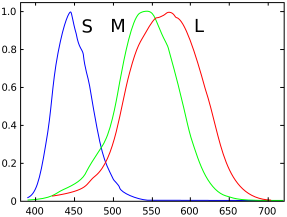
Having 3 cone cells is the reason that most electronic equipment has 3 types of subpixels (red, green, and blue). If you take the colors of these three subpixels, locate them on the CIE 1931 chromaticity diagram (http://upload.wikimedia.org/wikipedia/commons/b/b0/CIExy1931...) and draw a triangle to connect the points, this triangle is the color gamut of the monitor. The more types of subpixels you add (or the further apart they are in color), the more colors your monitor can reproduce. This is why Sharp's television with that 4th yellow pixel can reproduce more colors that humans can see.

It's thought that some people might be tetrachromats. They have 4 types of cone cells because of a genetic mutation. There's still some questions on how this extra information is processed by the brain, but there's a chance that for these people almost everyone else seems colorblind. They are able to distinguish two colors that everyone else cannot. This also means that television won't reproduce colors correctly for them, and it won't look natural.