Crashing rockets and recovering data from damaged flash chips
1–10 of 15 posts
Re: Crashing rockets and recovering data from damaged flash chips
#2Might be worth it to pot the flash chip in some epoxy or something. Heck, add another one and double it up for redundancy.
Re: Crashing rockets and recovering data from damaged flash chips
#3They should have first attempted going without VCC and GND. Just make sure CS# is hooked to ground and WP is hooked to VCC.
Both pads would have protection diodes to VCC/GND providing phantom power when tied to the appropriate rail. Plenty of chips work fine with phantom power.
Re: Crashing rockets and recovering data from damaged flash chips
#4Interesting use of a salt solution to weep into the broken parts to make contact. I personally would be shitting diamonds if I was reduced to this, it seems like it would be way too easy to short out the board with this method, especially when the packaging is so badly mangled.
I probably would have tried slowly and carefully whittling away the plastic near where the bond wires used to be to try to expose some metal first before using this salt water bath idea, but if it works it works.
Re: Crashing rockets and recovering data from damaged flash chips
#5Interesting use of a salt solution to weep into the broken parts to make contact. I personally would be shitting diamonds if I was reduced to this, it seems like it would be way too easy to short out the board with this method, especially when the packaging is so badly mangled. I probably would have tried slowly and carefully whittling away the plastic near where the bond wires used to be to try to expose some metal…
This is a big enough package that it has a lead frame, and same, I would have been using mechanical removal processes to gain access to it.
Re: Crashing rockets and recovering data from damaged flash chips
#6They should have first attempted going without VCC and GND. Just make sure CS# is hooked to ground and WP is hooked to VCC. Both pads would have protection diodes to VCC/GND providing phantom power when tied to the appropriate rail. Plenty of chips work fine with phantom power.
That's a cool idea. Going to file that away for another time. I imagine you'd maybe run your phantom voltage a little higher to overcome the ESD diode drop?
Re: Crashing rockets and recovering data from damaged flash chips
#7> the rocket dropped unchecked and burried [sic] itself 3 meters underground.
Very impressive! I wonder at what speed it impacted. I tried reading the chart at the bottom but I'm not sure what "axial" velocity is—probably not vertical speed given it drops over time rather than rises as the rocket dropped.
I suppose you could take the derivative of the height at impact point but I'm too lazy.
Re: Crashing rockets and recovering data from damaged flash chips
#8Dennis is also one of the (if not THE) leading vacuum robot hacker and makes https://github.com/dgiese/dustcloud. Amazing work.
Re: Crashing rockets and recovering data from damaged flash chips
#9What is that circular kit with the stands and pins that he's using here? https://dontvacuum.me/rocketflashrecovery/needles-1.jpg
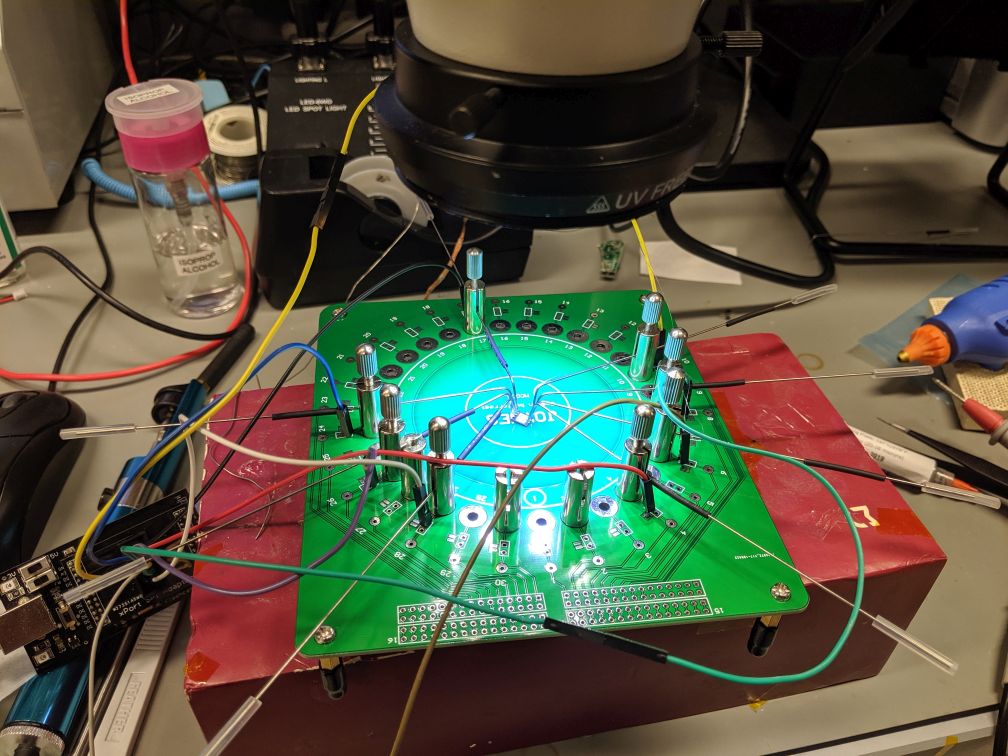
Reminds me of PCBite
Re: Crashing rockets and recovering data from damaged flash chips
#10They should have first attempted going without VCC and GND. Just make sure CS# is hooked to ground and WP is hooked to VCC. Both pads would have protection diodes to VCC/GND providing phantom power when tied to the appropriate rail. Plenty of chips work fine with phantom power.
That's a cool idea. Going to file that away for another time. I imagine you'd maybe run your phantom voltage a little higher to overcome the ESD diode drop?
The voltage drop is probably already accounted for in the allowable range unless it's a very low voltage chip. The main concern is you can't get away with anything high current. An SPI flash chip should be ok though, it's only driving one pin and you can choose whatever rate you want.