Lynn Conway has died
en.wikipedia.org
Lynn Conway has died
1–10 of 429 posts
Re: Lynn Conway has died
#2Is there a citation for this, or an announcement somewhere? The Wikipedia page was changed, but with no link backing it up, and I can't find any.
EDIT: ah, found it: http://www.myhusbandbetty.com/wordPressNEW/2024/06/11/lynn-c...
RIP.
Re: Lynn Conway has died
#3Lynn Conway co-wrote "the book" on VLSI design, "Introduction to VLSI Systems", created and taught this historic VLSI Design Course in 1978, which was the first time students designed and fabricated their own integrated circuits, including James Clark (SGI) who made the Geometry Engine, and Guy L Steel (MIT) who made the Scheme Microprocessor.
She invented superscalar architecture at IBM, just to be fired in 1968 after she revealed her intention to transition, then 52 years later IBM formally apologized to her in 2020. She successfully rebooted her life, invented and taught VLSI design to industry pioneers who founded many successful companies based on the design methodology she invented, wrote the book on, and personally taught to them, and then she became a trans activist who helped many people transition, find each other, and avoid suicide, fight abuse and bigotry, and find acceptance, by telling her story and building an online community.
Lynn Conway receives 2009 IEEE Computer Society Computer Pioneer Award:
Re: Lynn Conway has died
#4Lynn Conway, co-author along with Carver Mead of "the textbook" on VLSI design, "Introduction to VLSI Systems", created and taught this historic VLSI Design Course in 1978, which was the first time students designed and fabricated their own integrated circuits:
>"Importantly, these weren’t just any designs, for many pushed the envelope of system architecture. Jim Clark, for instance, prototyped the Geometry Engine and went on to launch Silicon Graphics Incorporated based on that work (see Fig. 16). Guy Steele, Gerry Sussman, Jack Holloway and Alan Bell created the follow-on ‘Scheme’ (a dialect of LISP) microprocessor, another stunning design."
Many more links and beautiful illustrations of her student's VLSI designs:
https://news.ycombinator.com/item?id=31758139
Also, Jim Clark (SGI, Netscape) was one of Lynn Conway's students, and she taught him how to make his first prototype "Geometry Engine"!
http://ai.eecs.umich.edu/people/conway/VLSI/MPCAdv/MPCAdv.ht...
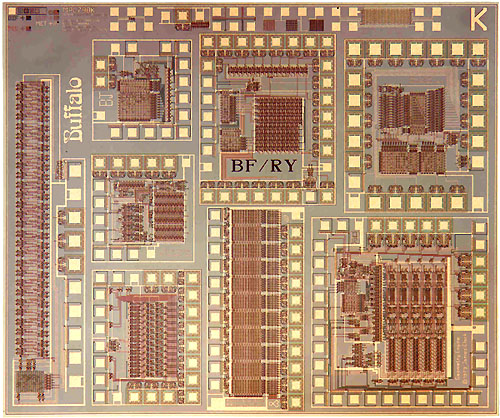
Just 29 days after the design deadline time at the end of the courses, packaged custom wire-bonded chips were shipped back to all the MPC79 designers. Many of these worked as planned, and the overall activity was a great success. I'll now project photos of several interesting MPC79 projects. First is one of the multiproject chips produced by students and faculty researchers at Stanford University (Fig. 5). Among these is the first prototype of the "Geometry Engine", a high performance computer graphics image-generation system, designed by Jim Clark. That project has since evolved into a very interesting architectural exploration and development project.[9]
Figure 5. Photo of MPC79 Die-Type BK (containing projects from Stanford University):
http://ai.eecs.umich.edu/people/conway/VLSI/MPCAdv/SU-BK1.jp...
[...]
The text itself passed through drafts, became a manuscript, went on to become a published text. Design environments evolved from primitive CIF editors and CIF plotting software on to include all sorts of advanced symbolic layout generators and analysis aids. Some new architectural paradigms have begun to similarly evolve. An example is the series of designs produced by the OM project here at Caltech. At MIT there has been the work on evolving the LISP microprocessors [3,10]. At Stanford, Jim Clark's prototype geometry engine, done as a project for MPC79, has gone on to become the basis of a very powerful graphics processing system architecture [9], involving a later iteration of his prototype plus new work by Marc Hannah on an image memory processor [20].
[...]
For example, the early circuit extractor work done by Clark Baker [16] at MIT became very widely known because Clark made access to the program available to a number of people in the network community. From Clark's viewpoint, this further tested the program and validated the concepts involved. But Clark's use of the network made many, many people aware of what the concept was about. The extractor proved so useful that knowledge about it propagated very rapidly through the community. (Another factor may have been the clever and often bizarre error-messages that Clark's program generated when it found an error in a user's design!)
9. J. Clark, "A VLSI Geometry Processor for Graphics", Computer, Vol. 13, No. 7, July, 1980.
Re: Lynn Conway has died
#5Lynn Conway, co-author along with Carver Mead of "the textbook" on VLSI design, "Introduction to VLSI Systems", created and taught this historic VLSI Design Course in 1978, which was the first time students designed and fabricated their own integrated circuits: >"Importantly, these weren’t just any designs, for many pushed the envelope of system architecture. Jim Clark, for instance, prototyped the Geometry Engine an…
This book was so good that I bought myself a new copy years after leaving college - the only textbook I've done that for.
Re: Lynn Conway has died
#6If this is verified, I think a black band is 100% warranted. As I understand it, she was a real innovator in VLSI, which I think we all agree is somewhat important :)
EDIT: GG, the black band appeared as I sent this
Re: Lynn Conway has died
#7Not to be mistaken with John Conway, known for Conway’s game of life.
Re: Lynn Conway has died
#8Is there a citation for this, or an announcement somewhere? The Wikipedia page was changed, but with no link backing it up, and I can't find any. EDIT: ah, found it: http://www.myhusbandbetty.com/wordPressNEW/2024/06/11/lynn-c... RIP.
Re: Lynn Conway has died
#9If this is verified, I think a black band is 100% warranted. As I understand it, she was a real innovator in VLSI, which I think we all agree is somewhat important :) EDIT: GG, the black band appeared as I sent this
[deleted]
Re: Lynn Conway has died
#10A woman of incredible courage - to be able to rebuild her career after being kicked out of IBM despite her achievements, is inspirational. And, given how even the implementation of superscalar processors confuses me, smarter than I’ll ever be for understanding that AND chip fabbing at the same time, one of humanity’s finest technical achievements.