The Illustrated GPT-2: Visualizing Transformer Language Models (2019)
jalammar.github.io
The Illustrated GPT-2: Visualizing Transformer Language Models (2019)
1–6 of 6 posts
Re: The Illustrated GPT-2: Visualizing Transformer Language Models (2019)
#2That is an excellent explanation full of great intuition building!
If anyone is interested in a kind of tensor network-y diagrammatic notation for array programs (of which transformers and other deep neural nets are examples), I wrote a post recently that introduces a kind of "colorful" tensor network notation (where the colors correspond to axis names) and then uses it to describe self-attention and transformers. The actual circuitry to compute one round of self-attention is remarkably compact in this notation:
https://math.tali.link/raster/052n01bav6yvz_1smxhkus2qrik_07...
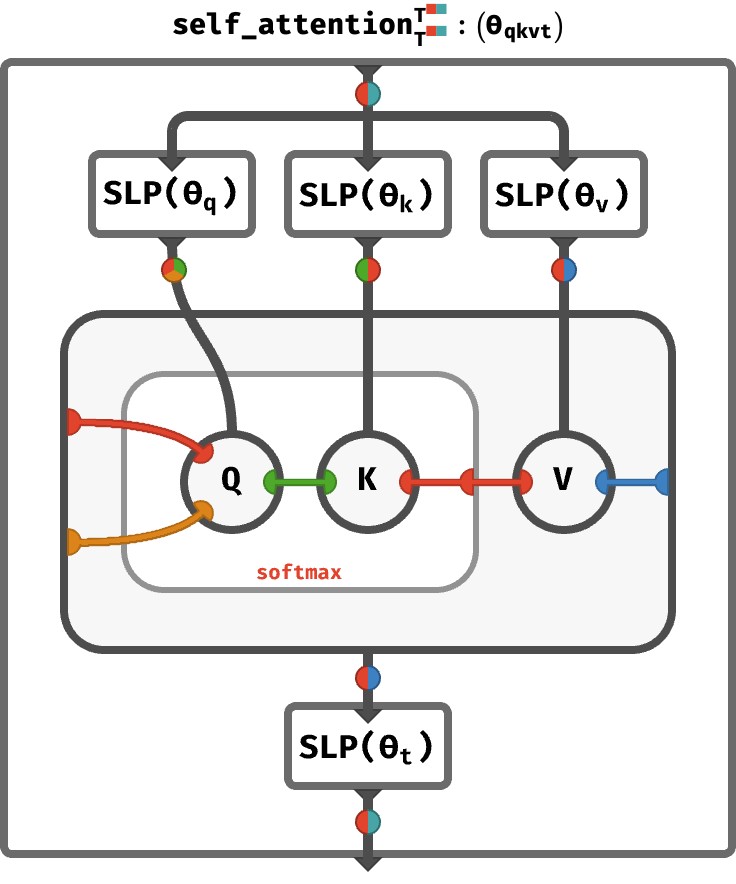
Here's the full section on transformers: https://math.tali.link/rainbow-array-algebra/#transformers -- for more context on this kind of notation and how it conceptualizes "arrays as functions" and "array programs as higher-order functional programming" you can check out https://math.tali.link/classical-array-algebra or skip to the named axis followup at https://math.tali.link/rainbow-array-algebra
Re: The Illustrated GPT-2: Visualizing Transformer Language Models (2019)
#3Jay Alammar is one of the greats in our field and we are lucky to have him.
Re: The Illustrated GPT-2: Visualizing Transformer Language Models (2019)
#4More excellent resources from Jay and others:
The Illustrated Transformer - http://jalammar.github.io/illustrated-transformer/
Beyond the Illustrated Transformer - https://news.ycombinator.com/item?id=35712334
LLM Visualization - https://bbycroft.net/llm
Re: The Illustrated GPT-2: Visualizing Transformer Language Models (2019)
#5That is an excellent explanation full of great intuition building! If anyone is interested in a kind of tensor network-y diagrammatic notation for array programs (of which transformers and other deep neural nets are examples), I wrote a post recently that introduces a kind of "colorful" tensor network notation (where the colors correspond to axis names) and then uses it to describe self-attention and transformers. Th…
This topic has been reposted few times recently, yet never gained much traction. I wonder how much changes there have been between GPT2 to GPT4?
Re: The Illustrated GPT-2: Visualizing Transformer Language Models (2019)
#6That is an excellent explanation full of great intuition building! If anyone is interested in a kind of tensor network-y diagrammatic notation for array programs (of which transformers and other deep neural nets are examples), I wrote a post recently that introduces a kind of "colorful" tensor network notation (where the colors correspond to axis names) and then uses it to describe self-attention and transformers. Th…
This topic has been reposted few times recently, yet never gained much traction. I wonder how much changes there have been between GPT2 to GPT4?
Mixture of Experts model is likely the most significant.
And the scale of everything. GPT3 embedding vectors are around 12,000, vs 768 shown here.
I was curious and the 12k figure closely approximates the median synapse dimensionality of human neurons. Maybe we don’t need much more.