AMPKT – Amateur radio packet explorer
github.com
AMPKT – Amateur radio packet explorer
1–10 of 30 posts
Re: AMPKT – Amateur radio packet explorer
#2This is a project to connect two Linux machine's network stacks via the amateur radio bands. It uses Linux's TAP interface to read & write packets at layer 2 to/from the kernel. QPSK modulation is used at the RF layer.
For now experimentation has mainly been done in a Ramsey box. The next step is to add a callsign field to the QPSK frames so the data can be legally TX'd.
Re: AMPKT – Amateur radio packet explorer
#3If anyone is looking for a really good place to get started with SDR, I'd highly recommend the RTL-SDR Blog V3:
Re: AMPKT – Amateur radio packet explorer
#4If anyone is looking for a really good place to get started with SDR, I'd highly recommend the RTL-SDR Blog V3: https://www.amazon.com/gp/product/B0BMKB3L47
Dumb question (and maybe this isn't legal?) but are there SDR transceivers/libraries?
It'd be neat to have a zigbee/zwave hub with my SDR so I could mix and match some stuff.
Re: AMPKT – Amateur radio packet explorer
#5If anyone is looking for a really good place to get started with SDR, I'd highly recommend the RTL-SDR Blog V3: https://www.amazon.com/gp/product/B0BMKB3L47
Dumb question (and maybe this isn't legal?) but are there SDR transceivers/libraries? It'd be neat to have a zigbee/zwave hub with my SDR so I could mix and match some stuff.
HackRF One is an option. There are a number of others. Legality varies by country/frequency/power level.
Can also make a Raspberry Pi act as a transmitter (https://github.com/F5OEO/rpitx), which could hit the zwave frequency but not the zigbee one. (Also, make sure to put a low pass filter on it.)
Re: AMPKT – Amateur radio packet explorer
#6This is a project to connect two Linux machine's network stacks via the amateur radio bands. It uses Linux's TAP interface to read & write packets at layer 2 to/from the kernel. QPSK modulation is used at the RF layer. For now experimentation has mainly been done in a Ramsey box. The next step is to add a callsign field to the QPSK frames so the data can be legally TX'd.
You'll like my IP over DVB-T2 test bed using GNU Radio. It uses the ULE protocol dvbnet driver that's built into Linux.
Not shown on the diagram is that it also supports IPv6.
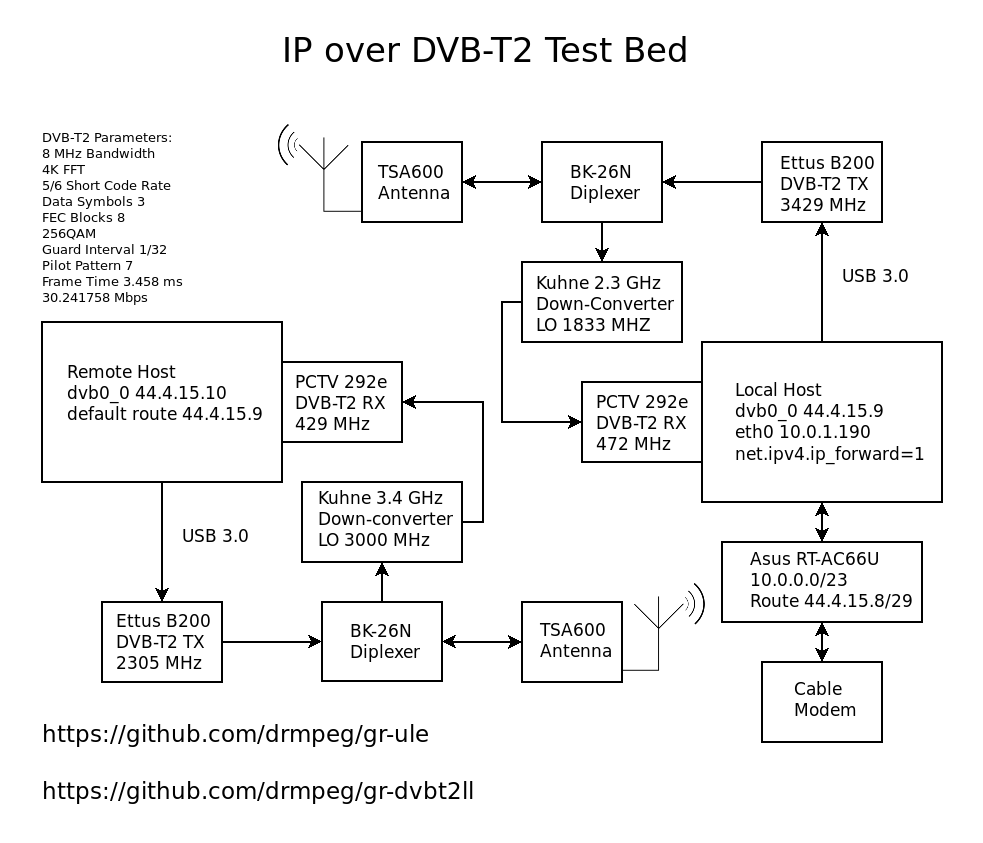
Re: AMPKT – Amateur radio packet explorer
#7If anyone is looking for a really good place to get started with SDR, I'd highly recommend the RTL-SDR Blog V3: https://www.amazon.com/gp/product/B0BMKB3L47
Dumb question (and maybe this isn't legal?) but are there SDR transceivers/libraries? It'd be neat to have a zigbee/zwave hub with my SDR so I could mix and match some stuff.
Gnuradio
Re: AMPKT – Amateur radio packet explorer
#8If anyone is looking for a really good place to get started with SDR, I'd highly recommend the RTL-SDR Blog V3: https://www.amazon.com/gp/product/B0BMKB3L47
Dumb question (and maybe this isn't legal?) but are there SDR transceivers/libraries? It'd be neat to have a zigbee/zwave hub with my SDR so I could mix and match some stuff.
Yup, lots around. The hint is to look for 'full duplex' SDR.
Re: AMPKT – Amateur radio packet explorer
#9If anyone is looking for a really good place to get started with SDR, I'd highly recommend the RTL-SDR Blog V3: https://www.amazon.com/gp/product/B0BMKB3L47
Dumb question (and maybe this isn't legal?) but are there SDR transceivers/libraries? It'd be neat to have a zigbee/zwave hub with my SDR so I could mix and match some stuff.
Doing zigbee or zwave stuff is a lot easier with zigbee and zwave than with SDR. Just use homeassistant with something like zigbee2mqtt, and you can control your LIDL light with an Ikea light switch and xiaomi movement sensor without any issues.
Re: AMPKT – Amateur radio packet explorer
#10I recently got back into amateur radio with an SDR (listening only, my license has lapsed and I need to renew it)
I found that using the FT8 protocol, I can pick up transmissions from up to ~6000 miles away, using a very cheap magnetic loop antenna mounted indoors in my apartment. My building is made of concrete slabs and I was pretty shocked that I was able to receive such distant transmissions.
I think I've invested maybe $70 into radio equipment for this capability. I've listened to a lot of other signal sources, but so far FT8 is the most interesting. I can run a companion app that maps out all the contacts, it is pleasing to watch on a nice slow evening