The Secret of the Fibonacci Sequence in Trees
1–10 of 29 posts
Re: The Secret of the Fibonacci Sequence in Trees
#2wow people! slightly off topic but that's how you DELIVER information. no ads bullshit, straight, references...
now compare that to the first link we got.
Re: The Secret of the Fibonacci Sequence in Trees
#3Brilliant. Perhaps first time I'm seeing some one using Fibonacci for other than learning programming language ;-)
Re: The Secret of the Fibonacci Sequence in Trees
#4This is by far and away the better article. Such a shame the discussion is on the totally crap repackaging of it:
Re: The Secret of the Fibonacci Sequence in Trees
#5I wish Aidan had been allowed to write this in his own words, rather than his parent's / someone else's words.
On the other hand, whoever's taking care of him behind the scenes has done an incredible job. I'd even say Aidan's "set for life"; that might seem over the top, but consider... this link will forever be associated with his name. It demonstrates that even at age 13, he was a very capable real-world problem solver, while also showing off his ability to perform and present his own original research in ways that other people can build on.
That's going to impress virtually everyone he ever meets, probably. Admissions boards, employers, investors, etc. Obviously that assumes he plays his cards correctly going forward. Still, though... this will always be a future de-facto "get-his-foot-in-the-door" for him, regardless of whatever it is he's trying to do. Except maybe pickup chicks.
I just hope he doesn't become a victim of his own success. Hearing "you're such a genius!" from everyone around him would not be good for his future self.
Re: The Secret of the Fibonacci Sequence in Trees
#6I'm not sure how much of this the kid actually discovered on his own. The Wikipedia page on Phyllotaxis cites plenty of past research on why the Fibonacci sequence shows up (and the kid oddly hand copied the illustrations from that page).
It's an emergent pattern from the branches shoving each other around as they grow. It minimizes the overlap of the leaves if they are being added indefinitely. If you know in advance how many leaves/panels there will be then obviously you can just space them evenly. If you ran that experiment with one tree of evenly spaced/angled panels and one tree of golden angle spaced panels, I think the evenly spaced one would win.
Re: The Secret of the Fibonacci Sequence in Trees
#7I'm not sure how much of this the kid actually discovered on his own. The Wikipedia page on Phyllotaxis cites plenty of past research on why the Fibonacci sequence shows up (and the kid oddly hand copied the illustrations from that page). It's an emergent pattern from the branches shoving each other around as they grow. It minimizes the overlap of the leaves if they are being added indefinitely . If you know in advan…
Crucial difference: the tree-leaf problem is about how to arrange leaves which are shading each other; but here he compares such a "tree" with a flat array that has no overlaps at all. He claims that the tree generates more energy than the no-overlaps array, which is impossible. I have a longer comment about this in the other thread:
Re: The Secret of the Fibonacci Sequence in Trees
#8Here's a little something that most people don't know, that I picked up from my architecturally interested father long ago:
The French architect Le Corbusier (http://en.wikipedia.org/wiki/Le_Corbusier) made use of Fibonacci sequences to create his famous "Modulor" (http://www.apprendre-en-ligne.net/blog/images/architecture/m... - "A harmonic measure to the human scale, universally applicable to architecture and mechanics.") which represents a few fixed points in Fibonacci sequences that have been in use in architecture, interior decoration, carpentry etc. for more than 50 years, at least here in Europe - I have no idea if these scales are as rigorously followed in the Americas or in Asia.
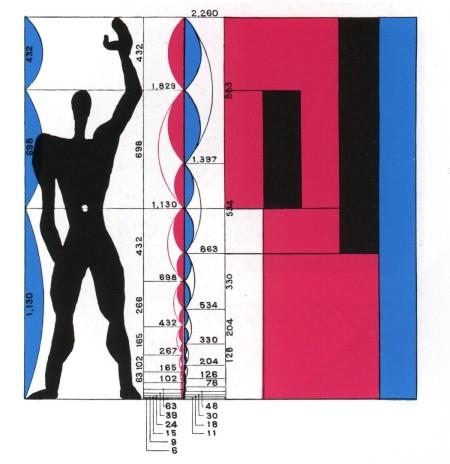
If you look at the picture, and then look at the height of the seat of your kitchen chairs, your kitchen table, your kitchen sink, your cupboards etc., you will find that their tops, bottoms and heights almost always align around numbers in these scales. These measurements create a strange sense of harmony in the way the mind processes geometry picked up from eyesight, which is not perceivable as soon as you move away from these dimensions, in some way quite similar to how the Golden Ratio pleases the eye.
Just for fun I measured some of the interior in my home. Desk: 69cm. Kitchen chairs and kitchen table: 43cm and 70cm. Kitchen sink: 88cm. Bottom and top of wall-mounted kitchen cupboards: 138cm, 225cm (height of 87cm).
Also interesting to note is that similar scales have been found to be used in ancient times as well - seems we took notice of this particular natural pattern long ago.
Re: The Secret of the Fibonacci Sequence in Trees
#9I wish Aidan had been allowed to write this in his own words, rather than his parent's / someone else's words. On the other hand, whoever's taking care of him behind the scenes has done an incredible job. I'd even say Aidan's "set for life"; that might seem over the top, but consider... this link will forever be associated with his name. It demonstrates that even at age 13, he was a very capable real-world problem so…
I'd even say Aidan's "set for life"
And I would strenuously disagree. No one is set for life at that age. As you yourself point out, sometimes marking a mark early just makes thing difficult later on. There are plenty of historical examples.
Best wishes to him. There are still plenty of mountains to climb.
Re: The Secret of the Fibonacci Sequence in Trees
#10> Scientists and naturalists have discovered the Fibonacci sequence appearing in many forms in nature, such as the shape of nautilus shells, the seeds of sunflowers, falcon flight patterns and galaxies flying through space. What's more mysterious is that the "divine" number equals your height divided by the height of your torso, and even weirder, the ratio of female bees to male bees in a typical hive! (Livio)
Except that most of this is simply not true: http://www.lhup.edu/~dsimanek/pseudo/fibonacc.htm
It's a very tasty popular myth that people like to repeat, that there's a magical sacred golden constant producing all the complexity in nature and more.
Except that nobody actually bothers to measure anything, they just keep repeating and reposting the same images of spiral galaxies and nautilus shells.
Nor is there anything "inherently beautiful" about the golden ratio, research into perceived aesthetics of ratios simply showed that people prefer fractions of small numbers. It's imprecise enough that you really can't say whether people like 1.5 (3/2) or 1.667 (5/3) or 1.618 (phi) best.
The one thing where he is right, is the pattern in sunflower seeds. If you divide the 360 degrees of a circle in two parts so that their ratio is 1:1.618, and you use that angle (about 137.5 degrees) to rotate outwards as a spiral, put a big dot at every point, you'll get a pattern that looks pretty much exactly like sunflower seeds.
The thing about this particular pattern is that the seeds end up being rather uniformly spaced over the plane, while using other angular ratios creates swirly patterns and waves of filled and empty regions.
So I can imagine if you apply this to the rotation of tree branches, it'll result in a more uniformly distributed pattern, that will capture sunlight more efficiently than a pattern with holes in it.
I kind of wonder, though, if it's not the other way around--because nature uses golden ratio angles in tree branches, the fibonacci numbers pop up. Because really it's super easy for fibonacci numbers to pop up anywhere, especially the small ones, what's significant, however, is when the golden ratio actually plays a meaningful role.