The stable marriage problem and modern dating
1–10 of 224 posts
Re: The stable marriage problem and modern dating
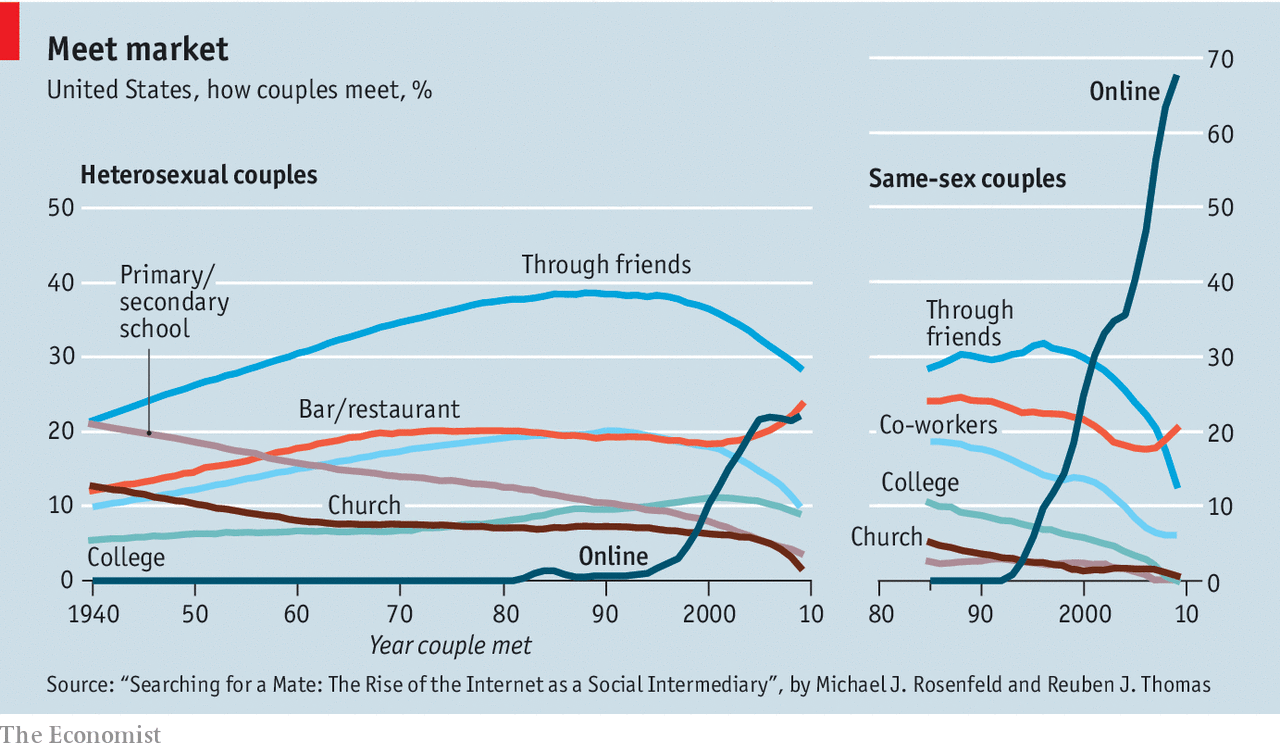
#2This is especially interesting as same-sex dating is even more skewed toward online interaction, probably just due to the fact that we make up only ~5% of the population; any person we meet in public is straight 19 out of 20 times [1].
[1] https://cdn.static-economist.com/sites/default/files/images/...
Re: The stable marriage problem and modern dating
#3Why would having a larger pool make dating harder?
I think the author is confusing the probability of a “stable marriage” with the probability of a relationship.
What this says is you’d expect cheating to go up. As Chris Rock says, “you’re only as faithful as your options.”
Re: The stable marriage problem and modern dating
#4This is especially interesting as same-sex dating is even more skewed toward online interaction, probably just due to the fact that we make up only ~5% of the population; any person we meet in public is straight 19 out of 20 times [1]. [1] https://cdn.static-economist.com/sites/default/files/images/...
Also Jewish dating and so on.
Re: The stable marriage problem and modern dating
#5Why would having a larger pool make dating harder? I think the author is confusing the probability of a “stable marriage” with the probability of a relationship . What this says is you’d expect cheating to go up. As Chris Rock says, “you’re only as faithful as your options.”
Right, I should have made that a bit clearer. Modern dating is harder because the pursuit of a stable marriage is harder.
Although this is all assuming people date to get married.
Re: The stable marriage problem and modern dating
#6Some interesting stuff there. I think you could also frame it as a explore vs exploit problem. If we assume there is a successive series of partners you could meet but only in sequence and you choose whether to "attempt to exploit, i.e. form a relationship" or pass and continue to explore. At which point should you commit such that it maximizes the expected gain (marginalizing over your lifespan)? It's like RL game except you only get to play once. In addition, the time gap between successive prospects is unknown and may even be infinite.
Last year I purchased a condominium in the downtown core of where I live and I thought the process was very similar. At the time the market was very competitive. It's a sequence of potential "offers" for which you make a binary decision and you cannot go back and must consider them in chronological order and there is no guarantee if you pass on a okay condo now that you will find a spectacular one down the line and prices will not be even less palpable.
Re: The stable marriage problem and modern dating
#7This is especially interesting as same-sex dating is even more skewed toward online interaction, probably just due to the fact that we make up only ~5% of the population; any person we meet in public is straight 19 out of 20 times [1]. [1] https://cdn.static-economist.com/sites/default/files/images/...
I've seen numbers between 1% and 10%, but there's a lot of noise about it, is there a good source?
In any case, are homosexuals distributed equally over the area? My intuitive assumption is that they gravitate to larger cities for a variety of reasons (but less discrimination is probably a big one, since cities tend to be much more liberal and anonymous than the nation they are in), which would change the chances significantly.
Re: The stable marriage problem and modern dating
#8Some interesting stuff there. I think you could also frame it as a explore vs exploit problem. If we assume there is a successive series of partners you could meet but only in sequence and you choose whether to "attempt to exploit, i.e. form a relationship" or pass and continue to explore. At which point should you commit such that it maximizes the expected gain (marginalizing over your lifespan)? It's like RL game e…
What you describe is called the "secretary problem", among other names
Re: The stable marriage problem and modern dating
#9This is especially interesting as same-sex dating is even more skewed toward online interaction, probably just due to the fact that we make up only ~5% of the population; any person we meet in public is straight 19 out of 20 times [1]. [1] https://cdn.static-economist.com/sites/default/files/images/...
I've seen numbers between 1% and 10%, but there's a lot of noise about it, is there a good source? In any case, are homosexuals distributed equally over the area? My intuitive assumption is that they gravitate to larger cities for a variety of reasons (but less discrimination is probably a big one, since cities tend to be much more liberal and anonymous than the nation they are in), which would change the chances sig…
Re: percentages. I just picked 5% for a talking point. It is definitely more than 1%, but it really depends on how you define 'homosexual'. Some surveys might count someone who has had a same-sex partner in the past but now does not, or people who are open to the idea but have not acted on it. Then there's trans people, who generally are attracted to the opposite gender but might get counted because they are 'not really straight' :(.
Re: The stable marriage problem and modern dating
#10> I created a Python implementation of the classic SMP solution in order to calculate some initial results...
> Did I write all of this to justify why I'm single?
Despite the demotion of most masculist search results in Google and YouTube, if one skips the first page of results, the answers to the Stable Marriage Problem exist within MRA, Red Pill, MGTOW, and Manoshpere online articles and videos.