Cosmology Has Some Big Problems
blogs.scientificamerican.com
Cosmology Has Some Big Problems
1–10 of 76 posts
Re: Cosmology Has Some Big Problems
#2Re: Cosmology Has Some Big Problems
#3It is of course entirely plausible that the validity of general relativity breaks down much closer to our own home than at the edge of the hypothetical end of the universe.
Is it really? Have people formulated specific break downs, then gone to look for evidence?
Re: Cosmology Has Some Big Problems
#4Biggest takeaway from this is how many underlying presuppositions appear to be assumptions.
Re: Cosmology Has Some Big Problems
#5>It's perhaps worth stopping to ask why astrophysicists hypothesize dark matter to be everywhere in the universe?
>To explain observations of galaxies inconsistent with general relativity, the existence of dark matter was posited as an unknown and invisible form of matter calculated to make up more than a quarter of all mass-energy content in the universe
Food for thought: the best current evidence of dark matter is the Bullet Cluster[0]. In particular, look at this picture: https://upload.wikimedia.org/wikipedia/commons/a/a8/1e0657_s...
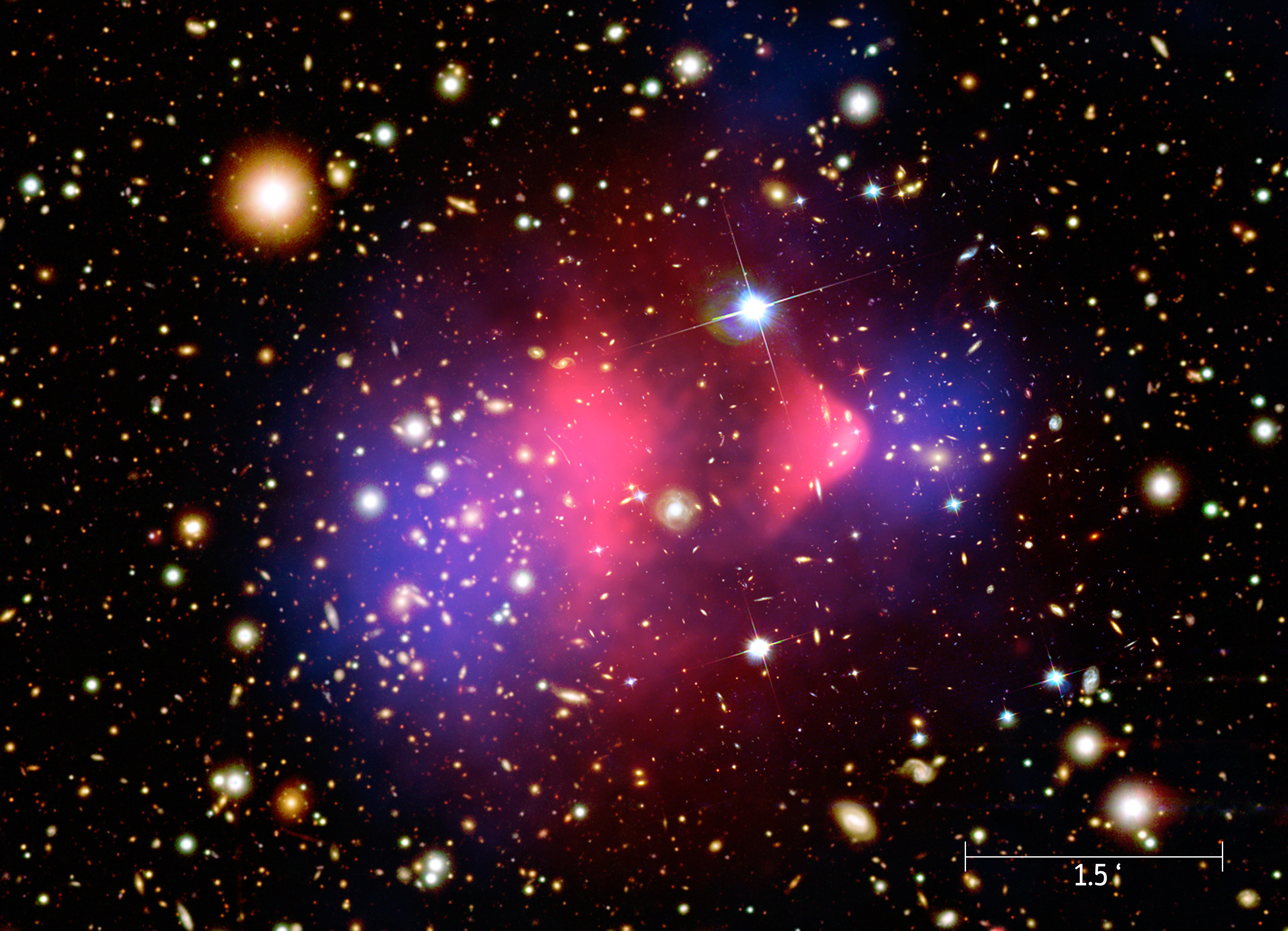
At first, these were two blobs of dark matter and gas. They collided. That resulted in what we see now: the dark matter portions (purple, measured by gravity lensing) magically went through each other (because dark matter is weird like that) while the gas portions (pink) actually collided and formed a shockwave (like normal matter behaves), with much of the gas remaining in the middle.
The tone in the article quotes there makes it seem like dark matter is some esoteric rounding error, but that seems like pretty "solid" evidence for... the anomalous mass readings we call dark matter.
Re: Cosmology Has Some Big Problems
#6To be fair, I bet most, if not all, cosmologists would agree that they know far less than they don't know. The title of the article is a bit sensationalistic from that point of view, but then I guess "Cosmology has some big details to work on" isn't nearly as catchy.
Re: Cosmology Has Some Big Problems
#7Interesting view. Near the end, it says:
“The crux of today's cosmological paradigm is that in order to maintain a mathematically unified theory valid for the entire universe, we must accept that 95 percent of our cosmos is furnished by completely unknown elements and forces for which we have no empirical evidence whatsoever.”
Empiricism is based on sense observations. And a lot of science has been confined to human senses. I’m curious if tapping into more basic science research by analyzing different types of senses, for instance, available to animals, may offer breakthroughs down the line. For instance, fish employ the lateral line system to detect pressure gradients in the environment.
Re: Cosmology Has Some Big Problems
#8It is of course entirely plausible that the validity of general relativity breaks down much closer to our own home than at the edge of the hypothetical end of the universe. Is it really? Have people formulated specific break downs, then gone to look for evidence?
A more damning quote seems to be Another recent probe found galaxies inconsistent with the theory of dark matter, which posits this hypothetical substance to be everywhere. There is no reference given, but I have the suspicion that it refers to the discovery of galaxies with almost no dark matter (cf. https://news.ycombinator.com/item?id=16701248). That does indeed refute the assumpion that dark matter is everywhere, but that is not an assumption anyone makes and is not part of any relevant theory of dark matter. On the contrary, the existence of galaxies like that is generally seen as one of the strongest arguments for the existence of dark matter as an independent, if elusive physical entity.
Re: Cosmology Has Some Big Problems
#9Interesting view. Near the end, it says: “The crux of today's cosmological paradigm is that in order to maintain a mathematically unified theory valid for the entire universe, we must accept that 95 percent of our cosmos is furnished by completely unknown elements and forces for which we have no empirical evidence whatsoever.” Empiricism is based on sense observations. And a lot of science has been confined to human…
What kind of senses available to animals are there that we should be using for science?
Also I'm not entirely sure what you mean that we're confined to "the 5 senses". First, humans have way more senses. Second, I don't think it's confining ourself to build technology that converts something we can't sense (like gravitational waves) into something we can (like a spreadsheet).
Re: Cosmology Has Some Big Problems
#10Interesting view. Near the end, it says: “The crux of today's cosmological paradigm is that in order to maintain a mathematically unified theory valid for the entire universe, we must accept that 95 percent of our cosmos is furnished by completely unknown elements and forces for which we have no empirical evidence whatsoever.” Empiricism is based on sense observations. And a lot of science has been confined to human…
What aren’t we using from the animal kingdom? We create sensors that are extra human. Infrared etc...
Maybe this is an unknown unknown problem. We can’t develop technology for senses we do not know about and so on.