Monopoly, is it a problem?
capitalism.org
Monopoly, is it a problem?
1–10 of 21 posts
Re: Monopoly, is it a problem?
#2Seems somewhat backwards. This relies on a how-did-it-get-there argument: is a monopoly the result of illicit activity, or did it get there by "winning" in its market segment? For example, this passage, from the article:
  If such status is gained by competition in the free-market then the
  "monopoly" -- the successful business -- is good. If such status is gained
  by using the government, or Mafia, to force one's competition out of
  business, then the monopoly is evil.
Some more modern, mathematically-heavy theory phrases this as more or less an issue of feedback behavior: in a properly functioning market, the market is determined by something outside the market mechanisms themselves (idealized as "real" supply and demand), but in a malfunctioning market, the market mechanisms themselves feed back into the market, so it's mostly determined, self-referentially, by itself.
Re: Monopoly, is it a problem?
#3Bleh, this started off sounding like an interesting piece - but it devolves into stating that the only "evil" monopolies are governments.
Which might not be a completely incorrect conclusion, it just reads like a political piece more than anything.
Re: Monopoly, is it a problem?
#4Seems somewhat backwards. This relies on a how-did-it-get-there argument: is a monopoly the result of illicit activity, or did it get there by "winning" in its market segment? For example, this passage, from the article: If such status is gained by competition in the free-market then the "monopoly" -- the successful business -- is good. If such status is gained by using the government, or Mafia, to force one's compet…
I agree. Thanks for explaining :-).
Re: Monopoly, is it a problem?
#5As long as there is no coercion involved, I'm okay with monopolies. All a monopoly is a cornering of the market for a particular thing and you could even see entertainers as having a monopoly on their own unique offerings.
Most of the things people consider monopolies actually have competition. Its just not quite exactly the same, as cheap or as good.
If you had a monopoly on the automobile, there would still be the bicycle, the train, the horse and buggy, and of course, walking. These all compete with people just moving closer to work. Or living near a navigable body of water or getting a helicopter.
And lets not forget that the government is handing monopolies in exchange for sharing ideas (also known as patents). When such a deal makes sense for society, the monopoly is a good deal. When it isn't, we shouldn't be granting them.
Re: Monopoly, is it a problem?
#6What?! The problem with monopolies is nicely illustrated in this little diagram that everyone who ever had econ 101 has seen far too many times: http://upload.wikimedia.org/wikipedia/commons/thumb/e/ef/Mon...
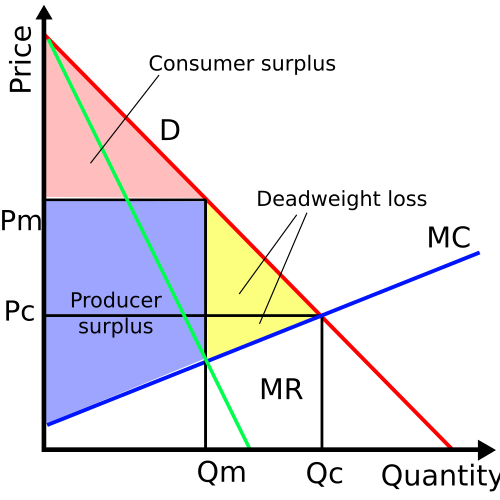
Of course monopolies are not intrinsically evil. I can’t really see what that has to do with the question as to whether states should prevent companies from becoming monopolists, though.
Re: Monopoly, is it a problem?
#7I think the author completely fails to understand the problem caused by monopolies and why the underlying capitalist philosophy implies the problem - namely that they can jack up prices without competition and its always in their best interest to do so.
Really the problem with monopolies is how we implement capitalism with so few checks and balances - in an "idealised" setting you want monopolies to get the most efficient use of resources globally - its capitalism that messes it up by driving the monopoly to do "evil" things like jack up prices. The incentive to be greedy and selfish needs to be removed - this is a LOT easier said than done, but it is something that governments are most certainly capable of.
Re: Monopoly, is it a problem?
#8"If any business attempts to charge prices higher than the market will bear, he will lose all his business to his competition, since he cannot force his competition out of business."
This seems dated in our modern world.
Of course you can force your competition out of business if you're big enough. It's even easier if you're willing to use some dirty tricks. It's also sometimes impossible to compete in some modern industries like software. I can't simply sell a cheaper version of Windows -- only Microsoft can sell Windows. It's not as simple as going to the shoppe to pick from different brands of top hat. They're basically the same thing so they can compete against each other directly. Capitalism is great for soft drinks and tennis shoes but I'm not convinced it's the best choice for everything.
Re: Monopoly, is it a problem?
#9What?! The problem with monopolies is nicely illustrated in this little diagram that everyone who ever had econ 101 has seen far too many times: http://upload.wikimedia.org/wikipedia/commons/thumb/e/ef/Mon... Of course monopolies are not intrinsically evil. I can’t really see what that has to do with the question as to whether states should prevent companies from becoming monopolists, though.
"the question as to whether states should prevent companies from becoming monopolists"
I believe the general agreement about this question is a resounding "No." The anti-monopoly regulations prevent companies from abusing their monopoly power and most of the anti-monopoly law discussion revolves around the extent of this.
Re: Monopoly, is it a problem?
#10Seems somewhat backwards. This relies on a how-did-it-get-there argument: is a monopoly the result of illicit activity, or did it get there by "winning" in its market segment? For example, this passage, from the article: If such status is gained by competition in the free-market then the "monopoly" -- the successful business -- is good. If such status is gained by using the government, or Mafia, to force one's compet…
Steve Keen (one of the less wacky economists to predict the GFC) claimed that monopolies often aren't so bad. Note, Steve claims to be part Keynesian, part math modeler, and part empiricist; and is extremely critical of free-market economists; but he'll flame any school of thought that he disagrees with.
http://www.debunkingeconomics.com/extracts.htm#4
>"The historical record gives many reasons to be critical of monopolies. Some of today’s most respectable names accumulated fortunes in the 19th century by grossly unethical means, and held on to their economic wealth by the abuse of the many forms of power that wealth can confer. This record of 19th century corporate lawlessness is the major explanation for America’s distinctive anti-trust laws, which enable the judiciary in this bastion of capitalism to dismantle corporations that have acquired the position of ultimate market power.
>Economists have reduced this plethora of reasons to be critical of monopolies to just one: the size of a monopolist relative to the size of the market. According to economists, monopolies are worse than the alternative of competitive markets simply because the absence of competitors allows a monopoly to set price above marginal cost. Perfectly competitive industries, on the other hand, set price equal to marginal cost. Economists argue that monopolies are therefore necessarily bad, and that small, competitive firms are necessarily good, because monopolies produce a lower output for a higher price, thus restricting the supply of their products and exploiting consumers by over-pricing. However, the ‘proof’ of this argument makes the fundamental mathematical mistake of equating a very small quantity to zero. When this mistake is corrected, the economic argument against monopolies collapses, as does the economic theory of competition..."