A Look at Embedded WiFi Development Boards
blog.fusiondigital.io
A Look at Embedded WiFi Development Boards
1–10 of 37 posts
Re: A Look at Embedded WiFi Development Boards
#2One thing that this article kind of glosses over is that there are a ton of different form factors for the ESP8266 (ESP-01 is the original, also the ESP-03, -07 and -12 are common).
Most of them are rather inconvenient to work with directly though, not least because they aren't breadboard friendly. There are a bunch of breakouts made though that help this and integrate a voltage regulator, power jack, pin breakouts etc. The NodeMCU dev board mentioned is one- Adafruit, Olimex, Sparkfun and RaysHobby also make them and they are much easier to use for hobby projects. I've had to use an ESP-12 directly for a project before due to space constraints and it was a hassle.
Re: A Look at Embedded WiFi Development Boards
#3> [Philips Hue Bulb] A $50 light bulb that requires a $60 base station, proving my point entirely
I'm not sure what this has to do with the article. Philips Hue uses ZigBee Light Link, not WiFi, and I'm pretty sure the steep price tag has nothing to do with hardware costs.
As for WiFi, it is exciting to see hardware like ESP8266 open up previously cost-prohibitive possibilities for hackers. My biggest complaint about using WiFi for IoT-related projects is the fact that every marketable WiFi-enabled device has it's own (often cumbersome) association/inclusion process. Perhaps that's a feature - enabling more options for wireless network security, but when it comes to user experience, the standard bluetooth pairing process makes WiFi association feel like pulling teeth for the average consumer. Maybe we just need a good WPS replacement.
Re: A Look at Embedded WiFi Development Boards
#4You can do worse than defaulting to the ESP8266.
Very cheap, good tool chain available, simple component infrastructure.
Re: A Look at Embedded WiFi Development Boards
#5One thing that this article kind of glosses over is that there are a ton of different form factors for the ESP8266 (ESP-01 is the original, also the ESP-03, -07 and -12 are common). Most of them are rather inconvenient to work with directly though, not least because they aren't breadboard friendly. There are a bunch of breakouts made though that help this and integrate a voltage regulator, power jack, pin breakouts e…
Three pieces of wire makes a harness that removed the hassle and takes 2 minutes to crimp.
Re: A Look at Embedded WiFi Development Boards
#6Nice summary.
I recently picked up an ESP8266 for a project, but yet to start farting around with it. Excited to find some spare time.
Re: A Look at Embedded WiFi Development Boards
#7> [Philips Hue Bulb] A $50 light bulb that requires a $60 base station, proving my point entirely I'm not sure what this has to do with the article. Philips Hue uses ZigBee Light Link, not WiFi, and I'm pretty sure the steep price tag has nothing to do with hardware costs. As for WiFi, it is exciting to see hardware like ESP8266 open up previously cost-prohibitive possibilities for hackers. My biggest complaint about…
I agree that setup for WiFi IoT products is a total pain. The simplest method I've seen is what WeMo uses...out of the box device is an Access Point, you connect, then enter your own network credentials...still takes a few minutes, but beats requiring another hub.
Re: A Look at Embedded WiFi Development Boards
#8> [Philips Hue Bulb] A $50 light bulb that requires a $60 base station, proving my point entirely I'm not sure what this has to do with the article. Philips Hue uses ZigBee Light Link, not WiFi, and I'm pretty sure the steep price tag has nothing to do with hardware costs. As for WiFi, it is exciting to see hardware like ESP8266 open up previously cost-prohibitive possibilities for hackers. My biggest complaint about…
I was mistaken on the ZigBee, thanks for the correction.
I will also agree that the setup is a pain in the butt for most of these things. I think that's why the Chromecast's and Dash's ultrasonic methods are interesting. Perhaps a low cost NFC one touch setup would be really cool, but any method I think of requires an extra app. But maybe that's not a bad thing?
Re: A Look at Embedded WiFi Development Boards
#9> While controlling the ESP8266 is great, the raw chip itself lacks an analog to digical [sic] converter (ADC)
The ESP-12 and a few other models have an ADC integrated.
> and only a few I/O pins.
Again, with 9 GPIO pins on the ESP-12 (and various numbers in between on other models), I wonder how many are required to qualify as more than a few.
> [Philips Hue Bulb] A $50 light bulb that requires a $60 base station, proving my point entirely
As another poster mentions, Philips Hue uses ZigBee Light Link, not WiFi. All around, a sloppy blog post, but slick web page.
Re: A Look at Embedded WiFi Development Boards
#10One thing that this article kind of glosses over is that there are a ton of different form factors for the ESP8266 (ESP-01 is the original, also the ESP-03, -07 and -12 are common). Most of them are rather inconvenient to work with directly though, not least because they aren't breadboard friendly. There are a bunch of breakouts made though that help this and integrate a voltage regulator, power jack, pin breakouts e…
> Most of them are rather inconvenient to work with directly though, not least because they aren't breadboard friendly.
You're looking for the ESP-201:
http://smarpl.com/sites/default/files/images/ESP8266-ESP-201...
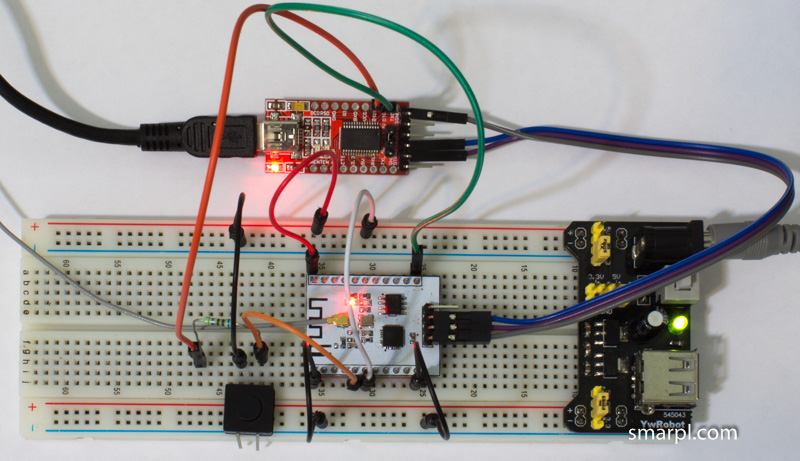
Enjoy!