[deleted]
Amazon Go
921–930 of 1001 posts
Re: Amazon Go
#922Earlier quoted context omitted.
Honestly, that's an "incentive" that should be illegal. You should only get charged for something if you actually take it home or use it. Anything else is a cop out to push the costs of a deficient system onto the user/customer.
It's the store's fault when you selfishly and silently put perishable goods in non-refrigerated areas so they can spoil? IMO the store would have the right to charge you with destruction of property, if not the cost of the goods they're now out entirely due to your actions. The number of people that never learned "put stuff back where you got it" from their parents is astounding.
> It's the store's fault when you selfishly and silently put perishable goods in non-refrigerated areas so they can spoil?
It's incorrect and misleading to talk like that malicious use case is the only one at play here.
Re: Amazon Go
#923Earlier quoted context omitted.
yep. full on dystopian tracking was my first thought.
It's not "dystopian" if you're on private property and have accepted their terms of service. You can avoid surveillance by, you know, choosing not to shop there.
Nope, get back on narrative! If it involves tracking me it's dystopian and literally 1984, especially if I've voluntarily signed myself up to be tracked
Re: Amazon Go
#924Earlier quoted context omitted.
Stores bake that into the cost of doing business, it's like dropping something and breaking it, in the vast vast majority of cases you won't be charged for it, just be clean up on aisle 3... Heck I've dropped jars or similar things during bagging after paying for them several times and every time I was offered a replacement. Mistakes happen, it's often considerably more expensive to deal with customer complaints espe…
In Australia if you break something in store, they typically wont charge you, but if they do, they have to charge at cost. I wonder if this another reason many stores dont charge. As any store with a larger markup would have to let you know that $55 vase they were trying to sell you cost them $6.
I've never heard this "rule" before, do you have a source? "Cost" is a pretty flimsy concept.
Re: Amazon Go
#925Earlier quoted context omitted.
All the supermarkets I use already push you to self check-out stations....
True, but these often require one or two hosts to unlock issues. I was for the test but I find the self checkout annoying. It's less efficient than the usual kind. You have less space to unload you stuff; less space to rebag them, and the cashier is lighting fast at scanning and grabbing the money because of 7h/day of doing so. I'm not pro human cashier, I don't think lots of cashier really like it either. But self c…
Yes. My main supermarket (a former Safeway in the UK) has one person looking after 20 self-checkout stations. I guess most of us have learned the system by now.....
Self-checkout works well for half a dozen items in a hand basket. If you have a trolley full of a week's shopping, you're going to use a cashier. In fact, in this supermarket, you can't even get a trolley into the self-checkout area.
My local M&S store has three different checkout areas. (1) traditional, for people with trolleys. (2) Self-checkout area for people with baskets. (3) Really fast (but very narrow) lane for people just holding a few items in their hands. You almost never see people using the "wrong" area.
What's interesting is that I usually pick the one with the longest queue, ie line 3. The cashiers are really fast so you don't have to wait long.
One other factor is that a lot of us in line 3 are using contactless (Wave & Pay) cards, so the payment process doesn't slow things down. People who don't usually use the waiting time to get their cash ready.
Re: Amazon Go
#926Look, I know this might not be a popular view here on HN, but I think this is useless. And bad. I'm not talking about the technology behind it (I think it's an amazing achievement).. I live in Barcelona and I have at least 5 medium-sized supermarkets within 5 minutes walking distance from my home. Plus there are several smaller shops that sell fruits and vegetables. I know all the people who work in these supermarket…
Trying to save jobs that are no longer the most efficient way of solving a problem is not the way to promote the value of humanity, in my opinion. People want groceries as cheap and fast as possible. They don't go to the grocery store for social interaction and forcing the majority of people to pay extra for something that only the minority get value out of is not a competitive strategy. If humanity were to take your…
Because societal evolution can be directly measured by how quickly you can buy your pizza pockets, and also how few other members of society you have to interact with while doing so?
Re: Amazon Go
#927Earlier quoted context omitted.
> The customer is always right. This adage only works when marginal value of a customer is high, and monetary preferences aren't utterly dominating customer's thought process. Business dealing with necessities, or ones where demand outweights supply, aren't like that - that's why in a grocery store, customer is trash. There's plenty more where he/she came from.
Have you ever worked in grocery? The customers tend to be brand loyal, and the lifetime value of a customer is very high (family with 2.4 kids and a dog is minimum $10k/year in gross sales), so when you start banishing customers for doing things that they may not even realize that they did, they will loudly tell everyone they know what a bunch of assholes you are! The $25 roast will cost you $500. If I stop shopping…
Only briefly, helping with inventory. But my SO did, and well... I eat food, and so does my family. And so I learned that with grocery, the one consideration that literally trumps all others is... price. Other significant factors are geography - people tend to shop closest to home or their commute path, and assortment - the more you can buy in one place, the better. There's very little a grocery store can do to chase away customers living in the area except having prices higher than the shop next door.
Now my experience is of course limited to shops in urban Europe, servicing low- and middle-income populations. Maybe high-income people can afford to vote with their wallets, but with all the people I know, the ability to save $100+ / month by just going to the cheaper store of the few nearby is enough to make them not mind grumpy cashiers.
> they will loudly tell everyone they know what a bunch of assholes you are!
I have never in my entire life seen this behaviour impact a single company. Even though I'm first to badmouth asshole businesses and praise the nice ones. Even in tech, I'm yet to see a single company seriously impacted by people's reaction to bad behaviour. I mean, how is Uber still around? Or how is Lenovo still selling laptops?
Re: Amazon Go
#928Earlier quoted context omitted.
One interesting benefit of the “detect removal from shelf” concept is that there might finally be a time stamp associated with the removal of the item. Right now, if you see a random perishable item sitting on a shelf, you HAVE to throw it away because it could have been there for a long time. On the other hand, if you can see that some Frozen Peas were only taken off the shelf 2 minutes ago, you can just put them ba…
Good luck with that. The customer is always right. You start doing stuff like that it will bite you back 10x.
This is a tangent, but I think that's better stated as "the customer is never wrong". That frames it as a customer support challenge rather than a surrealist exploration of what your customer may claim as their desire.
Re: Amazon Go
#929I worked at a grocery store for several years, and one thing I recall is customers CONSTANTLY putting items back in a random aisle, rather than where they found it. I wonder how this tech deals with that? Maybe they figured that out, too. But I was amused in the video when I saw the customer putting it back where it belonged, because that's not how I remember that going... All that said, this is fantastic and excitin…
I would argue the fact that you are automatically charged for an item when it is removed from shelf is incentive enough for people to ensure they put it back in its right place if they decide not to purchase it.
Re: Amazon Go
#930Look, I know this might not be a popular view here on HN, but I think this is useless. And bad. I'm not talking about the technology behind it (I think it's an amazing achievement).. I live in Barcelona and I have at least 5 medium-sized supermarkets within 5 minutes walking distance from my home. Plus there are several smaller shops that sell fruits and vegetables. I know all the people who work in these supermarket…
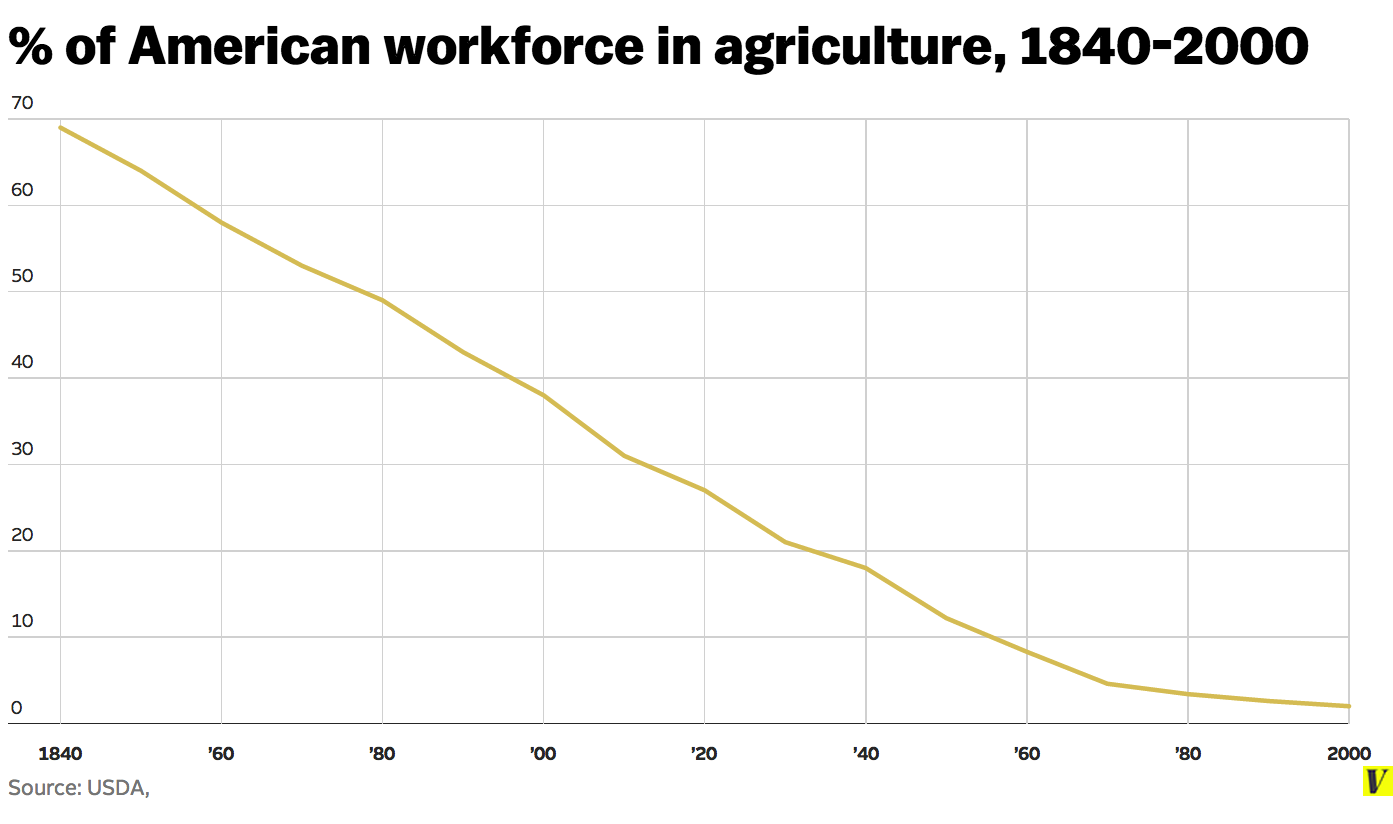
Here's a curve showing how the proportion of the working force employed in agriculture has dropped from 70% to around 2% over 175 years [1]. So in other words, it went from almost everyone working in agriculture, to almost no one working in agriculture. This has happ
So how is this possible? It's possible because the very reason that fewer people work in agriculture is because each human is more productive, resulting in cheaper goods on the shelves, because each salary can produce more of the same good. In other words: when an employee becomes more productive, a company can sell its product at a lower price, and earn more money. It can use this money to hire more employees, to produce more goods, rather than result in a layoff. In a free-ish market (with healthy competition), competitors will force incumbents to lower their prices, in search for profits.
This has been seen countless times, in many different areas of industry (from pantyhose to, TVs to phones, cars etc.). All of these products have become significantly cheaper (relative to median income) over the past decades, and this has resulted in more people buying them, such that layoffs have become unnecessary because the increase in productivity is offset by an increase in demand.
So, it's relatively simple. 1) If the decrease in price does not cause an increase in demand, employees will have to be laid off. 2) If it causes an increase in demand, then the company can afford to hire, perhaps dramatically more. So, for example, if shoppers buy 5% more items because prices are reduced by 5% (because of automatic checkout), then the cashiers can work at the packaging facility, or the farm, or in transportation, needed to make 5% more goods available to consumers.
[1] https://cdn2.vox-cdn.com/assets/4565243/Ag_workforce.png