Earlier quoted context omitted.
We have to ask ourselves why college is so expensive. It's certainly not due to inflation in quality of education. More and more classes are taught by graduate students and adjuncts rather than actual professors (who are mostly focused on their research programs in order to earn tenure). There are probably a few factors. - increased student expectations of 'fun', leading to new facilities (dorms, student centers, etc…
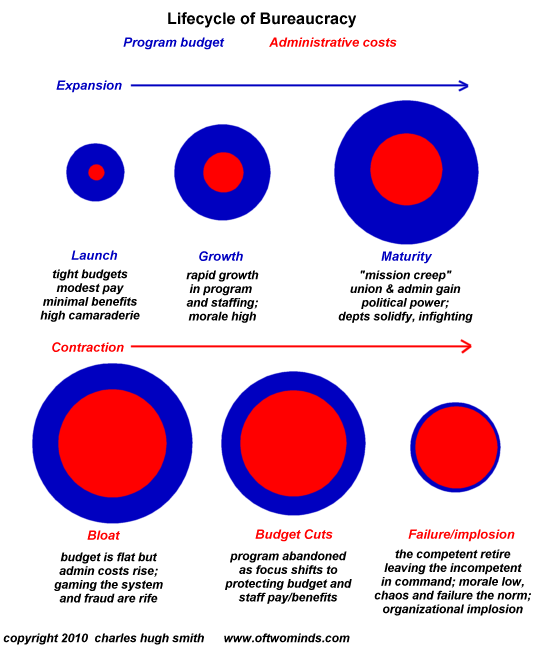
- increasingly top-heavy administration (hey, let's add another $300K Assistant Deputy VP of Student Diversity, etc) providing a path for faculty to 'advance' in their careers I'd like to point out that much of the administrative bloat has occurred because of new (bipartisan) laws forcing colleges to provide more services. There are services for veterans, services for the disabled, services for victims of crimes, ove…
It’s impossible to work your way through college nowadays
91–100 of 205 posts
Re: It’s impossible to work your way through college nowadays
#92Earlier quoted context omitted.
We have to ask ourselves why college is so expensive. It's certainly not due to inflation in quality of education. More and more classes are taught by graduate students and adjuncts rather than actual professors (who are mostly focused on their research programs in order to earn tenure). There are probably a few factors. - increased student expectations of 'fun', leading to new facilities (dorms, student centers, etc…
>increased student expectations of 'fun', leading to new facilities (dorms, student centers, etc), as colleges compete with each other for students This gets cited a lot, and sometimes people actually go to the trouble of citing the cost of a new facility at $x million. Is there evidence that these facilities actually raise the cost substantially per student per year? Often when I hear people getting offended about,…
Re: It’s impossible to work your way through college nowadays
#93The solution though, isn't to stop providing money to students for college. If you don't have Pell Grants, Stafford loans and the like, lower income bracket individuals would never be able to afford college. There is a simple fact: I could not pay my way through my Midwest university education without these things. I will graduate and be in debt, but I'll be better off having done it. Certainly the experience is wort…
When compared to people who are selected to not have the ability to complete (or even enter) college. It seems highly improbable to me that someone who struggles to pass classes in high school has the same average earning potential as a straight-A student, even if they both end their education at the same point.
Re: It’s impossible to work your way through college nowadays
#94We have to ask ourselves why college is so expensive. When some people read articles like this, they call for more government aid to students. "We need to help young, hard working students from unprivileged backgrounds to pay for college!" Their hearts are certainly in the right place, and it isn't an unreasonable idea at first glance. However, could this idea be part of the problem? Maybe giving people free money fo…
We have to ask ourselves why college is so expensive. It's certainly not due to inflation in quality of education. More and more classes are taught by graduate students and adjuncts rather than actual professors (who are mostly focused on their research programs in order to earn tenure). There are probably a few factors. - increased student expectations of 'fun', leading to new facilities (dorms, student centers, etc…
UGH! These kind of comments make me so angry. Sure, lots of graduate students are sub par due to inexperience or distraction or pure, simple busy-ness, but lots and lots of professors don't give a damn either. I TA'd on and off for about five years, sometimes spending 20-30 hours a week meeting with students and doing 1:1 sessions with them to help them learn whatever topics the course required. Did I sometimes get stumped by a slightly off-the-beaten-path question in a recitation section? Sure. But I'd still take a motivated grad student over many of the professors I suffered through.
(And to be fair, tons of--perhaps even most--graduate students don't give a damn either. But the problem isn't "More and more classes taught by graduate students and adjuncts", it's a combination of "Lack of interest in being a good teacher" and "Lack of interest in incentivising good teaching".)
Re: It’s impossible to work your way through college nowadays
#95Although it is somewhat cynical...
Re: It’s impossible to work your way through college nowadays
#96Earlier quoted context omitted.
This is true within a fixed labor market, but it gets more complex with globalization. If a country's educational mix changes, its position vis-a-vis the world labor market can also change. How to manage that in a way that produces a net-positive outcome is more complex, though. The Danish educational strategy is more or less betting on "going upmarket" via levels of education that are much higher than the global nor…
> Hence a goal to have 50% of people have bachelor's degrees by 20xx Interestingly, the college enrolment rate is 66% in the USA with around 30% of the population completing. Similarly, in Canada, the university enrolment rate is 50% with 25% of the population completing. Given that, it seems that the only way we might even be able to come close to a 50% degree attainment rate, in North America at least, is to force…
But, I somewhat misspoke: the goal is not to have 50% have specifically bachelor's degrees, but 50% complete some form of accredited tertiary education, which includes vocationally oriented degrees (currently a pretty small proportion, but makes the gap to 50% less than it would be if they weren't included).
The current numbers (for young people, typically age 25-34) are approximately: ~65% of people enter university, and 1/2 of those graduate (~32% of the population). Also, 25% (some the same people) enter tertiary vocational education, and 1/3 of those graduate (~8% of the population). Some people complete both, so the total is a bit less than 32+8, but overall ~38% of young people are attaining some kind of tertiary education.
Current trends are that vocational education is roughly flat (in both enrollment and completion rates), but university education is massively increasing (also, in both enrollment and completion rates). It used to be very common to attend university a few years and then do something else, with very low completion rates (only 1/4 of enrolled students eventually graduated as of 1995), perhaps partly because it's free to try it out for a year or two. This seems to be becoming less common, with completion rates now on par with the U.S. and Canada (1/2 completing as of 2010).
I haven't read too much on the current policy, but I believe further increasing university enrollment rates, to maybe closer to 80% rather than 65%, is one part of it. There are also some efforts to improve completion rates of vocational degrees to be closer to the university rates (1/2) rather than the current ones (1/3). Possibly also to get more people into vocational programs, especially people from the category of "young people not currently in work or education".
Data on the current rates and trends from this big PDF: http://www.oecd.org/edu/highlights.pdf
Re: It’s impossible to work your way through college nowadays
#97Earlier quoted context omitted.
> I don't know anyone who gets free money for college Here you go http://studentaid.ed.gov/types/grants-scholarships
I didn't even think you were talking about grants. Are you saying grants are responsible for high tuition costs? Without grants, the gap would have to be made up in student loans. What good would that do? It would simply make students assume a higher debt burden to get the same education that society demands from them.
Re: It’s impossible to work your way through college nowadays
#98The solution though, isn't to stop providing money to students for college. If you don't have Pell Grants, Stafford loans and the like, lower income bracket individuals would never be able to afford college. There is a simple fact: I could not pay my way through my Midwest university education without these things. I will graduate and be in debt, but I'll be better off having done it. Certainly the experience is wort…
Your colleges will only produce successful people in the sense that success can be directly correlated with income. There would be no point in doing anything else. Do you think that income-generating activities are the only purpose of education?
Re: It’s impossible to work your way through college nowadays
#99I didn't realize this was ever possible outside community colleges.
I worked my way through school for both my undergraduate degree and a masters in computer science. It wasn't bad. Just have to work hard. The nice thing was, I finished up school with zero debt.
Re: It’s impossible to work your way through college nowadays
#100We have to ask ourselves why college is so expensive. When some people read articles like this, they call for more government aid to students. "We need to help young, hard working students from unprivileged backgrounds to pay for college!" Their hearts are certainly in the right place, and it isn't an unreasonable idea at first glance. However, could this idea be part of the problem? Maybe giving people free money fo…
In the US, few students get much free money these days. Instead they get loans which charge hefty origination fees - like 5 points, and which are almost impossible to discharge via bankruptcy...despite the fact that many of them are backed by insurance and those which are not insured typically compound interest during the time the student is in school (typically on the full principle). The bloat has not been fueled b…